




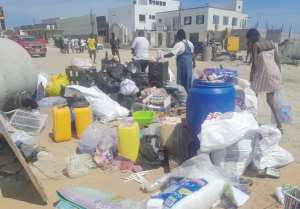
Business owners and workers at Laboma Beach in the La Dade-Kotopon Municipality of the Greater Accra Region have been left counting their losses after a government-led demolition exercise targeting structures allegedly built within the Kpeshie Lagoon buffer zone.
The operation was conducted by the Post-Flood Mitigating Task Force, led by the Director-General of Joint Operations of the Ghana Armed Forces, General Okai Yeboah. The 48th Engineer Regiment carried out the exercise with support from the police.
Heavy-duty equipment, including excavators and bulldozers, was used to pull down several structures, among them beachfront nightclubs, hotels, restaurants and other hospitality facilities.
The Laboma Beach operation is part of a broader government effort to address flooding through the removal of structures obstructing waterways, as well as the desilting and dredging of water bodies in areas such as Boundary Road in East Legon and Oyarifa.
21-Day Notice
The demolition followed a 21-day ultimatum issued in August by the Greater Accra Regional Security Council (REGSEC), directing occupants of the Laboma Beach area to vacate the lagoon’s buffer zones or face forced removal.
The Greater Accra Regional Minister, Linda Obenewaa Akweley Ocloo, who led the team that served the notices, said the affected developments had been constructed on land reserved as a buffer for the Kpeshie Lagoon.
She explained that the structures were contributing to the worsening flooding situation in the area. According to her, some developers had been warned against proceeding with their projects while construction was still at the foundation stage, but ignored the directives.
During a visit by the Daily Graphic yesterday, business owners and workers were seen hurriedly removing personal belongings, equipment and other items from the affected premises as the demolition continued.
Owners of the Pink Flamingo Hotel, Bliss Escape Restaurant and other hospitality establishments expressed frustration with government agencies and traditional authorities, accusing them of failing to prevent developments in the disputed area.
A worker at Bliss Escape Restaurant, who spoke on condition of anonymity, disputed the claim that the demolished structures had blocked the waterway and contributed to flooding.
The worker argued that the area described as a buffer zone had reportedly remained without water for more than 50 years and questioned the basis for the demolition.
Businesses and Livelihoods at Risk
The Public Relations Officer of Laboma Beach, Nathaniel Nettey, warned that the exercise would have far-reaching consequences for businesses and more than 3,000 people whose livelihoods depend on activities in the area.
Although some structures had not been demolished, he said the impact would extend beyond the affected buildings to permanent employees, casual workers, business associates and other service providers connected to the beach’s commercial activities.
“Over 3,000 people work here. Yes, it's not every structure that has been demolished. Nonetheless, it would affect general business. So, all 3,000 people here would be affected. We have in-house staff, people we associate with and all of that,” he said.
Mr Nettey also questioned why some structures across the road, which he alleged had been built directly within the waterway, had not been affected.
He said demolishing businesses at Laboma Beach while leaving other allegedly obstructive developments standing raised questions about the consistency of the exercise.
While acknowledging the authority of the state, Mr Nettey said the management of Laboma Beach would engage the relevant government officials to assess the damage and determine the next steps.
Military Defends Demolition
The 48th Engineer Regiment of the Ghana Armed Forces, however, maintained that the exercise was necessary to restore the natural flow of the Kpeshie Lagoon and reduce the risk of future flooding.
The regiment’s Commanding Officer, Lieutenant-Colonel Frank Osei Amponsah, told the Daily Graphic that the operation formed part of the Post-Flood Mitigating Task Force’s response to the severe floods recorded in June and July this year.
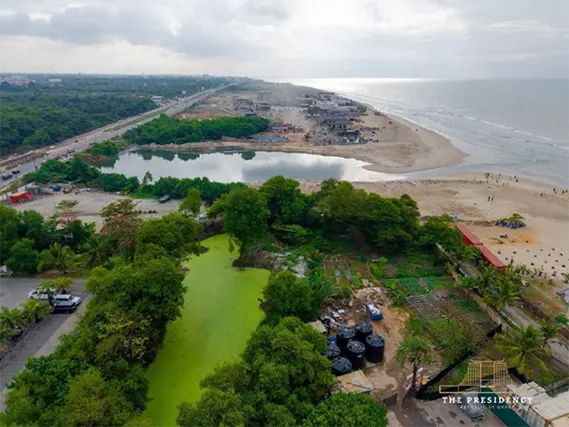
He said construction and the filling of portions of the lagoon had narrowed the waterway, thereby restricting the movement of water into the sea.
According to him, the military was targeting structures that had encroached on or obstructed the watercourse. Once the demolitions were completed, the channel would be widened to restore its natural route.
Lt-Col Amponsah described the operation as a “strategic demolition”, explaining that it was not intended to remove all structures in the area but to focus on developments identified as blocking the waterway.
He disclosed that personnel of the 48th Engineer Regiment rescued 121 people during the June 29 floods, underscoring the seriousness of the flooding situation.
He urged the public to comply with planning and building regulations and avoid constructing on waterways.
“We should adhere strictly to the laws of the land.
We should all refrain from building on waterways, and if we do so, we will not find ourselves in the situation we find ourselves in today,” he said.

 Don't be a Bar that flips on principles but a Bar that is consistent — AG tells ...
 24-hour economy market projects poorly planned, lacks consultation – Minority
 Stan Dogbe orders Greater Accra Regional Coordinating Council to restore Kpeshie...
 Police probe mysterious death of popular primary school teacher at Ampabame No. ...
 NACOC arrests three members of ‘Bolle Jos’ Network over French cocaine seizure
 Regular sex is not prostate cancer prevention — Urologist cautions
 Bawumia will use digitalisation to create opportunities for youth – Afenyo-Marki...
 NAPO calls for improved systems to address SHS placement concerns
 Bawumia listens to NASTAG concerns, outlines strategic agricultural transformati...
 Laboma Beach demolition leaves businesses counting losses


