




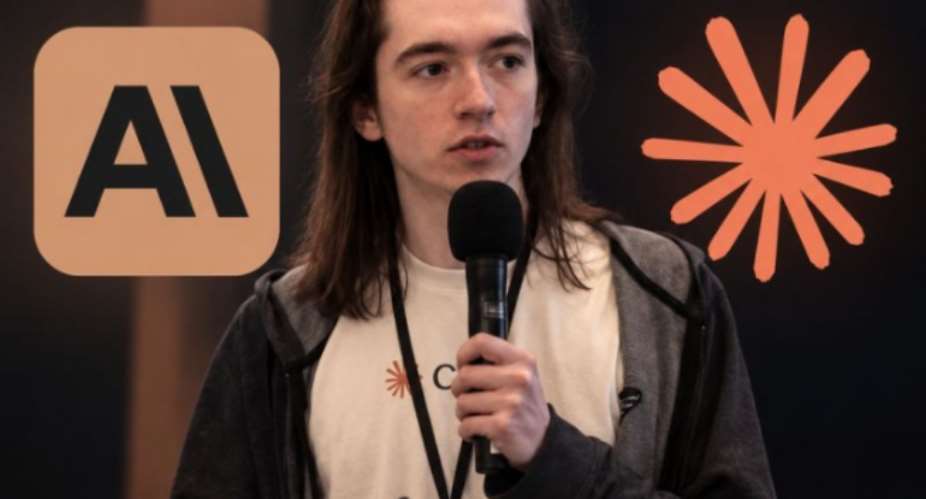
Evan Hubinger, Anthropic's Alignment Science Lead, said this week that he believes there is a greater than 10 percent chance that artificial intelligence could kill all of humanity within the next ten years — one of the most stark public warnings yet from a researcher working inside a leading AI lab.
What Hubinger Said
Writing on X, Hubinger stated plainly: "We really do earnestly believe AI could kill all humans! I personally think it is >10% within the next decade." He added that while Anthropic is "trying its best," the company does not yet have a plan to solve alignment for superintelligence the still-theoretical idea of an AI system smarter than the sharpest human minds and is "not clearly on track to" develop one.
Hubinger has since clarified that he considers the risk posed by current, present-day AI models to be low. His concern is specifically about what could come next: superintelligence potentially emerging through recursive self-improvement AI systems that improve their own capabilities a trend he says appears to be advancing faster than expected.
The Context: A Colleague's Resignation
Hubinger's comments came in direct response to a post by Jacob Coxon, a researcher who has worked on pretraining at both OpenAI and Anthropic, who announced his resignation from Anthropic over safety concerns. Coxon said he was resigning because he believes the leading AI companies are "gambling with our lives" by racing toward self-improving superintelligent systems without adequate safeguards.
His post read, in part, that the people building AI "earnestly believe that it could kill us all by the end of the decade," and warned that emerging systems could soon be "superhuman systems that can hack anything, revolutionize any field overnight, and acquire real power and resources." Coxon's post has reportedly been viewed more than 70 million times.
The exchange landed in an already tense week for the industry: in the span of a few weeks, both Anthropic and Meta separately acknowledged that their AI tools had been used to carry out hacks.
Not a New Debate, But a Notable Voice
Concerns about AI posing an existential risk to humanity are not new, but Hubinger's estimate adds a prominent, specific figure from inside one of the field's leading labs. Anthropic CEO Dario Amodei has previously put his own estimate of the odds that AI leads to catastrophe at between 10 and 25 percent, while still arguing the potential benefits are worth pursuing. Geoffrey Hinton, one of the so-called "godfathers of AI," has estimated roughly a 10 percent chance AI could wipe out humanity within 20 years, and fellow AI pioneer Yoshua Bengio has put the figure closer to 20 percent.
In 2023, a wide coalition of AI researchers and executives including both Amodei and OpenAI CEO Sam Altman signed a one-sentence public statement declaring that "mitigating the risk of extinction from AI should be a global priority alongside other societal-scale risks such as pandemics and nuclear war." More recently, in July, more than 1,300 employees across AI companies signed an open letter calling on the US government to support an international effort to deliberately pace the development of frontier AI systems a letter reportedly signed by figures including Anthropic co-founder and Chief Scientist Jared Kaplan and OpenAI Chief Scientist Jakub Pachocki.
The Policy Backdrop
The warnings arrive as governments weigh how directly to intervene in frontier AI development. In the US House of Representatives, a bipartisan bill known as the AI Kill Switch Act is advancing, which would give Congress the authority to shut down AI models found to pose a threat to the public. In the United Kingdom, the government's AI Security Institute said it continues to work closely with industry, including Anthropic, to make models safer, noting it had recently completed testing on OpenAI's latest flagship model.Reaction: "Why Would Someone Want to Say That?"
The BBC reported that Hubinger's comments and Coxon's resignation prompted a sharp reaction from Dame Wendy Hall, a computer scientist who advises the United Nations on AI. She told BBC Radio 4's The World at One that she was "shocked" by the posts, while noting that some of it could amount to "PR and marketing" given that both Anthropic and OpenAI are racing toward highly anticipated stock market debuts. Still, she added: "Why would someone want to say that? I would plead with investors not to invest in this company if that is their value system."
The BBC also reported that Coxon's resignation prompted Darren Jones formerly chief secretary to the Treasury under Sir Keir Starmer to write an open letter to Prime Minister Andy Burnham calling for a new multinational treaty governing the safe development of AI. Jones told the BBC that governments need to "collaborate" on what such a treaty should contain.
The BBC noted that Hubinger's intervention did not spell out a specific mechanism by which AI could cause human extinction, but framed it as part of "a series of increasingly stark warnings about AI," with public debate shifting from whether the technology poses a risk at all to how large that risk actually is.
Where This Leaves Things
Hubinger's remarks underscore a tension that has defined the AI industry for several years: the same researchers and executives building the most advanced AI systems are, in many cases, the ones most publicly worried about where that technology could lead. As Anthropic and OpenAI continue to release increasingly capable models and reportedly move toward major public listings the gap between the pace of deployment and the pace of solving alignment for more powerful future systems remains, by Hubinger's own account, unresolved.
Mustapha Bature Sallama
Medical/Science communicator, Private Investigator, Criminal Investigation and Intelligence Analysis,United States Institute of Peace (USIP), [email protected] +233555275880
Sources
BBC / Ghana News Agency, "Anthropic researcher believes more than 10% chance AI 'could kill all humans,'" September 9, 2026
CBS News, "Anthropic researcher says more than 10% chance AI 'could kill all humans,'" September 2026
CNBC, "Experts weigh in as researcher says AI has more than 10% chance of 'killing all humans,'" September 9, 2026
Forbes, "Anthropic Alignment Lead Warns AI Could 'Kill All Humans' as Researcher Quits," September 9, 2026
Seeking Alpha, "AI could kill every human on earth, Anthropic insider says"
Evan Hubinger (@EvanHub), post on X
TechRadar, "Top AI researcher says AI will end humanity and we should stop developing it now but don't worry, Elon Musk disagrees"
TechRadar, "Anthropic's CEO gives 'a 25% chance things go really, really badly' with AI"


 'If we were wrong, we must first apologise to NPP' – Mustapha Gbande on National...
 Han SHS to get boarding status as Mahama inspects GETFund projects in Upper West
 Late herbal doctor’s wife granted GH¢100,000 bail amid poisoning, arson claims
 NDC has failed to deliver on Agenda 1-3-3 for 24-hour economy – Sam Pyne
 Wa-Bolgatanga trunk road to be asphalted – Mahama
 Gbewaa College of Education lecturer dies after alleged military assault in Pusi...
 Ghana won’t back down on mining value addition – Ambassador Kojo Bonsu
 How Dr Jesse Amuah, wife was murdered over GH¢1,500 payment dispute
 Mahama announces 20% salary incentive for health workers in deprived areas
 Ghana must move from plastic policies to implementation – EPA CEO


