




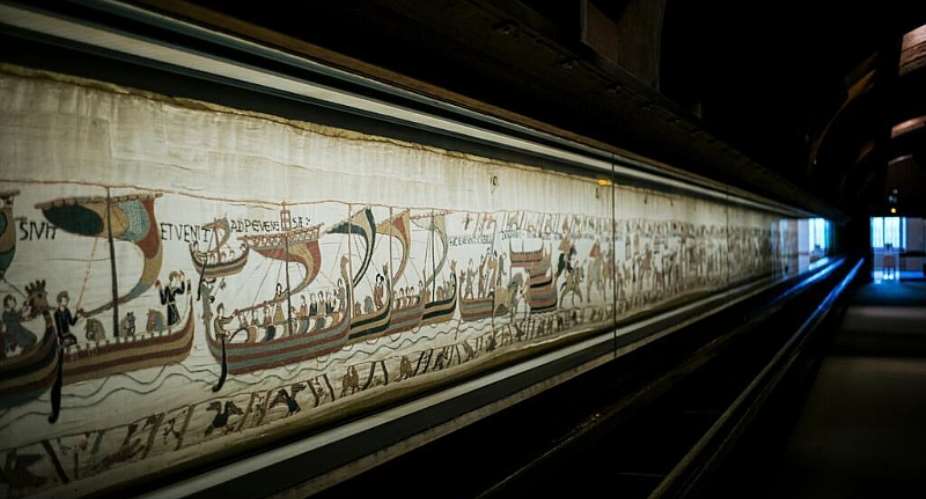
But this is not the world-renowned 70-metre long Bayeux Tapestry on loan from France at the British museum.
It is the little known Bayeux Tapestry of Reading, a commuter-belt town west of London.
Here in the town's museum, this near-exact replica of the famed original has been quietly telling the story of William the Conqueror and 1066 for some 130 years. A scene on the Bayeux Tapestry depicts horsemen and Mont Saint-Michel, believed to be one of the earliest known visual representations of the French landmark, while on display at the Bayeux Museum during its final days before the museum closes for renovations and sends the historic embroidery on loan to the British Museum, in Bayeux, France, August 29, 2025. REUTERS/Ardee Napolitano/File Photo
The original 11th-century work goes on display to the public in London from Thursday.
With the first round of tickets sold out, curators at Reading are enjoying the flurry of attention the much-anticipated British Museum show has generated for their own version.
The replica - the only full-sized woven copy known to be in existence - is the work of 35 women who belonged to a Victorian-era Leek Embroidery Society in central England.
Secrecy surrounds Bayeux Tapestry's imminent Channel crossing
"It's a masterpiece of the arts and crafts movement," said Brendan Carr, a curator at the Reading Museum, referring to the artisanal crafts revival in the second half of the 19th century that was a reaction to the advent of the machine age.
"My argument is that it's much more than second best to visiting the British Museum to see the original," he told French press agency AFP.
Working from photographs, engravings and etchings supplied by what is now the Victoria and Albert Museum of the original for around a year from 1885 to 1886, each of the Victorian embroiderers took on a section of the tapestry.
Nudity removed
Historians are locked in a lively dispute over how many penises appear on the Bayeux Tapestry, with the tally hanging on whether one ambiguous detail counts as male genitalia or part of a weapon.
In 2018, Oxford medievalist Professor George Garnett published a count of 93 penises: 88 on horses and five on men.
More recently, Dr Christopher Monk, a specialist in the tapestry, has argued there is a 94th, pointing to a running figure in the border whose tunic appears to reveal an extra appendage. Britain's King Charles III and Britain's Queen Camilla alongside France's President Emmanuel Macron and his wife, view a section of the Bayeux Tapestry, during a preview event for the Bayeux Tapestry Exhibition, at the British Museum in London on September 2, 2026. Un précieux symbole de confiance » : Charles III, Camilla et les Macron visitent l'exposition de la tapisserie de Bayeux - Le ParisienUn précieux symbole de confiance » : Charles III, Camilla et les Macron visitent l'exposition de la tapisserie de Bayeux - Le Parisien Un précieux symbole de confiance » : Charles III, Camilla et les Macron visitent l'exposition de la tapisserie de Bayeux
Garnett maintains his original total, contending that the disputed shape is actually the scabbard of a dagger.
His key objection is that “right at its end is a yellow blob”, which he interprets as a brass fitting; by his reading, none of the tapestry's unquestionable penises terminate in such a feature.
Monk, by contrast, insists the detail represents male genitalia, keeping the academic tug‑of‑war very much alive
Raising the profile
After the "Reading replica” was completed it toured widely from the United States to South Africa for nearly a decade before going on display in Reading in 1895.
In a reversal of the current roles, the long international tour had the effect of raising the profile of the original housed in northern France.
"All of this time later, the original coming to England has returned the favour because there's now much more awareness of Britain's reproduction," Carr added.
Bayeux leave? 45,000 sign petition to halt tapestry's loan to British Museum
The curator said he was happy that the London show was receiving so much attention and helping to bring the "truly iconic piece of art" to a whole new audience.
Despite the passage of time, one of the most striking parts of the work was the relevance of its depiction of war, according to Carr.
In a scene featuring one of only three women in the tapestry, soldiers are setting fire to her home as she escapes with a young child.
"It's so poignant, so timeless, so universal in terms of the innocent victims of war, those that are caught up in the collateral damage of war," he said.
"And we see it on our TV screens to this day."
(With newswires)


 NCA clears MTN, Telecel and Goal Telecom for next stage of 5G spectrum licensing
 ICT accounts for 41.5% of Ghana’s 6% Q2 2026 economic growth – GSS
 Ghana Highway Authority to correct defects on portions of Eastern Corridor Road
 ECG private sector participation to be determined after transaction advisor's re...
 Over 70% of Ghanaians walking with hypertension unaware – Cardiothoracic Centre ...
 Weija Dam spillage: $350million flood control project to begin by December
 Ghanaians should be grateful for voting Mahama back to power for saving Ghana’s ...
 I remain committed to NPP despite withdrawal from National Organiser race — Sala...
 John Boadu, Sammy Crabbe, Paul Afoko, Boakye Agyarko secure 1st to 4th spots in ...
 Auditor-General report exposes financial rot at 18 assemblies in Volta Region; C...

