




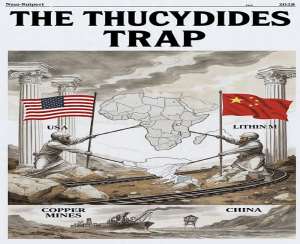
As the established ruling power, the United States of America sees its global dominance shaken by the rise of China, and Africa is paying the price. Caught between Washington’s fear and Beijing’s ambition, the continent has become the terrain for a Sino‑American tug of war. Political scientists call this the "Thucydides Trap": when a rising power threatens to displace a ruling power, structural stress follows, and war becomes likely.
For Africa, the war is not yet military. It is economic, diplomatic, and technological. The result is the same: we are treated as a battleground, not a stakeholder. The risks are real. Extractive deals are deepening. Market dumping is accelerating. Proxy competition is rising. All of it threatens Africa’s sovereignty, unity, and industrialization.
The Thucydides Trap, Briefly
Thucydides, a historian chronicling the Peloponnesian War in the 5th century BCE, wrote:
"It was the rise of Athens and the fear this instilled in Sparta that made war inevitable."
Harvard’s Graham Allison revived this in 2017 to explain United States of America (US)–China rivalry. His warning: when ambition collides with fear, even small flashpoints can spiral. For Athens it was ambition. For Sparta it was fear. Today, Beijing is ambition. Washington is fear. And the Aegean Sea is now the Copperbelt, the Sahel, the Congo, and the Horn.
Core Dynamics: Why Africa?
The collision is triggered by two forces:
- Objective shift: China’s demand for cobalt, lithium, and coltan to power its tech and EV supply chains.
- Subjective fear: America’s fear of losing access, influence, and the post‑1945 order it built.
Africa sits on 30% of the world’s critical minerals (1). Africa has the world’s youngest population (2). Africa is the last large, open market. That is why both powers are here. Not because they love Africa. Because they need Africa to win against each other.
Anatomy of Strategic Rivalry
The rivalry between the United States and China in the Democratic Republic of Congo (DRC) is intensifying as US copper imports from the nation surge and Kinshasa takes steps to control its critical mineral data. Of late, US imports of Congolese copper reached a record 53,290 metric tons in July 2026, beating the total amount imported during the entire year of 2024 (3). China’s share of these copper exports dropped slightly, though Beijing still controls most of the local mining infrastructure.
A report published Wednesday, August 26, by Chinese group China Nonferrous Mining Corp. (CNMC) outlined plans to expand its copper and cobalt operations, mainly in Zambia and the Democratic Republic of Congo (4). A few days earlier, US‑backed investment firm Orion CMC was reported to be planning a $500 million investment in a future nickel mine in Tanzania (5). The two developments are separate, but they illustrate how two rival powers are positioning themselves in Africa’s critical‑minerals sector.
The Sino‑American Contest, On African Ground
This is not theory. Look at the instruments already deployed.
On one side: US policy in Africa, 2023–2025
- AGOA: Trade access tied to political conditions. It entrenched raw exports — crude, minerals, textiles — and benefited fewer than 10 countries disproportionately. The current authorization was set to expire in September 2025 but has been extended to December 31, 2028.
- Lobito Corridor: $4 billion US‑EU pledge to build rail from DRC–Zambia copper to Angola’s port. Goal: get minerals out, fast [White House 2023].
- DTA + SIIWG: Digital and infrastructure partnerships with the AU, designed to counter Chinese tech and finance.
- Defense & Health MOUs: Status of Forces Agreements, Camp Lemonnier in Djibouti, and bilateral health deals tying funding to policy alignment.
On the other side: China policy in Africa, 2023–2025
- FOCAC 2024: $50.7 billion pledged for trade, agriculture, and security. Zero‑tariff treatment expanded to 33 least‑developed African countries [FOCAC Beijing Action Plan].
- BRI: Railways in Kenya, roads in Nigeria, power in Ethiopia. Port operations and state firms now run terminals in Lagos, Mombasa, and Durban.
- GSI: Police training centers, joint security drills, and the naval base in Djibouti.
The purpose on both sides is identical: secure supply chains. One uses conditional aid. The other uses infrastructure debt.
Both integrate Africa’s resources into someone else’s economy.
African Pushback
But Africa is not only reacting. Africa is acting.
- Zambia & DRC, 2023: Signed to build a battery precursor plant together. First attempt to move from ore to value‑added before export [AU 2023].
- Zimbabwe, 2022–2023: Banned raw lithium exports. Demanded local processing. Chinese firms had to build refineries or leave.
- AU at G20, 2023: Admitted as a permanent member. Used the seat to demand a common African position on critical minerals.
- AfCFTA, operational since 2021: Intra‑African trade up 22% from 2022–2024 [AfCFTA Secretariat]. Still small, but it is the only tool Africa has to trade with each other first.
These are not victories yet. They are signals. Africa is learning to say no, and to say "not like this."
The Cost of Being the Ground
The Thucydides Trap is already charging Africa fees:
- Debt distress: 22 African countries in or near debt distress, much of it from infrastructure loans with mineral collateral [IMF WEO Oct 2024].
- Resource exploitation: 90% of DRC cobalt and 70% of Zambian copper still exported raw in 2024 [IEA Critical Minerals Report].
- Political instability: Coups and elections in the Sahel and Central Africa increasingly framed as "pro‑US" vs "pro‑China."
- Economic collateral: When the US and China tariff each other, African exporters get caught in the middle.
Africa did not start this contest. But it is bearing the cost.
Conclusion: Two Demands, Not Slogans
If the Thucydides Trap is ambition meeting fear, then Africa’s task is to refuse to be the collision point, because African wisdom teaches us that when two elephants fight, it is the grass that suffers — and Africa should not suffer anymore. The answer is not choosing Washington or Beijing. The answer is choosing each other first, and setting terms.
That requires two concrete moves, now:
- An AU Common Position on Critical Minerals by 2026: No raw export of lithium, cobalt, graphite, and rare earths without 50% local beneficiation. Negotiate as a bloc of 1.4 billion, not as 54.
- Fund AfCFTA Industrial Corridors with our own money: 1% levy on mineral exports into an African Industrialization Fund. Use it to build regional value chains: batteries in Southern Africa, EVs in North Africa, processing in Central Africa.
From extraction to partnership. From battleground to stakeholder should be the rallying cry. For surely, a continent of 1.4 billion people cannot afford to be collateral in someone else’s war. And Africa will not be, if it finally acts like it owns the map.
F. Madondo (African Teacher)
References
- Africa Center For Economic Transformation (ACET), 5 December 2025, _"Green Industrialization in Africa: Adding Value to Critical Minerals Through Regional Collaboration"_. Available at: http://www.acetforafrica.org
- UNEP, 2020, _"Why African youth matter in global environmental discourse"_, Available at: http://www.unep.org
- Africa News, Agencies, 8 September 2026, _"DRC tightens state control over mining data in bid to boost influence over its vast mineral wealth"_, Available at: http://www.africannews.com
- Ecofin Agency, Aurel Sèdjro Houenou, 1 September 2026, _"China vs. U.S.: Anatomy of a Strategic Rivalry Over Africa’s Critical Minerals"_ Available at: http://www.ecofinagency.com


 NCA clears MTN, Telecel and Goal Telecom for next stage of 5G spectrum licensing
 ICT accounts for 41.5% of Ghana’s 6% Q2 2026 economic growth – GSS
 Ghana Highway Authority to correct defects on portions of Eastern Corridor Road
 ECG private sector participation to be determined after transaction advisor's re...
 Over 70% of Ghanaians walking with hypertension unaware – Cardiothoracic Centre ...
 Weija Dam spillage: $350million flood control project to begin by December
 Ghanaians should be grateful for voting Mahama back to power for saving Ghana’s ...
 I remain committed to NPP despite withdrawal from National Organiser race — Sala...
 John Boadu, Sammy Crabbe, Paul Afoko, Boakye Agyarko secure 1st to 4th spots in ...
 Auditor-General report exposes financial rot at 18 assemblies in Volta Region; C...

