




With just 52 months left to deliver on the Sustainable Development Goals, the world is already falling dramatically short on goals related to gender equality and health rights. Decades of progress secured through legally binding treaties and other international agreements and commitments, are being threatened by a growing anti-rights backlash.
Well-coordinated anti-rights forces are invoking seemingly benign and reassuring words like 'national sovereignty', 'family values', 'culture' and 'religion' to oppose or dilute measures intended to advance women's equality, bodily autonomy and health rights.
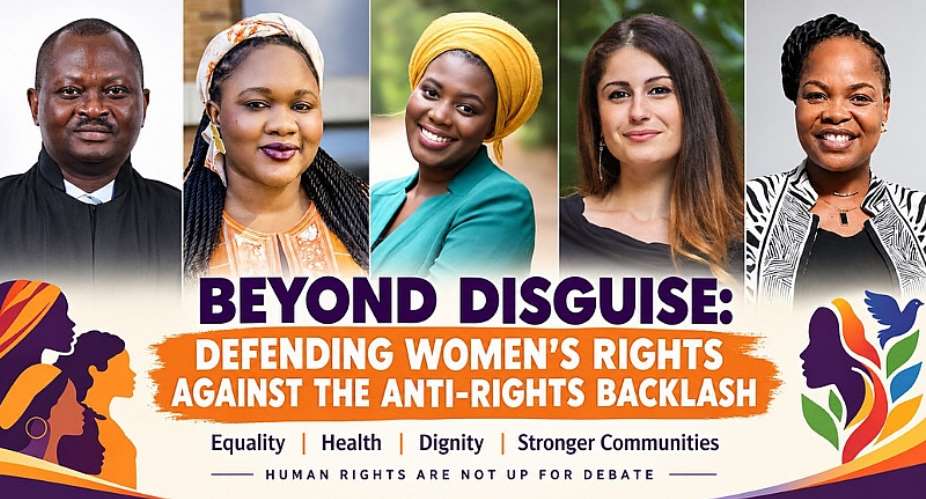
Such anti-rights narratives are increasingly being deployed to 'legitimise' discrimination and restrict women’s autonomy. Under the garb of 'protecting the family', laws and policies are being proposed that can curtail women’s bodily autonomy, reproductive choices, economic rights and equality within marriage, said the experts on the panel of the latest SHE & Rights session on the theme "Countering anti-rights pushes and upholding human right to health and gender equality."
The central question, they argued, is fundamental human rights (like gender equality and right to health) survive when confronted with forces that misinterpret 'equality' in the name of 'family', 'tradition' or 'sovereignty'.
This is at the heart of the growing anti-rights backlash. The family, supposedly a place of safety and protection, is being invoked to so-called 'legitimise' discrimination within the family itself. Sovereignty, meant to affirm the independence of nations, is being turned into an argument against accountability to human rights standards.
Family should be a safe haven for equality, not inequality
The extent to which discriminatory practices can become normalised was brought home by an exercise recounted by Dr Robert Eno, Registrar of the African Court on Human and Peoples’ Rights at the African Union. At a recent conference in Nairobi, participants were given several statements and asked whether they were fact or fiction. One stated that a woman seeking a no-fault divorce is required to compensate her husband financially. Another said a daughter could inherit only half the share of her brother, with property passing to male relatives where there was no brother. A third suggested that a husband cannot not be held responsible for rape within marriage because the wife cannot refuse his sexual demands.
Eno assumed these were fictional. "I was mistaken," he acknowledged. All three, he said, reflected provisions that have existed, or continue to exist, in laws in several countries and represent the lived realities of women and girls.
That is precisely why the current battle over the meaning of family values matters. As Rehema Namukose of Musawah pointed out that the garb of 'family' is increasingly being used to wrongly 'justify' harmful practices like child marriage and female genital mutilation/ cutting, confine women to unpaid care work, deny them property and inheritance rights, and institutionalise patriarchal male authority within households.
The rhetoric of family protection therefore needs to be interrogated: ‘Whose family is being protected, and from what?’
A family cannot be strengthened by making its women less equal. Nor can children be protected by denying girls education.
Sovereignty is not a licence to discriminate
The anti-rights push is diabolically sophisticated. It camouflages itself so that it is not perceived as opposition to human rights.
An analysis by the Initiative for Strategic Litigation in Africa (ISLA) of the regressive draft African Charter on family values and sovereignty, found precisely this pattern: "rights language is kept on the surface, but the substance of the rights is narrowed." 'Family protection' becomes a rationale for exclusion, 'sovereignty' a means of resisting accountability, and 'culture' and 'values' a way of limiting equality protections.
This makes the debate about sovereignty particularly important. States have every right to preserve their constitutional independence and cultural identities. But sovereignty cannot mean freedom from human rights obligations.
It is not about dismissing sovereignty but preventing it from becoming a shield against accountability.
As Dr Eno put it, tradition deserves respect, culture deserves protection and religion deserves freedom - but none can be invoked to legitimise discrimination or diminish human dignity.
#PauseForPurpose
The debate over the African Union Convention on Ending Violence Against Women and Girls, (AU CEVAWG), illustrates why scrutiny of new legal instruments matters. The Convention was adopted in February 2025 and had been signed by nine states and ratified by two. But fifteen ratifications are required for it to enter into force.
Fatou Bantou Salah of the Initiative for Strategic Litigation in Africa (ISLA) argues that this period before the convention’s entry into force should be used for careful scrutiny rather than simply pushing ahead with ratification.
ISLA has called for a “Pause for Purpose” campaign around AU CEVAWG. The proposal is not to abandon the convention, but to pause long enough to allow an independent, Article-by-Article legal review, wider consultation and comparison with existing African human-rights standards, says Salah.
The message is simple: "pause, listen, review, strengthen, then ratify."
Such scrutiny is not anti-rights. It is precisely what a serious rights framework requires, says Salah.
The same principle applies to national laws. If a law discriminates against women in marriage, divorce, inheritance or custody, it must be challenged. If a girl is pushed out of school because she is pregnant, the response cannot stop at blaming her. If a woman cannot obtain healthcare without stigma or permission, the existence of a health policy on paper means little.
Reclaiming religion, culture and community
Perhaps one of the most effective ways to counter anti-rights narratives is to stop allowing their proponents to claim exclusive ownership of religion, culture or family.
Samah Hadid, Global Executive Director of Musawah, argues that religion itself is being weaponised to police the women and reinforce patriarchal control. Her response is not to abandon religious discourse but to reclaim it. "We do not cede the ground on religion to conservative voices. We rather reclaim it," she says, advocating gender-just interpretations from within religious traditions.
Human rights advocates cannot simply speak to those who already agree with them. As Dr Eno argues, sustainable change requires engagement with communities rather than addressing them only from outside. Conversations must move beyond courtrooms and conference halls into homes, schools, places of worship, traditional institutions and communities.
This also means engaging men - not to speak over women or occupy feminist spaces, but to challenge the attitudes and systems that sustain inequality. As Vimbai Kapurura of Girls Not Brides and Women Unlimited Eswatini put it, women and girls must remain at the centre, but equality has to involve the whole ecosystem around them.
The strongest counter to anti-rights politics is therefore not another polarising slogan. It is a better vision of family, culture and community - one in which equality does not destroy families but makes them safer and fairer.
Lived realities on the ground
Vimbai Kapurura’s experience from Eswatini offers a useful reminder. The country has made progress in reducing adolescent births and early childbearing, yet girls in rural and poorer communities continue to face greater risks. Access to services often exists on paper, and unmet need for contraception stays high. The question cannot simply be why a girl became pregnant. It must also ask whether she had access to information, healthcare and support to remain in school.
That is the test of whether rights are real. Does a girl stay in school? Can a young woman access healthcare without stigma? Can a survivor report sexual harassment and be believed and protected? Can a woman inherit property on equal terms? Can she make decisions about her own body?
These are more meaningful measures of progress than the number of treaties signed or declarations adopted.
From good policies to implementation
Policy commitments alone do not save lives. A treaty that is not implemented, a judgment that is ignored, and a strategy that remains only on paper do not change the reality of a woman who cannot reach a hospital or a girl who is denied education. The next frontier is implementation and accountability, said Kapurura.
Kapurura pointed to mechanisms like the Universal Periodic Review (UPR) as opportunities to move from commitments to budgets, services and community-level change, keeping the focus on those still left behind. Communities cannot simply be beneficiaries of change; they must be partners in creating it.
The anti-rights backlash thrives when discrimination is 'normalised', when fear is converted into policy and when silence is mistaken for consensus. The response must therefore be equally determined: challenge discriminatory laws, expose manipulative narratives, reclaim religion and culture from those who weaponise them, and — above all — work with communities rather than simply speaking at them.
The family should be where rights begin, not where they end. And sovereignty should be the foundation for democratic self-determination, not a convenient excuse for denying women equality, dignity and freedom.
Shobha Shukla – CNS (Citizen News Service)
(Shobha Shukla is a feminist, health and development justice advocate, and an award-winning founding Managing Editor and Executive Director of CNS (Citizen News Service). She serves as Chairperson of Global AMR Media Alliance (GAMA), Host and Coordinator of SHE & Rights (Sexual Health with Equity & Rights), President of Asia Pacific Media Alliance for Health, Gender and Development Justice (APCAT Media), and founder leader of DJOP (Development Justice for Older Persons) initiative. She is the author of 2026 book "Justice Unbound: Feminist Voices on Gender Equality, Health Rights, and Inclusive Futures" and was also the Lead Discussant for SDG-3 at United Nations inter-governmental High Level Political Forum 2025. GAMA under her leadership received the prestigious AMR One Health Emerging Leaders and Outstanding Talents Award at UN High Level Ministerial Conference on AMR 2024. Follow her on X @shobha1shukla or read her writings here www.bit.ly/ShobhaShukla)


 Abronye loses again as Court of Appeal dismisses bid to halt Samson Anyenini’s d...
 Over 30 women feared trapped in prostitution in Savannah as GIS arrests traffick...
 Govt pays GH¢24.8bn to statutory funds since January — Ato Forson
 Seven missing Axim fishing canoe crew located in Togo’s waters — Western Regiona...
 Health Ministry assures Ghanaians of readiness to manage Ebola cases
 FDA shuts down Arcan Bitters factory again over illegal production in Ashanti Re...
 PAC chair praises NPA CEO Edudzi Tameklo’s performance at committee hearing
 Ghanaian jailed nine months in US for using relative’s social security number to...
 Ukraine war: I'm going to Russia to convince President Putin to ceasefire — Maha...
 'Prof. Jane Naana is Vice President of Ghana; not for women and girls' — Victori...


