




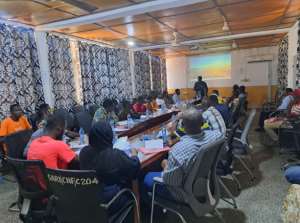
The Council for Scientific and Industrial Research–Savanna Agricultural Research Institute (CSIR-SARI) has trained about 50 soybean Small and Medium-sized Enterprises (SMEs) in the Northern and Upper West Regions to strengthen their business planning, improve access to finance and position their enterprises for investment and expansion.
The initiative, funded through the Technologies for African Agricultural Transformation (TAAT II) programme under the Soybean Compact, seeks to address key constraints limiting the growth of soybean enterprises, particularly inadequate access to finance and weak business planning capacity.
The intervention is also part of efforts to transform Northern Ghana's soybean sector from a production-focused industry into a competitive, market-driven and investment-ready value chain.
Participants received practical training in business plan development, market and buyer analysis, financial forecasting, enterprise strategy, investment readiness and negotiation. They were also guided to develop business plans using their own enterprise data, financial records, production activities and identified market opportunities.
The training followed a needs assessment conducted among beneficiaries of agribusiness training under the TAAT II Soybean Compact during the 2024/2025 production season. The assessment identified limited access to finance as a major constraint.
It found that although several soybean SMEs had viable business opportunities, many struggled to translate those opportunities into credible proposals capable of attracting funding. Some entrepreneurs also lacked the confidence and practical skills required to prepare and present business plans to financial institutions and potential investors.
Building investment-ready enterprises
CSIR-SARI considers improved business planning an important step towards helping soybean enterprises unlock financing and expand their operations.
The SMEs were taken through key components of a business plan, including market analysis, production and operations, marketing strategy, financial planning, risk management and supporting documentation.
Emphasis was placed on using accurate business information and financial records to develop realistic financial projections and investment proposals.
Participants were also equipped with skills to understand buyer requirements, assess market structures and negotiate effectively as they seek to compete in an increasingly commercial soybean sector.
Dr. Prince Maxwell Etwire, Agricultural Economist at CSIR-SARI, said agribusiness success depends on more than simply increasing production.
“Successful agribusiness is not only about producing more, but producing what the market demands, meeting buyers’ quality requirements and negotiating from a position of knowledge.”
He said farmers and entrepreneurs who understand their markets, know the value of their produce and negotiate collectively and confidently are better positioned to secure fair prices and establish sustainable businesses.
Strengthening soybean enterprises
Soybean production and marketing have expanded considerably in Northern Ghana, creating opportunities across the value chain, including seed production, input supply, aggregation, grain trading, processing and marketing.
However, Dr. Desmond Sunday Adogoba, Agricultural Innovations Scaling Specialist at CSIR-SARI, said the ability of enterprises to benefit from these opportunities increasingly depended on their capacity to operate as sustainable businesses.
“For many agribusinesses in Northern Ghana, particularly those operating on a small scale, business planning remains limited. As a result, some enterprises struggle to expand their operations or take advantage of available financing opportunities.”
He said the needs assessment showed that only a small number of the SMEs had previously developed business plans themselves, with many relying on third parties to prepare documents mainly for loan or grant applications.
“This training therefore goes beyond producing a document for a loan application. We want SMEs to understand their own businesses, use their business plans as management and growth tools, and build the confidence to engage financial institutions, buyers and investors directly,” Dr. Adogoba said.
The training was therefore designed to ensure that participating SMEs could develop and take ownership of their business plans rather than depend on external consultants.
From production to profitable growth
Dr. Charles Nelimor, Team Lead of the TAAT II Soybean Compact at CSIR-SARI, said the initiative reflected the broader objective of building a stronger and more inclusive soybean value chain.
“The goal of the Soybean Compact is not only to increase soybean production. It is to ensure that farmers, processors, entrepreneurs and other actors along the value chain can turn soybean into sustainable businesses and greater economic opportunities.”
He said improving the capacity of SMEs to add value, understand markets, develop credible investment proposals and expand their operations was essential to ensuring that increased soybean production translated into wider economic benefits.
“By equipping small and medium-scale enterprises with the knowledge and skills to add value to soybean and expand their businesses, we are helping to move from increased production to processing, innovation, investment and market development.”
According to Dr. Nelimor, stronger soybean enterprises could create broader opportunities across the agricultural economy through increased demand for farmers' produce, job creation, improved incomes and expanded processing and marketing activities.
The intervention is consequently expected to support the development of a more resilient and commercially oriented soybean ecosystem in Northern Ghana, with SMEs playing a greater role in value addition, market development and rural economic growth.
Preparing SMEs for expansion
The capacity-building programme represents a shift towards recognising soybean SMEs as private-sector actors capable of driving the next phase of value-chain development rather than merely beneficiaries of agricultural interventions.
By improving their capacity to plan, access finance, understand markets and negotiate with buyers, CSIR-SARI and the TAAT II Soybean Compact are seeking to help soybean enterprises transition from small-scale operations into growth-oriented and investment-ready businesses.
The broader objective is to ensure that Ghana's growing soybean industry generates value across the entire chain, linking farmers to markets, SMEs to financing and increased production to jobs, incomes, investment and sustainable economic opportunities.

 'I couldn’t have refused an order' – Major Adjei-Ampofo explains why he took par...
 'Some NDC members are working with NPP to get your GoldBod job' – Kevin Taylor w...
 'It is too early for you to take this political heat' – Kevin Taylor cautions Ay...
 NPP knows GoldBod is our strength, that is why they want to bring it down – Suhu...
 Stop using radio airtime for greetings, talk about Mahama’s economy – Suhuyini t...
 IEA proposes binding long term national development plan to stop successive gove...
 Health Minister moves to prevent stockouts of HIV, TB and Malaria commodities
 IEA wants MPs, ministers barred from serving on State-Owned Enterprise boards
 Constitutional review: IEA warns against changes that could turn judiciary into ...
 Eastern Regional Minister orders temporary closure of two SHSs after violent stu...

