





From chip labs to university research teams and technology companies, a growing number of international students are looking to China for more than cultural immersion. They are coming for research opportunities, technical training, and a pathway into global careers.
The numbers back this up. According to an official with China’s Ministry of Education, 380,000 international students from 191 countries and regions studied in China during the 2024–2025 academic year. More telling is what they're studying: engineering is now the most popular field among degree-seeking international students, accounting for 27.8 percent. China also boasts 66 disciplines ranked among the world's top 0.01 percent.
Starting up in China
Rather than treating international students as visitors who leave after graduation, some local governments are building international talent parks offering office space, business registration support and other services to graduates. China isn't alone in trying to retain international talent. Canada, Australia and Germany run similar programs. But China's approach is closely tied to its manufacturing and tech base, giving graduates a potential landing pad.
 On November 1, 2025, an international talent exchange zone is featured at the “Shenzhen Talent Carnival” held at Shenzhen Talent Park in Shenzhen, Guangdong Province. [Photo: CFP]
Programs tied to innovation clusters like Shanghai's Zhangjiang Science Hub can also give students opportunities to gain industry experience while still enrolled, bringing universities and companies closer together. The idea is straightforward: don't just prepare students for the future — put them inside the industries building that future.
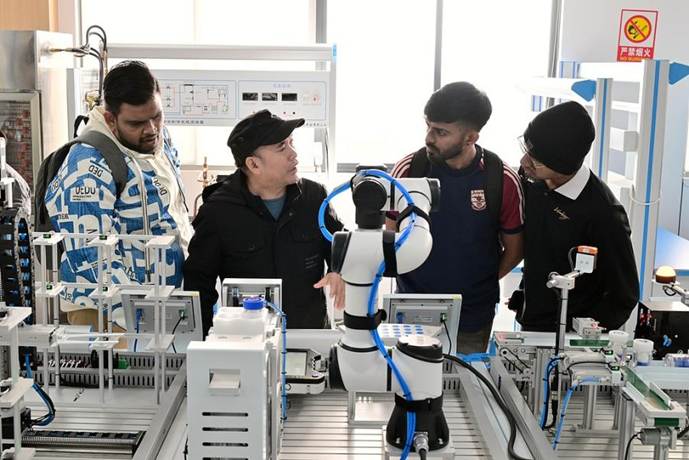
Efforts extend beyond traditional degree programs. Through initiatives like the Luban Workshops, China has built vocational training centers abroad that pair language study with hands-on skills in smart manufacturing, engineering and healthcare. The underlying bet is that practical skills, not just credentials, will be more valuable to the next generation of workers.
 On November 7, 2025, international students learn drone operation and flight principles at Zhejiang Traffic Technician College in eastern China’s Zhejiang Province. [Photo: CFP]
Learning without leaving home
Not every student who benefits from China's education push needs to set foot in the country. China's National Smart Education Platform now streams educational resources to learners worldwide, while the China–ASEAN Colorful Smart Academy offers multilingual courses and virtual learning resources across Southeast Asia.
It's part of a broader shift in global education: education increasingly travels to the student, not the other way around.
A new kind of degree
The old question used to be which country has the best universities. For a growing number of students, it’s becoming a different one — which country can actually give them not only a degree, but a pathway into the industries they want to work in? China might not be the only answer. But it's increasingly one of them.
Author: Wang Yangyang, Liu Yushan, both worked as CGTN journalists based in Beijing

 'Remember me in your prayers' – Nana Ama McBrown
 Turf war among OSP, A-G and EOCO undermines graft fight– Sulemana Braimah
 Here are 100 unrecognised universities listed by GTEC as of August 2026
 Mahama arrives in Luanda for AU Summit
 Fallen live electricity cable kills 10 cattle at Abrewanko
 Ketu South residents to demonstrate against ECG due to over-billing
 Ghanaians outraged over cigarette-shaped candy targeting children
 Volta NPP in turmoil over appointment of 10 regional officers
 Bolgatanga events ban beyond 8pm will make government unpopular – Gabriel Agambi...
 Irresponsible security reporting could worsen ethnic and religious tensions – Sh...

