




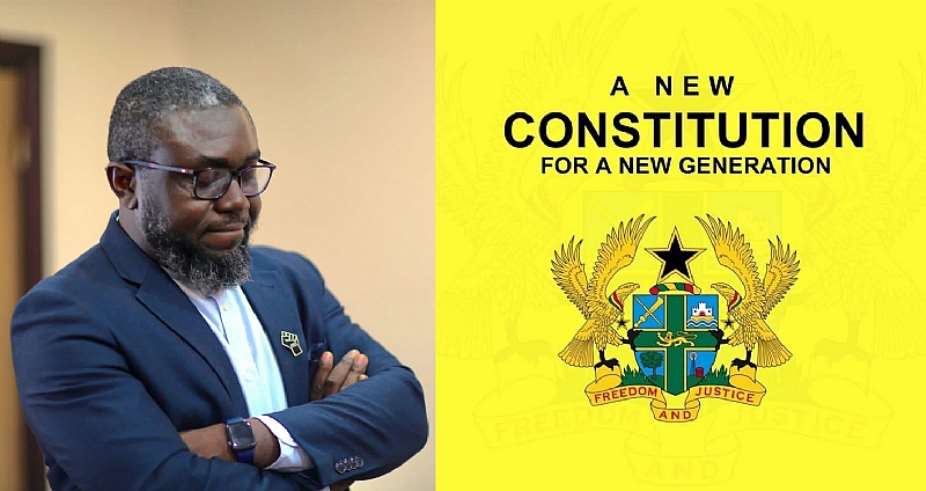
The appointment of Oliver Barker-Vormawor as Secretary of Ghana’s Constitution Review Implementation Committee is more than a routine government appointment. It represents an interesting full-circle moment in a constitutional reform journey that has stretched across successive administrations, multiple review exercises and more than a decade of recommendations awaiting implementation.
Barker-Vormawor is not entering this process as an outsider who has suddenly discovered constitutional reform. He has been here before.
In fact, his appointment brings him back to a process in which he participated more than 15 years ago.
The chronology matters.
2010–2011: The first major constitutional review
Ghana’s constitutional review process under the Fourth Republic gained significant momentum with the establishment of the Constitution Review Commission to examine the strengths and weaknesses of the 1992 Constitution and make recommendations for its improvement.
Between January 2010 and December 2011, Oliver Barker-Vormawor served as a Constitutional Researcher and Access to Justice Advisor to that Commission. His contribution was formally recognised with an award for extraordinary service.
The Commission’s final report was produced in 2011, containing recommendations on a wide range of constitutional and governance issues.
That is the first important link in the story.
2011 onwards: The problem of implementation
The 2010 Constitution Review Commission generated substantial recommendations, but Ghana’s constitutional reform challenge did not end with the production of reports.
The difficult question has always been: what happens after the recommendations?
Some proposals require ordinary legislation. Others require constitutional amendments. Still others involve entrenched provisions requiring parliamentary supermajorities, Council of State processes and, ultimately, a referendum.
This distinction between reviewing the Constitution and actually implementing constitutional change would become central to subsequent reform efforts.
Indeed, the current Constitution Review Committee’s own mandate included reviewing the work of the 2010 Constitution Review Commission, the related implementation committee and the later consultative process.
2023–2024: Another attempt to reopen the constitutional conversation
The constitutional reform process was subsequently revisited through the 2023–2024 Constitution Review Consultative Committee, whose work became part of the institutional history that the current Constitution Review Committee was required to examine.
The significance of this stage is that Ghana was no longer dealing with a single constitutional review document. It had accumulated layers of recommendations, consultations and implementation questions.
The country was effectively carrying forward an unfinished constitutional reform agenda.
January 2025: Mahama establishes a new Constitution Review Committee
President John Dramani Mahama subsequently established a new Constitution Review Committee, chaired by Professor H Kwasi Prempeh.
The committee was tasked with reviewing the 1992 Constitution and drawing from the accumulated constitutional reform work, including previous review processes. Its mandate was therefore not simply to start from zero, but to examine what Ghana had already learned and recommended.
This was an important distinction.
Ghana was attempting to avoid the familiar cycle in which governments establish committees, committees produce reports, governments acknowledge those reports—and implementation becomes the missing chapter.
2025: Nationwide consultations and review
The 2025 Constitution Review Committee embarked on extensive consultations and stakeholder engagements across the country.
Its work sought public input on constitutional governance and examined proposals relating to the functioning of the executive, Parliament, local government, accountability and other aspects of Ghana’s constitutional architecture.
The committee ultimately produced its recommendations after approximately 11 months of work.
22 December 2025: The report reaches President Mahama
On December 22, 2025, Professor H. Kwasi Prempeh presented the committee’s report to President Mahama.
The report contained significant recommendations, including proposals concerning the presidential term and other aspects of Ghana’s constitutional system. Kindly read the full report.
President Mahama indicated that the next stage would be implementation and announced plans for an implementation committee.
This was the point at which the process formally moved from review to implementation.
But implementation did not happen immediately.
2026: Government begins deciding what to accept.
The next challenge was for government to examine the recommendations and determine which proposals it accepted, which it rejected and where it wished to offer alternative positions.
By July 2026, President Mahama announced that Cabinet had completed its consideration of the Constitutional Review Committee’s recommendations and that the Attorney-General was preparing the Government’s Position Paper.
The President explained that government had accepted many recommendations but had alternative views on others.
This is constitutionally and politically important.
A review committee can recommend.
Government must decide what it is prepared to sponsor.
Parliament must debate and legislate where necessary.
And where the Constitution requires a referendum, the electorate ultimately becomes part of the constitutional amendment process.
8 July 2026: Government prepares the Position Paper
President Mahama disclosed that Cabinet was preparing to finalise the Government’s Position Paper.
The intention was for the Attorney-General and Legal Counsel to consolidate the government’s position with the recommendations before handing the documents to an implementation committee.
The process was therefore moving toward its most difficult phase: converting recommendations into legally and politically executable reforms.
14 August 2026: Mahama announces the Implementation Committee
During a Resetting Ghana engagement in the Upper East Region, President Mahama announced the next major step.
He said an Implementation Committee would examine the Government’s Position Paper alongside the constitutional review recommendations and divide the proposals into two broad categories:
non-entrenched provisions and entrenched provisions.
That distinction is crucial because the amendment procedures are different.
The announcement signalled that government was finally moving from constitutional diagnosis toward constitutional surgery.
28 August 2026: The Implementation Committee is inaugurated
On Friday, August 28, 2026, Attorney-General and Minister of Justice Dr Dominic Ayine inaugurated the 11-member Constitution Review Implementation Committee.
The committee is chaired by former Attorney-General and Presidential Legal Counsel Marietta Brew Appiah-Oppong.
Its mandate is to examine the Government’s Position Paper alongside the recommendations of the Constitution Review Committee and develop a framework for implementing the proposals accepted by government.
And among the members is a familiar name.
Oliver Barker-Vormawor — Secretary
The man who worked on constitutional review between 2010 and 2011 has returned, this time not as a researcher advising a review commission but as Secretary of the committee responsible for helping turn constitutional reform proposals into implementation.
That is the remarkable part of this appointment.
He has travelled from the research desk of the 2010 Constitution Review Commission, through academia, international legal and policy work and his emergence as one of the most prominent voices of Ghana’s #FixTheCountry movement, into the institutional machinery of constitutional reform.
The symbolism is difficult to miss.
The activist who spent years demanding fundamental changes to Ghana’s governance system is now sitting inside the process that could help determine which of those reforms actually become law.
FROM #FIXTHECOUNTRY TO THE CONSTITUTION REVIEW TABLE
Barker-Vormawor’s political journey makes the appointment even more interesting.
He became widely known as a co-founder and lead convener of the #FixTheCountry movement, which criticised governance failures and demanded greater accountability and systemic reform.
His appointment therefore presents an unusual question:
Can a prominent government critic become an effective insider without losing the intellectual independence that made his criticism valuable in the first place?
That question should not be answered by political labels.
It should be answered by performance.
The position of Secretary is not merely ceremonial. The Secretary will be central to the committee’s administrative, technical and coordination work as it attempts to translate recommendations into an actionable reform programme.
And this is where Barker-Vormawor’s previous experience becomes particularly relevant.
He understands the constitutional review process from the inside.
He also understands the frustration of citizens who have watched constitutional reform discussions repeatedly produce recommendations without sufficiently decisive implementation.
That combination could be useful.
THE REAL TEST IS IMPLEMENTATION
Ghana does not suffer from a shortage of constitutional reports.
The country has recommendations from previous constitutional review exercises, consultative processes and the latest Constitution Review Committee.
The real deficit has been converting recommendations into durable institutional change.
The Implementation Committee therefore has a fundamentally different job from a conventional review committee.
It must answer practical questions:
Which recommendations does government accept?
Which require constitutional amendments?
Which require ordinary legislation?
Which provisions are entrenched?
Which require a referendum?
What must Parliament do?
What must the Executive do?
What institutions need restructuring?
What is the implementation timetable?
And, perhaps most importantly, how will the reforms survive changes of government?
These are the questions that will determine whether the current exercise becomes another chapter in Ghana’s constitutional history or a genuine restructuring of the country’s democratic architecture.
BARKER-VORMAWOR’S SECOND CHANCE
There is an intriguing historical irony here.
In 2010, Barker-Vormawor was helping to research constitutional reform.
In 2026, he has been appointed to help implement it.
Sixteen years later, he has returned to the same constitutional conversation—but with considerably more experience and a much larger public profile.
That makes the appointment both an opportunity and a test.
For Barker-Vormawor, the challenge is to demonstrate that the transition from activist to institutional actor does not require abandoning principle.
For government, the challenge is to demonstrate that appointing a former critic is not an exercise in political domestication, but a genuine attempt to bring independent expertise into the reform process.
For the committee, the challenge is even bigger: to ensure that constitutional reform does not end where previous reform exercises ended—with another report on a shelf.
GHANA NEEDS RESULTS, NOT ANOTHER REPORT
The constitutional reform journey has already travelled from the 2010 Constitution Review Commission, through subsequent consultative processes, to the 2025 Constitution Review Committee and now to the 2026 Implementation Committee.
That chronology tells its own story.
Ghana has spent years discussing what should change.
The country now needs to demonstrate that it can actually change it.
Osagyefo Oliver Barker-Vormawor’s appointment is therefore significant not simply because of who he is, but because of what his return represents.
The researcher has returned as an implementer.
The activist has entered the institution.
The critic has been given responsibility for part of the reform process.
The question is no longer whether Ghana needs constitutional reform.
The question is whether Ghana finally has the political will, institutional discipline and technical capacity to implement it.
And that is where the real constitutional test begins.
Cheers Bou! Kelly West
#KWP #Vormawor #ConstitutionalReform #EkpeLeKpedzi #Implemention
Michael Agbesi Kelly

 Websites go dark as AI exposes critical security flaws worldwide
 Ghana remains friends to all and enemies to none — Mahama
 October 22: Cedi sells at GHS12.25 on forex market, GHS11.66 on BoG interbank
 Western Region: Seven missing fishermen rescued in Benin territorial waters – Po...
 Sammi Awuku calls for strict enforcement of child protection policies amid risin...
 Foreign Affairs Ministry denies Minority’s claim of harassing staff over South A...
 Nigerian police rescue 11 Ghanaians allegedly held hostage in Ogun State
 Mahama urges AES countries to open up to international support in fight against ...
 Websites shut down worldwide as critical cyber-security update issued
 South Africa evacuation expenditure: Ablakwa harassing Foreign Ministry staff ov...


