




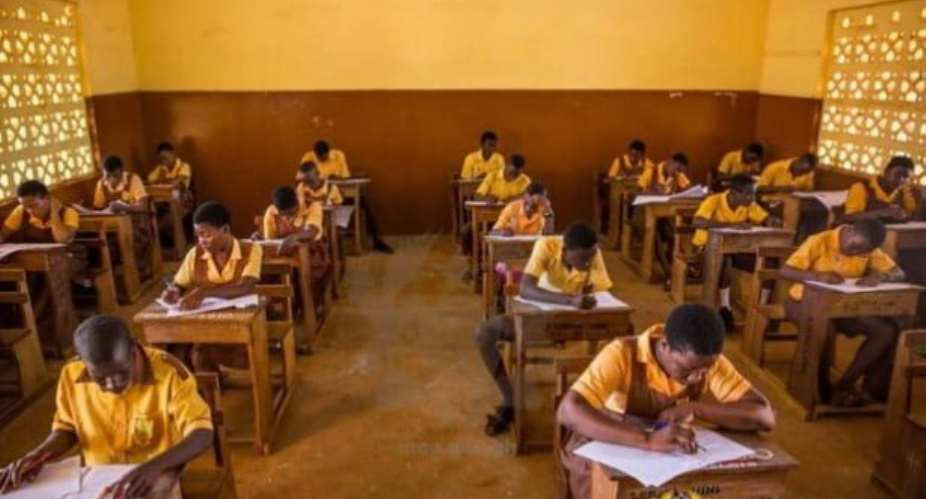
“Some of them are just lazy and do not have time for their books” – A Mathematics teacher, Krachi West District.
Something is deeply wrong with our children and the signs have been there for years.
Walk into any Junior High School classroom today and you will see it: students staring at screens instead of textbooks, fingers scrolling through TikTok while the teacher explains a mathematical concept, eyes glazed over, waiting for the bell to ring, minds elsewhere. A mathematics teacher in the Krachi West District put it bluntly: "Some of them are just lazy and do not have time for their books." A head teacher added: "They use mobile phones in class whilst lessons are ongoing. How can they concentrate?"
These are not merely complaints about young people. They are signs of a much deeper national crisis.
The crisis is visible in our examination results. It is visible in declining reading habits, increasing dependence on technology, examination malpractice, weak foundational learning, inadequate educational resources, and a growing culture of seeking instant answers without doing the hard work required to acquire knowledge. We therefore need to confront the uncomfortable truth: we are not dealing with one crisis. We are dealing with a cycle and unless we deliberately break it, it will reproduce itself.
The Foundation is Crumbling
The Basic Education Certificate Examination is supposed to represent the foundation of Ghana's educational system. Yet evidence presented in the source material shows disturbing declines in several districts.
In the Ho Municipality, BECE pass rates reportedly fell from 69% in 2019 to 68% in 2020 further fell from 68% to 61% in 2021, it did not end there; consistently fell from 61% to 59% to 54% in 2023. In 2019, only 6 students out of 2,938 obtained an aggregate of 6. By 2022, not a single candidate out of 3,070 obtained an aggregate of 6. In the Bongo District, the rate fell from 56% in 2021 to 32% in 2023, before a modest recovery to 40% in 2024. Talensi also remained below 50% for several consecutive years, with a reported pass rate of just 26% in 2022/2023. Even in districts that once performed well, the decline is visible. Teachers in Upper Manya, who were once lauded for their performance, saw pass rates drop from 92.59% in 2022 to 87.90% in 2023.
Nationally, the situation is equally concerning. The source reports that 603,328 candidates from 20,395 schools sat for the 2025 BECE, while a survey following the examination indicated that approximately 90% of candidates were unable to answer Mathematics and Science questions correctly. Nine out of ten students could not answer basic questions in core subjects.
Then comes the WASSCE
The 2025 results revealed a dramatic deterioration in performance. Core Mathematics passes reportedly fell from approximately 67% in 2024 to 48.73% in 2025, while the proportion failing the subject increased from 6.10% to 26.77%. More than 220,000 students failed to obtain grades within A1–C6. Integrated Science and English Language saw their failure rates double.
These figures should frighten us.
Not because examinations are everything, but because examination performance can expose weaknesses in the knowledge and skills students are expected to acquire.
A child who leaves Junior High School without a firm grasp of reading, writing and basic mathematics does not magically acquire those abilities at Senior High School. The weaknesses travel with the child.
Technology: A Tool that has become a Trap
Technology itself is not the enemy.
The problem is what we have allowed technology to become.
The smartphone can be a library, classroom, calculator, communication device and gateway to knowledge. Artificial intelligence can explain difficult concepts, generate practice questions, and provide feedback and help students explore ideas. But the same technology can also become a shortcut. Instead of using AI to understand a difficult mathematics problem, a student may simply copy the answer. Instead of reading an entire book, the student may search for a summary. Instead of writing an essay and developing an argument, the student may ask an AI system to write it.
The result is dangerous: the student receives the product of learning without experiencing the process of learning.
Georgina Asare Fiagbenu, MTN Ghana's Head of Corporate Communications, warned at the 2025 National Youth Mentorship Summit at the University of Cape Coast that the introduction of AI has made some students lazy because they increasingly rely on tools such as ChatGPT and Grammarly for their academic work.
This is the real danger of AI, not that machines can think, but that humans may gradually stop thinking.
A student who never struggles with a difficult problem never develops problem-solving resilience.
A student who never writes without assistance never develops a personal voice.
A student who never reads deeply never develops deep understanding.
A student who always receives instant answers never learns patience.
From reading to scrolling
There was a time when reading was part of everyday student life. Students read textbooks, novels, newspapers and magazines. They read because reading was not simply an academic requirement; it was a way of understanding the world. Today, many young people spend hours consuming short-form digital content while struggling to maintain concentration on a few pages of a textbook. The source describes a generation that can swipe but struggles to spell, scroll but struggles to summarize, and watch but struggles to wonder.
That should concern every parent, teacher and policymaker.
Reading is not merely about passing English Language. Reading trains the mind. It develops vocabulary. It improves comprehension. It strengthens concentration. It exposes people to different perspectives. It teaches patience. It builds imagination.
The Two-Minute Mindset
The problem goes beyond phones and artificial intelligence. It is also a problem of mindset.
We are increasingly raising young people who have been conditioned to expect everything quickly: fast food, fast money, fast fame, fast entertainment and fast answers.
That mentality has entered the classroom.
Some students want good grades without studying.
They want certificates without competence.
They want answers without understanding.
They want success without sacrifice.
This is the two-minute mindset, the belief that anything difficult should have a shortcut.
However, there is no shortcut to intellectual development.
There is no shortcut to mastery.
There is no shortcut to character.
And there is certainly no shortcut to building a nation.
But let us not blame the Children alone
It would be easy and unfair to place the entire burden on students. Yes, students have responsibilities. Laziness, truancy, indiscipline and poor study habits can contribute to academic failure. The source cites research linking such pupil characteristics to poor academic performance. However, children do not educate themselves.
Parents, teachers, schools, communities and governments all have responsibilities.
How can we demand excellent academic performance from students who lack textbooks?
How can teachers deliver quality instruction in overcrowded classrooms?
How can children develop a love for reading when books are unavailable or inaccessible?
How can we expect students to resist technology when adults themselves are constantly glued to their phones?
The source reports that thousands of JHS 3 students sat for the 2025 BECE without textbooks for the new curriculum, despite funding reportedly being released for printing.
We cannot demand excellence while failing to provide the conditions necessary for excellence.
Accountability must be shared.
Students must work. Parents must supervise. Teachers must teach. Schools must support. Government must provide. And society must demand results.
If we continue on this path, the consequence will be severe, what are we losing?
If we do nothing, the cost will be enormous. We are losing critical thinking when students outsource their thinking to machines. We are losing creativity when young people become consumers rather than creators. We are losing resilience when every difficulty is met with a search for an instant solution. We are losing discipline when entertainment consistently takes priority over responsibility. We are losing curiosity when students stop asking questions and simply search for answers. Ultimately, we are losing our future.
A nation cannot build a competitive economy with citizens who cannot think critically. A democracy cannot function effectively when citizens cannot evaluate information. Businesses cannot thrive when workers lack problem-solving skills. And communities cannot develop when young people are trained to expect someone else to solve every problem.
The situation is serious but not hopeless. We can change course. First, rebuild the reading culture in schools and at home. Establish responsible technology policies that regulate smartphone use and teach digital discipline. Teach AI literacy, use AI to understand concepts, not replace thinking. Strengthen foundational education in reading, writing, numeracy and problem-solving. Provide necessary resources like textbooks, teacher training, infrastructure.
Restore accountability
Students must work.
Parents must monitor.
Teachers must challenge.
Authorities must enforce.
Government must deliver
Address poverty and inequality because children cannot "study harder" when they lack food, housing and basic necessities.
To parents: put down your phone, read, talk to your children, monitor their online activity, and do not let technology become their parent.
To teachers: do not give up; challenge students, make them think, let them struggle and grow through that struggle.
To government: stop treating education as a political slogan; invest, provide resources, and measure success by whether children are actually learning.
To students: you are smarter than your phone; you do not need AI or WhatsApp to think for you, read, study, ask questions, make mistakes, learn to work when you do not feel like it, because the easy path gives answers but the difficult path gives ability.
The work begins now. The choice is ours. Will we raise a generation that is lazy, or a generation that has simply been left behind by a system that failed to meet them where they are? The answer depends on what we do today.

 Missing toll from Nepal, China flood nears 3,000 as race for survivors continues
 Niger junta says it is back in control after soldiers' mutiny
 Netanyahu condemns 'criminal acts of violence' by settlers in West Bank villages
 Martin Amidu points to $3million in 2016–2017 transfers in Asante Berko bribery ...
 Man arrested for flogging two-year-old daughter after she failed to greet him
 'I am sure of myself': A look back at Dolly Parton's unspoken feminist legacy
 Joint police-military operation arrests 11 suspects at Kromase
 Ghana’s public debt rises to GH¢719.52bn by June 2026
 “Powder Guy” denies $32,000 visa fraud
 'Homeless' Barosky ready to return home after Ghana's High Commissioner to UK vi...

