




In Ghana and across Africa, the paradox of governance is stark. On paper, the numbers are impressive: Ghana’s goods trade reached $52.5 billion in 2026, dominated by gold exports. Yet the headline number masks deeper systemic issues, including dependency, ecological damage, and weak wealth redistribution. Citizens complain that “people don’t vote for statistics, they vote for better lives.” The disconnect between macroeconomic triumphs and lived hardship is not accidental — it is systemic. Selective justice, corruption, and waste erode trust in leadership, while youth view migration as an escape and the diaspora hesitates to identify with Africanness.
The government lauds its job-creation statistics, but these figures do not match the lived realities of millions who struggle to pay rent, utilities, school fees, and food. Youth remain without jobs or training to prepare them for the future. Justice appears partisan, eroding legitimacy not only in the judiciary but also in the African self as a collective. This erosion of trust is the defining crisis of African leadership. It is not simply about bad actors or isolated scandals. It is about structures designed to perpetuate dependency, reinforced by educational systems that normalize and create more imitators than innovators, and political elites who fail to embody custodianship.
Source: Ghana Statistical Service (GSS) report, published August 11, 2026.
Gold Wealth, Empty Pockets
Ghana’s gold exports dominate trade figures, yet ordinary citizens struggle with inflation, unemployment, and poor infrastructure. The paradox is glaring: wealth leaves the continent, while poverty remains entrenched. Selective justice compounds the problem. Citizens see leaders who squander resources and institutions that fail to deliver dignity. The result is cynicism. People no longer believe in the promise of reform because they see wealth mismanaged and justice applied unevenly. The CMS lens of Consequence literacy exposes this gap: legitimacy cannot be measured by statistics or optics, but by tangible impact on lives.
Youth Migration and Diaspora Hesitation
Africa’s youth are voting with their feet. Ineffective governance, waste, and corruption make migration not just an aspiration but a necessity. Young people see no future in systems that fail to deliver jobs or dignity. At the National Youth Conference, leaders urged youth to “contribute, not only complain.” Yet contribution requires trust, and trust is eroded when leadership fails to embody responsibility. Diaspora communities, meanwhile, hesitate to identify with Africanness. They see a continent framed as reliant on charity, unable to steward its own wealth. This hesitation is not about identity alone; it is about consequence. When leadership fails, diaspora pride falters.
The CMS lens of custodianship reframes leadership as trusteeship. Leaders must safeguard resources and identity, dismantling corruption and waste. Only then can youth see migration as choice rather than escape, and the diaspora see Africanness as dignity rather than a burden.
AI and Infrastructure as Civilizational Consequence
Africa’s digital future is often framed in terms of artificial intelligence. Yet the IMF warns that Africa’s biggest AI challenge is not algorithms but electricity and internet access. This is not a technical glitch — it is a civilizational consequence of governance lapses. Persistent failure to invest in power and connectivity locks Africa at the bottom of the global chain, consuming obsolete technology and clothing from the North while producing cheap raw materials for export. The high cost of internet connectivity highlights this failure. Ghana’s two major telecom networks have adopted the short-term mindset prevalent in governance, focusing on daily or hourly bundles that may seem affordable but ultimately cost far more in the long run. Many parents on PTA platforms often avoid downloading school messages because of data costs, while foreign telcos report staggering profits.
Comparative Internet Costs Highlight the Distortion
- Ghana: Daily bundle GHS 10 for 1GB (~$0.80) → $0.80/GB, expires in 24h. Monthly bundle GHS 100 for 25GB (~$8) → $0.32/GB. Most low‑income users rely on daily bundles, paying 2–3x more per GB.
- Nigeria: Typical mid‑tier bundles ₦5,000 for 20GB (~$3.30) → $0.16/GB. Larger packages (₦10,000 for 40GB) average ~$0.20/GB — far cheaper than Ghana’s effective rates.
- South Africa: Telkom 40GB prepaid R189 (~$10) → $0.25/GB. MTN 50GB monthly R299 (~$16) → $0.32/GB.
- India (Asia): Average mobile data cost ~$0.09/GB — among the cheapest globally, driven by Jio’s data revolution.
- Germany (Europe): Broadband/5G packages €30–50/month (~$33–55) for 100–250 Mbps, translating to $0.30–0.50/GB equivalent.
Africa cannot compete globally when its citizens pay 5–10 times more for basic connectivity than peers in Asia or Europe. This is not a technical glitch — it is a governance lapse, a civilizational consequence of short‑termism and custodianship denied.
Sources: GSMA Mobile Economy Report 2026; Cable.co.uk Global Data Pricing Index; national telecom pricing guides (MTN Ghana, Telkom SA, Jio India, Deutsche Telekom Germany)
Education and Structural Traps
Africa’s education systems do not merely omit colonialism’s deliberate architecture; they actively prevent citizens from recognizing the global systemic flaws that sustain dependency. Curricula remain anchored in European history and imported epistemologies, presenting colonial economic design as neutral rather than intentional. Students graduate fluent in foreign narratives but ill-equipped to deal with structural traps of debt, raw‑material dependence, and obsolete imports that continue to define Africa’s place in the global hierarchy. This blindfold is not accidental. By failing to cultivate consequence literacy, education reproduces the very mindset that normalizes subservience. Citizens are trained to accept the hierarchy as natural, rather than to interrogate its origins. The result is a society where reforms are piecemeal, disconnected from the architecture of dependency, and easily co‑opted by political elites.
To dismantle this trap, education must be re‑engineered to expose colonial residue and equip citizens to recognize systemic flaws. Only then can reforms move beyond rhetoric to structural transformation. CMS offers this lens: consequence literacy to measure legitimacy by impact, custodianship to embed responsibility into leadership, and continuity to restore civilizational memory. Economic and educational reforms must therefore be reevaluated through a new lens — one that exposes colonial residue and dismantles structural traps. CMS offers that lens: consequence literacy.
“Let Consequence Literacy be your compass. Let accountable leadership be your legacy. Let your actions — as African politicians, C-suite executives, Civil servants, and Leaders — reverberate through the ages, and take your rightful place among the world of men and women, made in the image of God.”
—Albert K. Owusu, CMS I, p. 301
Conclusion: A New Lens for Trust
Selective justice erodes trust. Gold wealth leaves citizens with empty pockets and leaves landscapes scarred. Uncontrolled galamsey operations poison rivers with mercury and cyanide, strip forests bare, and leave once‑fertile lands barren. The ecological damage is not abstract; it translates into human suffering.
- Water contamination: Rivers such as the Pra, Ankobra, and Offin are polluted with mercury and cyanide, exceeding WHO safety limits by several hundred percent. More than 5 million Ghanaians are directly exposed to unsafe water sources.
- Health crises: Communities report rising cases of skin diseases, respiratory illnesses, kidney failure, and neurological disorders linked to toxic exposure. Children suffer stunted growth, while pregnant women face risks of neurological damage to unborn children.
- Livelihood destruction: Farmers lose fertile soils, cocoa farms collapse, and fishing communities see biodiversity wiped out. Ghana has already lost over 9,000 hectares of forest reserves, with 5,200 hectares destroyed in the last three years.
- Economic burden: Environmental degradation costs Ghana an estimated GH₵2.3 billion annually in lost agricultural productivity, healthcare costs, and water treatment
These are not isolated crises — they are systemic, rooted in mimicry residue and perpetuated by leadership failures. Worse still, these failures are compounded by leadership complicity with short-termism, self-interest, political party membership cards, and the politics of family and friends. Auditor-General reports (2019–2025) revealed that Members of Parliament and ministers repeatedly awarded GETFund scholarships — meant for poor and brilliant students — to themselves, their children, and allies. In sampled years, over 30% of disbursements were captured by politically connected individuals, diverting tens of millions of cedis. While some defend this by claiming they are ‘also Ghanaians,’ the ethical breach is clear: custodians of public resources cannot simultaneously be its beneficiaries. This conflict of interest entrenches cyclical socioeconomic underdevelopment, locking the continent at the bottom of the global hierarchy.
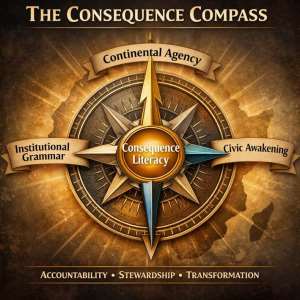
The continent remains firmly locked at the bottom of the global socio-economic hierarchy — producing cheap raw materials, consuming obsolete imports, and struggling to compete in innovation. One may argue that the global system is not broken at all but is working exactly as it was designed: to keep Africa dependent. Africa needs a new Compass. CMS offers that compass: consequence literacy, custodianship, and continuity. By embedding these pillars into governance, Africa can dismantle structural traps, restore trust, and reposition itself as a civilizational actor.
The erosion of trust is not destiny — it is design. And designs can be changed.
“We are not the victims of broken systems, nor of the past. We are the architects and designers of our choices — and of what comes next.”
—Albert K. Owusu, CMS I, p. 301
Source: Ghana Environmental Protection Agency (EPA), WHO Mercury Contamination Reports, GSMA Mobile Economy Africa 2026.
Source: Auditor‑General of Ghana, Performance Audit Report on GETFund Scholarships (2019); Follow‑up Audit Report (2025).
About CMS: The Consequential Management System (CMS) is an African governance framework authored across three volumes (CMS I–III). It introduces Consequence Literacy for institutions, enterprises, and communities, embedding Civilizational & Digital Governance tools to ensure industrialisation is intentional, accountable, and grounded in Africa’s custodianship. CMS is Africa’s codified civilizational offering to global governance, inviting critical engagement and diverse perspectives
Author Bio: Albert K. Owusu is the founder and architect of the Consequential Management System (CMS), an African governance framework authored and codified across three volumes. A global strategist, financier, and policy architect, he draws on lived experience of governance implementation at senior levels in corporations and institutions across Europe and Africa. Unlike purely academic models, his work integrates consequence-based measurement with practical realities of institutional reform, positioning CMS as a framework for accountability, retention, and custodianship in a multipolar world.
[email protected]
Click: Amazon.com: Consequential Management System (CMS)


 Sophia Akuffo calls for limits on Supreme Court interlocutory appeals to avoid u...
 Online fraud accounts for 47% of cybersecurity incidents in Ghana — CSA
 ‘Resign and join NDC’ — NPP tells Chief Justice over alleged political commentar...
 Gomoa Central MP A-Plus accuses Police of killing two, injuring 19 in New Winneb...
 Norway seizes Russian ship to enforce $4.22 billion Ukrainian compensation claim
 Okuapeman-Mount Sinai SHSs violence clash barbaric, perpetrators must face justi...
 Foreign Affairs Ministry reaffirms zero-tolerance on middlemen in attestation se...
 Bawumia engages nurses and midwives on healthcare policy and welfare
 September 3: Cedi sells at GHS12.15 on forex market, GHS11.33 on BoG interbank
 FDA orders recall of Arcan Bitters within 14 days over undeclared sildenafil

