




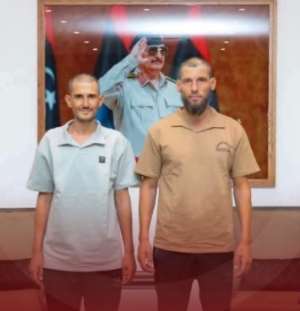
The release of two Russian servicemen held in Mali has put Libya’s powerful Haftar family at the centre of a remarkable new episode linking Libya, Russia and the Sahel.
Two Russian personnel from the Wagner/Africa Corps were captured in northern Mali in July 2024 during fighting near Tinzaouaten between Tuareg-led Azawad forces and Malian troops backed by Russian fighters. They were released in August 2026 following mediation involving Saddam Haftar, son of eastern Libyan military commander Field Marshal Khalifa Haftar.
According to The Libya Observer, sources said Saddam Haftar paid a ransom in exchange for the Russians' release. The two men were subsequently transferred to Libya and arrived in Benghazi before being handed over to Russian authorities. Haftar-affiliated media, however, presented the episode as a special security operation rather than a ransom payment.
Italian newspaper Il Foglio likewise reported that Haftar's forces played a role in securing the Russians' release, while describing the broader mediation effort as involving contacts with Tuareg separatists and jihadist networks in the Sahel. The report also linked the Haftar family's activities to support from the United Arab Emirates.
The episode is significant because it demonstrates the expanding regional reach of the Haftar network. Eastern Libya has maintained close relations with Moscow, while Russian military personnel and Africa Corps forces have operated in Libya and Mali. Haftar's forces have consequently developed relationships across a region where governments, armed groups, Russian personnel and jihadist organisations frequently intersect.
However, the widely circulated claim that €38 million was paid by Russia and Mali to secure the release of the two Russians should be treated cautiously. The sources currently available confirm a ransom/payment allegation, but I could not find a reliable independent source confirming the specific €38 million figure or establishing that both the Russian and Malian governments jointly paid that amount.
The more defensible conclusion is that a ransom or financial payment was reportedly involved and that Saddam Haftar's network played a key mediating role. This makes the episode another indication of the growing influence of the Haftar family beyond Libya's borders and of Benghazi's emerging role as an intermediary between Moscow and armed actors in the Sahel.
Mustapha Bature Sallama
Medical/Science communicator, Private Investigator, Criminal Investigation and Intelligence Analysis,United States Institute of Peace (USIP), [email protected] +233555275880
References
- The Libya Observer, “Saddam Haftar pays ransom to free 2 Russians held by Azawad Groups in Mali,” 22 August 2026.
- Il Foglio, “Russians and Americans. In Mali, Haftar frees everyone (with money from the Emirates),” 22 August 2026.
- African Perceptions, “Libyan Mediation Secures Release of Two Russian Captives Held by Azawad Rebels.”
- Reuters, reporting on ransom payments and the wider hostage situation in Mali, August 2026.


 Abronye loses again as Court of Appeal dismisses bid to halt Samson Anyenini’s d...
 Over 30 women feared trapped in prostitution in Savannah as GIS arrests traffick...
 Govt pays GH¢24.8bn to statutory funds since January — Ato Forson
 Seven missing Axim fishing canoe crew located in Togo’s waters — Western Regiona...
 Health Ministry assures Ghanaians of readiness to manage Ebola cases
 FDA shuts down Arcan Bitters factory again over illegal production in Ashanti Re...
 PAC chair praises NPA CEO Edudzi Tameklo’s performance at committee hearing
 Ghanaian jailed nine months in US for using relative’s social security number to...
 Ukraine war: I'm going to Russia to convince President Putin to ceasefire — Maha...
 'Prof. Jane Naana is Vice President of Ghana; not for women and girls' — Victori...


