




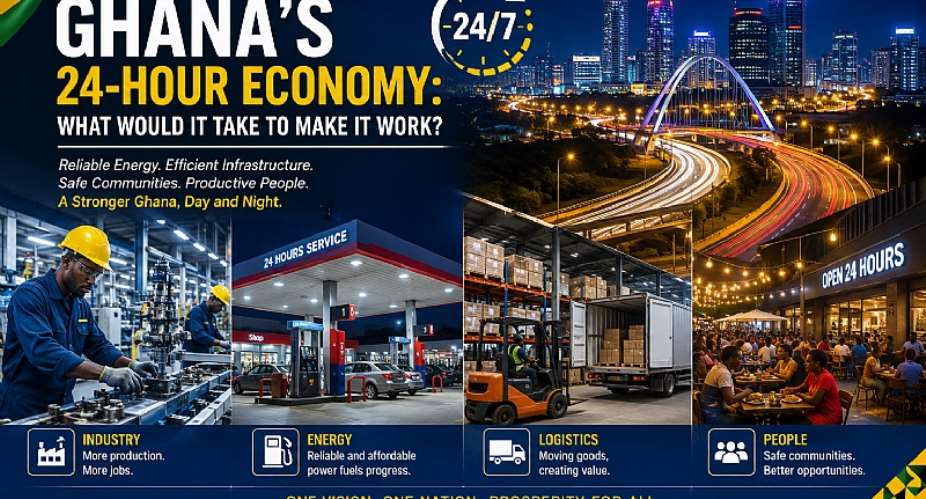
Ghana’s ambition to build a 24-hour economy has moved beyond a campaign promise and into the realm of policy and implementation. The 24-Hour Economy Authority Bill was passed by Parliament in February 2026, providing a legal framework for the initiative. Government has presented the programme as a strategy to increase productivity, expand industrialisation, strengthen exports and create quality employment. [MyJoyOnline]
But one fundamental question remains:
What will it take to make Ghana’s 24-hour economy work in practice?
The answer goes far beyond asking businesses to open their doors at night.
A genuine 24-hour economy requires reliable electricity, efficient transportation, security, digital infrastructure, access to finance, functioning logistics systems, productive industries and a workforce equipped to operate effectively in shifts.
At the heart of all these requirements is one indispensable resource: energy.
Energy Is the Foundation
Factories cannot operate without electricity. Cold-storage facilities cannot preserve agricultural products without dependable power. Digital businesses cannot function without electricity and connectivity. Hospitals, hotels, restaurants, warehouses, shopping centres and transportation systems all depend on reliable energy.
The Ministry of Energy and Green Transition identifies the provision of reliable, high-quality and accessible energy services as a core objective of Ghana’s energy sector. (Energy Ministry Ghana)
This makes energy policy central to the success of the 24-hour economy.
If a manufacturing company is encouraged to operate three shifts but cannot depend on stable electricity, the policy will struggle. If an agro-processing company has the capacity to work throughout the night but faces interruptions in power supply, the additional shift may become financially unattractive.
Economic activity cannot operate around the clock if the infrastructure supporting it cannot.
The Real Meaning of a 24-Hour Economy
A 24-hour economy should not mean that every Ghanaian must work 24 hours a day. Nor should it simply mean keeping shops open throughout the night.
Government has emphasized that the policy is about productivity, industrialisation, value addition and creating an economy in which opportunities can continue to be generated beyond conventional working hours. (MyJoyOnline)
A successful 24-hour economy should allow different sectors to operate according to their needs:
- A factory may run three shifts.
- A logistics company may operate throughout the night.
- A food-processing plant may use night shifts to increase production.
- Digital businesses may serve international customers across time zones.
The objective should therefore be greater productivity, not longer working hours for their own sake.
Ghana Needs Reliable and Affordable Electricity
The first major test will be the reliability and affordability of electricity.
Ghana has installed generation capacity, but what matters to businesses is dependable power delivered consistently and affordably.
Analyses of the 24-hour economy highlight electricity demand and supply as critical considerations, especially for manufacturing, agro-processing and industrial activity. (MyJoyOnline)
This requires continued investment in:
- Generation
- Transmission
- Distribution
- Maintenance
- System reliability
It also requires serious attention to renewable energy.
Solar power, battery storage, embedded generation and other technologies can complement the national grid. A diversified energy system can reduce exposure to interruptions and support Ghana’s energy-transition ambitions.
Fuel Supply and the Night-Time Economy
Electricity is only part of the energy equation.
Transportation, logistics, construction, agriculture and other sectors depend heavily on petroleum products.
In May 2026, the National Petroleum Authority announced a pilot involving 268 fuel stations, eight depots and two refineries to support round-the-clock operations. (MyJoyOnline)
This is significant because a functioning 24-hour economy needs an energy supply chain capable of supporting businesses beyond daytime hours.
Domestic refining capacity is also expanding. In June 2026, government broke ground for Phase Two of the Sentuo Oil Refinery, increasing capacity from 40,000 to 100,000 barrels per day. (The Presidency, Republic of Ghana)
The broader objective is an energy environment in which businesses can plan confidently, control costs and remain competitive.
Transportation Must Also Work at Night
Imagine a factory operating three shifts but workers cannot safely travel home after midnight.
The 24-hour economy would face an immediate limitation.
Transportation must therefore be part of the conversation:
- Public transport
- Commercial vehicles
- Logistics companies
- Ports and warehouses
- Road networks
Night-time transportation must be safe, predictable and affordable.
The same applies to freight. If goods produced at night cannot move efficiently to markets, ports or distribution centres, increased production will not translate into increased value.
The 24-hour economy should be viewed as an ecosystem, not isolated businesses.
Security Cannot Be an Afterthought
Businesses will not confidently operate overnight if workers, customers, vehicles and goods face unnecessary risks.
A serious 24-hour economy requires:
- Effective policing
- Adequate street lighting
- Emergency services
- Fire protection
- Well-planned commercial areas
The Assin Bereku 24-hour model market illustrates this integrated approach, including a police station, fire station, clinic, pharmacy, bank, cold stores, restaurants and a transport terminal. (The Presidency, Republic of Ghana)
Economic activity does not happen in isolation.
The Private Sector Must Be at the Centre
Government can create policy and infrastructure, but businesses will determine whether the 24-hour economy becomes productive and sustainable.
The private sector needs incentives that make additional shifts viable.
Businesses must answer practical questions:
- Will additional hours generate demand?
- Can labour costs be sustained?
- Is electricity reliable?
- Can workers travel safely?
- Are financing costs manageable?
- Can products reach markets efficiently?
- Are taxes and regulations predictable?
The Association of Ghana Industries has urged government to move beyond slogans and focus on concrete policies. (MyJoyOnline)
Success should be judged by factories expanded, exports increased, jobs created and incomes improved—not speeches.
The Opportunity for Ghanaian Industry
If properly implemented, the 24-hour economy could create opportunities across:
- Agriculture
- Manufacturing
- Logistics
- Tourism and hospitality
- Digital services
- Retail and food services
The Volta Economic Corridor is being developed with an integrated focus on agriculture, manufacturing, aquaculture, logistics, inland water transport, renewable energy, tourism and export-led industrialisation. (The Presidency, Republic of Ghana)
This integrated approach is more transformative than simply keeping businesses open late.
Skills and Labour Must Be Considered
A 24-hour economy requires a workforce prepared for shift-based employment.
Workers need:
- Appropriate compensation
- Safe working conditions
- Transport arrangements
- Clear labour protections
Employers need skilled workers who can operate machinery, manage digital systems, maintain equipment and meet quality standards.
Education, technical training, apprenticeships and industry partnerships must be part of the strategy.
The Measure of Success
The greatest danger is allowing “24-hour economy” to become a political slogan.
Success should be visible in people’s lives:
- Are more young people finding decent jobs?
- Are factories producing more?
- Are farmers earning more from processed products?
- Are exports increasing?
- Are businesses more competitive?
- Are communities receiving better infrastructure?
- Are investors confident?
- Are workers earning better incomes?
President Mahama has emphasized that success should be measured by expanded businesses, meaningful employment, better farmer incomes and competitive Ghanaian products. (The Presidency, Republic of Ghana)
Ghana Has an Opportunity
Ghana can build an economy that is more productive, competitive and connected to regional and global markets.
But this requires more than extending business hours.
It requires:
- Reliable energy
- Efficient transportation
- Modern infrastructure
- Security
- Affordable finance
- Skilled workers
- Digital connectivity
- Strong institutions
- A capable private sector
Energy must remain central.
A factory cannot manufacture without power. A cold store cannot preserve food without electricity. A digital company cannot serve clients without connectivity. A logistics system cannot function without fuel and transportation.
The 24-hour economy should be understood as an opportunity for Ghana to produce more, add more value, create more jobs and compete more effectively.
The vision is ambitious.
The challenge now is implementation.
Ghana does not simply need a 24-hour economy. Ghana needs a productive economy that works—day and night.
By Jenora Kwaning


 President Mahama calls for five permanent UN Security Council seats for Africa
 GRIDCo announces 15-hour power interruption in parts of Greater Accra
 Wenchi Traditional Council suspends Twafohene
 Nine Blue Water Guards arrested over alleged bribery, mpersonation of NAIMOS at ...
 Less than 20km of clearing work remains on Accra-Kumasi expressway – Roads Minis...
 My father predicted family feud, church division before his death – Adwoa Safo
 Afenyo-Markin knows why I called him ‘extortionist’; I dare him to sue me – Samm...
 45-year-old man accused of assaulting 90-year-old woman over witchcraft allegati...
 50 aspirants pick NPP national executive election forms; filing begins August 23
 'Contrary to law': US judge strikes down Trump's 75-country visa ban

