




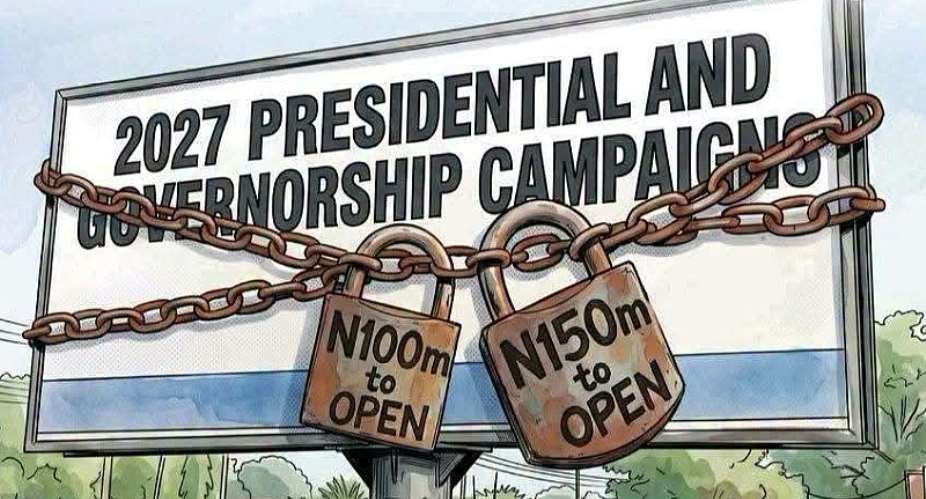
As campaigns for Nigeria's presidential and National Assembly elections officially opened on August 19, 2026, a quieter but consequential battle has emerged across the country's states: the cost of simply putting a candidate's face on a billboard.
Several state governments have fixed campaign signage permit fees running into hundreds of millions of naira, prompting accusations from opposition parties that the charges are less about revenue and more about shutting them out of the race before it has properly begun.
A Patchwork of Fees Across the Federation
The Independent National Electoral Commission (INEC) has cleared 19 presidential candidates to contest the January 2027 general elections, and outdoor advertising billboards in particular remains one of the most durable and visible campaign tools available to them. But the price of that visibility now varies wildly by state.
In Abia State, the Abia State Structures for Signages and Advertising Agency (ABSSAA) has set a ₦200 million (about $148,000) fee for presidential candidates seeking to erect billboards, with governorship candidates paying ₦150 million (about $111,000), senatorial candidates ₦100 million (about $74,000), House of Representatives candidates ₦50 million (about $37,000), and State Assembly candidates ₦20 million (about $14,800).
Kogi State has pegged its presidential candidate fee at ₦150 million (about $111,000), with senatorial, House of Representatives, and State Assembly candidates paying ₦50 million ($37,000), ₦30 million ($22,200), and ₦5 million ($3,700) respectively, alongside ₦2 million ($1,480) for chairmanship and ₦300,000 (about $220) for councillorship candidates ahead of October's local government polls.
Rivers State is charging ₦75 million (about $55,500) for presidential candidate billboards and ₦50 million (about $37,000) for governorship billboards, according to a source at the Office of the Special Adviser on Political Affairs to the governor, with the pricing designed to curb indiscriminate billboard erection in Port Harcourt.
Within Rivers, the Abua/Odual Local Government Area has gone further, passing its own 2026 by-law fixing ₦70 million (about $52,000) for presidential and ₦50 million ($37,000) for governorship candidate billboards at the local level.
Cross River has set its presidential billboard fee at ₦150 million ($111,000) and governorship at ₦100 million ($74,000), while Enugu applies a comprehensive ₦150 million ($111,000) fee covering campaign materials, billboards, and branded campaign vehicles.
Anambra's fees are comparatively modest ₦50 million ($37,000) for presidential candidates, ₦20 million ($14,800) for senatorial candidates, ₦5 million ($3,700) for House of Representatives candidates, and ₦1.5 million (about $1,110) for State Assembly candidates.
Kano stands apart from the trend entirely. The Kano State Signage and Advertisement Agency, created by Governor Abba Kabir Yusuf in 2025, makes no distinction between political and commercial billboards, charging a flat rate of roughly ₦1.15 million (about $850) covering administrative and annual fees.
Kaduna State, meanwhile, has not fixed a standard fee at all the Kaduna State Urban Property Development Agency (KASUPDA) instead assesses each billboard request individually based on location before quoting a price .
Separately, unverified claims circulated on social media that the Federal Capital Territory Administration had imposed a ₦750 million (about $555,500) billboard fee. The FCT Minister's media aide, Lere Olayinka, dismissed the figure as "political propaganda common during election seasons".
Opposition Parties Cry Foul
The African Democratic Congress (ADC) has vowed to legally challenge the fees, with its national publicity secretary, Bolaji Abdullahi, telling Daily Trust plainly: "It is certainly targeted at the opposition. And we are going to challenge it".
The Nigeria Democratic Congress (NDC) has similarly condemned the charges as arbitrary and undemocratic, with its director of publicity, Ossai Director, arguing that many of the affected states are controlled by the ruling All Progressives Congress (APC) and questioning why comparable measures were not seen during the Peoples Democratic Party's years in power.
In Kogi, the state PDP chairman, Mohammed Gambo, invoked constitutional protections for freedom of expression and peaceful association, urging the government to convene a stakeholder meeting to agree a more proportionate fee structure .
In Abia, governorship aspirant Doris Ogala publicly rejected the ₦150 million ($111,000) fee, calling it an attempt to "shut the door on ordinary citizens and entrepreneurs while systematically extorting political rivals" . The Abia government has stood firm, with the state's Strategic Communications Bureau describing the fee schedule as non-negotiable and framing it as a matter of road safety, urban aesthetics, and electoral integrity rather than political targeting.
The ruling APC has distanced itself from the controversy. A party chieftain told Daily Trust that billboard fees are set solely by state and local governments, not by the party or federal government, adding that the real concern would only arise "when a political party or candidate is denied a chance to mount such billboards even when they have the money to pay".
Analysts Question the Timing
Political scientist Professor Kamilu Sani Fage of Bayero University, Kano, said that while billboard taxation is not new citing Lagos as a longstanding example the timing and manner of the current wave of fee increases raises concern.
"For state governments to introduce it in the name of generating revenue, I believe there are certain sinister political motives. Opposition parties may not be able to pay such money, while ruling parties are often exempted," he said, warning that incumbent parties would likely draw on public funds to cover the fees regardless.
Olasupo Abideen, Global Director of the Brain Builders Youth Development Initiative, urged closer scrutiny of "why the policy is being introduced at this time" and whether adequate stakeholder engagement preceded implementation, while acknowledging that revenue generation could be a genuine motive alongside concerns about restricting opposition visibility.
Musa Aliyu, Director of the Media Advocacy and Technologies Centre (MATEC), was more direct, describing exorbitant billboard charges as one of several tools capable of limiting opposition access to voters and warning that such measures "endanger Nigeria's democracy" .
Legal Grey Area
Constitutional lawyer Kehinde Oloje told Daily Trust that Nigeria's Electoral Act 2026 contains no specific provision governing the physical placement of billboards, leaving regulation to state and local government urban planning laws and agencies such as the Lagos State Signage and Advertisement Agency (LASAA) or the FCT's Department of Outdoor Advertisement and Signage (DOAS).
The Act does, however, prohibit campaign materials near polling units on election day, bars campaigning within 24 hours of polls, and restricts language that could incite ethnic or religious hatred in political advertising, including on billboards .
A Bigger Spending Envelope Overall
The billboard fee controversy comes as Nigeria's overall campaign spending ceilings have risen sharply under the Electoral Act 2026. The maximum a presidential candidate may spend on election expenses has doubled from ₦5 billion (about $3.7 million) under the 2022 Act to ₦10 billion (about $7.4 million), while the governorship ceiling has tripled from ₦1 billion ($740,000) to ₦3 billion (about $2.2 million). Senatorial spending limits have risen five-fold, from ₦100 million ($74,000) to ₦500 million (about $370,000), and House of Representatives limits have more than tripled, from ₦70 million ($52,000) to ₦250 million (about $185,000).
Set against that backdrop, even a ₦200 million ($148,000) billboard permit fee represents a real but comparatively modest slice of a presidential candidate's legal spending envelope though critics argue the concern is less about affordability for well-funded frontrunners and more about the barrier such fees pose to smaller, cash-strapped parties.
Naira-to-dollar equivalents calculated at the CBN official rate of approximately ₦1,350/$1 as of August 2026 and rounded to the nearest hundred dollars.
Mustapha Bature Sallama
Medical/Science communicator, Private Investigator, Criminal Investigation and Intelligence Analysis,United States Institute of Peace (USIP), [email protected] +233555275880
References
Daily Trust, "As campaign begins: Billboard permit fees rattle candidates" https://dailytrust.com/as-campaign-begins-billboard-permit-fees-rattle-candidates/
Premium Times, "Abia fixes N200m for presidential campaign billboard permit" https://www.premiumtimesng.com/news/top-news/899542-abia-fixes-n200m-for-presidential-campaign-billboard-permit.html
Tribune Online, "2027: Kogi fixes N150m campaign signage fee for presidential candidates" https://tribuneonlineng.com/2027-kogi-fixes-n150m-campaign-signage-fee-for-presidential-candidates/
TheCable Fact Check, "DISINFO ALERT: Wike didn't approve N750m permit fee for presidential campaign billboards in FCT, says aide" https://factcheck.thecable.ng/disinfo-alert-wike-didnt-approve-n750m-permit-fee-for-presidential-campaign-billboards-in-fct-says-aide/
Leadership, "I Dare Anyone To Touch My Billboard Doris Ogala Rejects ₦150m Campaign Permit Fee" https://leadership.ng/i-dare-anyone-to-touch-my-billboard-doris-ogala-rejects-%E2%82%A6150m-campaign-permit-fee/


 Bawumia eyes 3R's Japanese tech that removes mercury, cleans soil and recycles w...
 'Our borders must command respect' – Osahen Afenyo-Markin on cocaine busts
 ‘Govt deeply involved in Beirut cocaine bust’ — Kofi Bentil reveals
 Ablakwa sues Benghazi, Media General over Fantana affair, corruption allegations
 Mahama instructs Finance Ministry to pay striking JUSAG members from November
 Mahama must sign same anti-gay bill NDC backed in opposition – Osahen Afenyo-Mar...
 Romance Scam: Asante Akyem North MP's extradition hearing set for November 18
 JUSAG accuses FWSC CEO of taking unilateral decisions in salary negotiations
 Police arrest three Nigerians over alleged bank customer robberies in Kumasi
 'Next week I will show how the new economy will turn the gains we have made into...


