




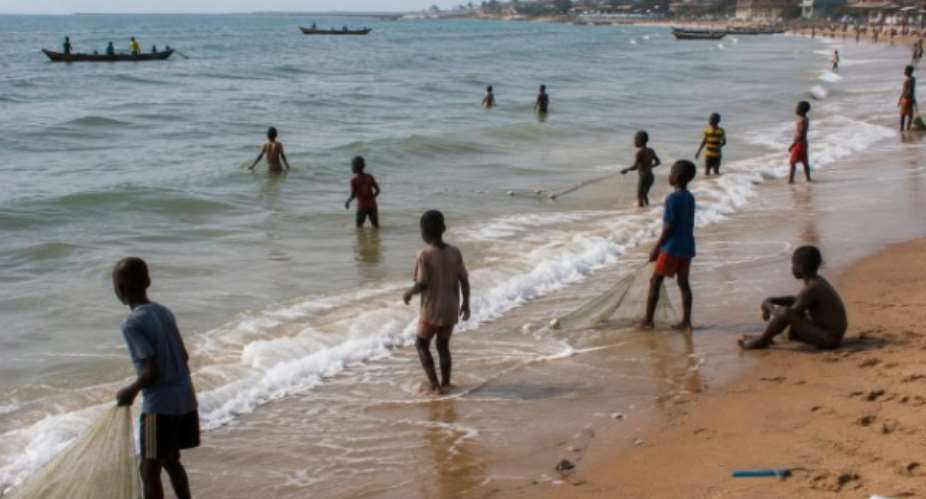
In the coastal fishing towns of Ghana, childhood is often split between the classroom and the sea. A field study conducted by the Journalists for Responsible Fisheries and Environment (JRFE) reveals that poverty and economic hardship frequently compel families to rely on child labor, creating an enduring tension between formal education and traditional livelihoods.
Early one morning along the shoreline, I watched as fishing canoes returned from the ocean while clusters of children hurried to help haul in heavy nets. Some balanced baskets of fish on their heads; others sorted the day's catch—all before many of their peers had even started school. This scene captures the daily reality in numerous fishing communities, where youth are often caught between educational aspirations and the pressing demands of the fishing industry.
Child involvement in fishing remains a complex and urgent issue across Ghana’s coast. Although notable progress has been made over the years, a number of children still participate in strenuous fishing-related tasks, raising serious concerns about their education, health, and overall development.
During my visit with the JRFE team, I spoke directly with fishermen, parents, teachers, and local residents. Our goal was clear: to move beyond statistics and understand, on a human level, why children remain engaged in fishing—and how this delicate balance shapes their present and future.
The Roots of the Practice: Poverty and Tradition
From my conversations along the coast, several interconnected factors emerged as drivers of child involvement in fishing. Foremost among them is deep-seated poverty, which forces many vulnerable families to depend on their children’s labor to supplement meager incomes. In households where survival is a daily struggle, formal education often takes a backseat to the immediate need for food and money—making fishing an urgent, if fraught, alternative.
Compounding this economic distress is the instability of broken homes. The loss of one or both parents frequently leaves children with little choice but to enter the workforce to support themselves and younger siblings. For others, involvement in fishing is inherited—born into fishing families, they are expected to carry on the trade. For these children, fishing is not merely a cultural tradition but a vital means of survival.
Perspectives from the Shore: Fishermen and Parents
Many fishermen I spoke with were quick to clarify that they do not advocate for pushing children into the sea or pulling them from school. They believe every child deserves the chance to pursue a path aligned with their interests and abilities. Rather than promoting fishing as an alternative to education, they acknowledged that some children develop a natural passion for the maritime life early on.
One fisherman noted a cultural shift compared to decades past: "Nowadays, many parents encourage their children to stay in school. Even when some children want to follow us to sea, their parents insist they attend classes first."
Yet another admitted that economic necessity still drives practice. During peak fishing seasons, children routinely assist with operations before or after school, simply because families need every available hand to sustain their livelihoods.
Parents expressed similar mixed feelings. While they overwhelmingly recognize the value of education, they detailed the crushing financial pressures they endure—declining fish stocks, high fuel costs, and rising household expenses. These realities push families to rely on children for tasks like carrying fish, mending nets, cleaning canoes, or selling catches at the market.
The Classroom Toll and Expert Warnings
In local schools, teachers voiced deep concern over how labor affects academic progress. Children heavily involved in fishing frequently arrive exhausted, struggle to concentrate, or experience chronic absenteeism during peak seasons.
While some manage light household chores alongside their studies, excessive involvement in commercial fishing severely undermines academic performance. One teacher emphasized a fundamental truth: education remains the most reliable pathway to expanding opportunities for coastal children beyond the fishing industry.
Public health and child protection experts have long echoed these warnings. They highlight that maritime fishing exposes children to serious hazards—long hours under harsh weather, physical injuries from heavy gear, and the constant, life-threatening risk of drowning. Such conditions pose profound threats to their physical and emotional well-being.
Signs of Progress and the Path Forward
Despite these challenges, hopeful changes are visible along the coastline. Several residents shared that growing awareness has led more parents to prioritize formal education. Today, many communities actively discourage children from going to sea during school hours, and school enrollment has shown noticeable improvement compared to previous years.
Nevertheless, residents insist that community goodwill alone is insufficient; comprehensive support is essential. Stakeholders emphasize the need for expanded scholarship programs, targeted livelihood assistance for vulnerable fishing families, improved access to educational infrastructure, and stronger, more consistent commitment to child welfare.
Looking Beyond the Shore
As my visit drew to a close, one truth stood out: while fishing remains the economic and cultural backbone of Ghana’s coastal communities, children should never have to sacrifice their education, safety, or childhood to keep their families afloat.
Protecting the next generation while preserving the heritage of fishing demands an unwavering, shared commitment from parents, community leaders, policymakers, and all who care about the future of these children. Every child deserves the chance to learn, grow, and dream far beyond the shore—ensuring that those who eventually choose fishing as adults do so safely, by choice, and equipped with the skills to sustain the industry for generations to come.

 It’s unlawful for landlords to increase rent charges without approval from us — ...
 Rent Control Boss directs landlords, hostel operators to issue rent cards
 “What type of scholarship pays only 25%; If you can’t spell it, don’t write it” ...
 Government gives Adamus Resources 12-month reprieve to revive mining operations
 'I was not the Chief of the Defence Staff in 2023 to procure armoured vehicles' ...
 ’We must unite to win 2028 elections’ - Bawumia tells new NPP executives
 Police arrest 27-year-old over provocative TikTok video on death of Mion Lana
 CLOGSAG Executive Secretary Dr Isaac Bampoe Addo dies
 Muntaka orders police to crack down on vigilante groups, unauthorised guards
 Wontumi campaign team picks NPP National Chairman nomination forms despite 20-ye...

