




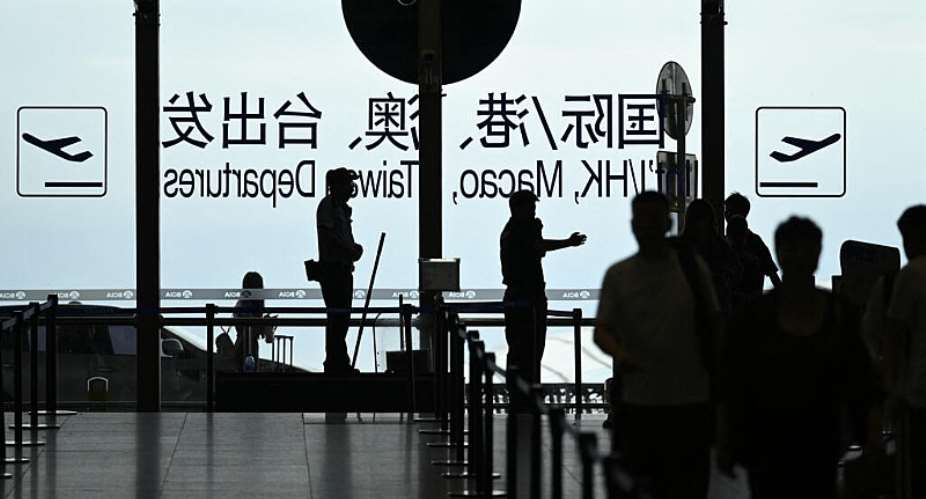
In a document published on July 31, China's State Council announced that, in order to “preserve national sovereignty and interests”, border control officials could require travellers to provide additional information and documents about their reasons for travelling.
Those who provide false documents or statements could be prohibited from entering or leaving the country. Chinese nationals who have “acquired travel documents by deceit” or have been involved in “exiting or entering the country illegally” could face an exit ban of between six months and three years in addition to existing punishments, according to the new rules.
The ban can also apply to citizens who have “participated in illegal activities” or “threatened national security and interests” while abroad.
The new articles also state that Chinese citizens can be prohibited from leaving the country if they “violate” regulations on the import and export of technology, and if these violations endanger China's “industrial or technological security”.
In March, Beijing imposed a travel ban on two co-founders of Manus, a Chinese AI company that Meta had planned to acquire for $2 billion.
China blocked the acquisition plan in April, and the Financial Times reported that the ban is soon to be lifted.
In a country where overseas travel is already heavily scrutinised, and where some civil servants are required to surrender their passports to their employers, the new rules have prompted intense discussion on social media. Some Chinese netizens have questioned whether they will still be able to travel abroad freely once the regulations come into force.
Meanwhile, analysts have warned that the regulations could formalise and expand existing exit restrictions.
'Leave while you still can'
In a post on X that was widely quoted by Chinese-language media, Henry Gao, a law professor at Singapore Management University, called for people in China to "leave while you still can".
"These regulations represent another major step in transforming the right to leave China into a privilege granted at the discretion of the state," he wrote.
In an interview with FRANCE 24, Gao said that while the new border rules do not significantly expand formal state power, they consolidate and codify existing regulations and “long-standing enforcement practices that already contained significant ambiguity and room for discretion".
"What the regulations mainly do is give enforcement agencies an explicit basis in written rules for what they were already doing," China legal expert Christopher Nye and policy analyst Charles Sun of the Jamestown Foundation said in an emailed response.
"What changes is the level of specificity," they said, adding that border officers now have "express authority" to review whether a traveller's stated purpose for leaving the country is "truthful".
"Standardisation of this kind lowers the cost of routine enforcement, and officials no longer need case-by-case approval from above to keep a citizen in the country."
For individuals barred from leaving, the practical avenues for challenging the decision may be limited.
Citing Article 6, Gao said authorities can prohibit individuals from leaving the country on national security grounds without providing detailed reasons, making such decisions difficult to challenge.
"Such measures are often insulated from robust judicial review, leaving affected individuals with few realistic remedies beyond administrative channels that rarely provide transparent reasoning or independent oversight," he said.
While the regulations call for anyone facing an exit ban to be notified and outline the channels for appeal, in some cases authorities can decline to notify the individual in question where doing so could affect national security or a criminal investigation.
As a result, individuals may not learn they are subject to an exit ban until they attempt to leave the country.
"The US State Department [notes in an] advisory ... that people usually discover an exit ban only when they try to leave, with no way to learn how long it will last," Nye and Sun wrote, adding that cases related to national security are rarely tried in Chinese courts.
“The person has nothing to appeal against and no record that the state ever acted.”
Beyond China's borders
While the new regulations are primarily aimed at controlling who can enter and leave China, experts say they could also strengthen Beijing's ability to exert pressure on Chinese nationals over activities carried out abroad.
Watch more 'China Targets': New investigation explores how Beijing extends its repression worldwide
“China has long asserted personal jurisdiction over certain offences committed abroad by its nationals, but historically this was more clearly associated with more serious crimes,” Gao said.
The new rules "broaden the practical reach of enforcement by extending consequences – such as post-sentence exit bans – to a wider range of offences, including those that may be vaguely framed".
Noting the potential for human rights abuses, Nye and Sun warned that individuals participating in advocacy activities abroad, where those activities are legal, could nevertheless face sanction when they return to China, as could their families.
"The effect is to project the party-state's standards onto Chinese nationals everywhere and to hold those standards over them as a standing threat against the ordinary exercise of freedoms abroad."
According to a 2024 report published by Safeguard Defenders, a human rights NGO, the Chinese Communist Party has been steadily expanding its use of exit bans. Beijing is increasingly barring human rights activists and journalists from leaving the country, or using restrictions on their family members to pressure them to return to China.
"This is less a dramatic expansion of legal jurisdiction in principle than a notable expansion of enforcement leverage and extraterritorial pressure in practice," Gao said.
"Beijing has spent the past decade extending the reach of its own law in order to extend its influence and protect party-state interests, and this is one more concrete instance of the long-arm jurisdiction it has been testing," Nye and Sun noted.
Foreign nationals
The regulations also contain provisions affecting foreign nationals, although the risks for them are different from those facing Chinese citizens.
Article 5 states that foreign nationals could be barred from entering China for between one and five years if they provide false information or statements when applying for a visa or seeking entry at the border.
Analysts say those who face particular risks include foreign nationals who were formerly Chinese citizens, as Beijing does not recognise dual nationality.
US seismologist Chen Youlin, a naturalised US citizen, is facing espionage charges after travelling to Beijing to visit family in November 2024.
Watch more Family of detained US scientist breaks silence after quiet diplomacy stalls
Taiwanese nationals, meanwhile, may also face increased risks, as Beijing does not view them as foreign nationals.
Taiwan's Mainland Affairs Council (MAC), the official body responsible for cross-strait affairs, has warned of heightened risks for Taiwanese travelling to China.
"China is not a country governed by the rule of law, the rules are abstract and open to interpretation," MAC Minister Chiu Chui-cheng told a press conference earlier this month.
"If they (the Chinese government) ban you from leaving, then you're not leaving."
According to MAC figures, as of August 14, a total of 416 Taiwanese citizens remain stuck in China, including 226 who have been detained, 156 who are missing and 34 who are being questioned.
Growing distrust
China's new border rules reflect a broader contradiction within the country, some analysts say. As China's economic and military power has grown, so too has the government's concern over security and control.
Gao said the new rules were notable not simply because they give border officials greater discretion, but because they apply that discretion to Chinese citizens seeking to leave the country.
While border authorities in many countries have powers to restrict entry, he noted, restrictions on citizens leaving their own country are generally reserved for specific legal circumstances and are typically accompanied by clearer grounds and avenues for judicial review.
Li Shaomin, a sociologist and professor at Old Dominion University, noted in a post on X that during the Mao era, travelling abroad was largely reserved for people trusted by the state. Today the situation has been reversed, with those closest to the regime often facing the greatest restrictions on their ability to travel.
“Not only is there a lack of trust in the general public, but there is an even greater lack of trust in its own [party] officials – in the very people it has promoted,” he wrote.
Beijing does not want to return to the complete isolation of the Mao era but instead seeks a more selective form of openness, according to Li: “An open economy but with people under heavy control.”
The new entry and exit regulations are not an isolated measure but reflect a broader tension between an increasingly powerful country and a government that is increasingly insecure about its own stability.
“Under a one-party dictatorship, this is a contradiction that cannot be resolved,” Li said.

 GoldBod warns buyers as new XRF gold purity rules take effect September 1
 Africa must lead together with global insights for local impact – Kafui Prebbie
 S.Africa asks regional summit for unity after anti-migrant backlash
 Lamour leaves key FIFA position after criticising Infantino
 EOCO leading AKSA bribery probe because case may involve money laundering not un...
 Ghana Cedi appreciates against US dollar from GHS11.75 to 10.94 in one week
 COCOBOD deploys directors to all 16 regions to improve cocoa production
 Bongo: Completed Gurigo mortuary abandoned for six years, families still travel ...
 New Defence Minister Kenneth Gilbert Adjei officially takes charge
 ECG announces planned power outages in Greater Accra, Ashanti and Central region...

