




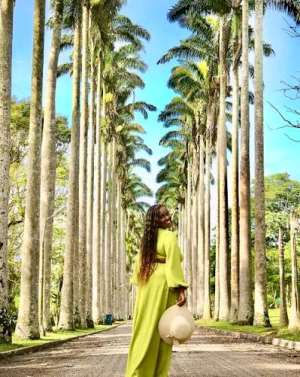
The Aburi Botanical Gardens remains one of Ghana’s most recognisable tourism and environmental assets, attracting tens of thousands of visitors each year. Yet, despite its popularity and revenue potential, an important question deserves greater attention: Is Ghana maximising the economic, tourism and conservation value of the Gardens?
In 2025, the historic facility recorded about 83,203 tourist visits, while the government is targeting approximately 195,000 visitors in 2026. If achieved, that would represent a significant increase in patronage and underline Aburi’s potential to become an even stronger contributor to Ghana’s domestic and international tourism industry.
Managed by the Department of Parks and Gardens, with support from institutions including the Ghana Tourism Authority, the Gardens have benefited from improvements over the years. Recent interventions have included the refurbishment of chalets, installation of streetlights, labelling of trees and improvements to revenue collection facilities.
These investments are important, but they should be viewed as the beginning rather than the end of efforts to transform Aburi into a world-class tourism destination.
Even using a conservative illustration of 300 visitors a day paying GH¢15 each, entrance fees alone could generate approximately GH¢1.64 million annually if that level of attendance were sustained throughout the year. At higher visitor numbers, the potential would be considerably greater.
More importantly, entrance fees represent only one possible revenue stream.
A properly developed botanical tourism destination can generate additional income from guided tours, restaurants and cafés, souvenir shops, parking, accommodation, conferences, weddings, photography, educational programmes, cultural events and carefully managed commercial concessions.
Aburi already has demonstrated demand. The Ghana Tourism Authority’s tourism statistics for 2023 placed the Gardens among the country’s most visited attractions, with about 78,870 visits recorded during the year.
The question, therefore, should no longer be whether people are interested in visiting Aburi. The challenge is how Ghana converts that interest into a sustainable tourism economy while protecting the ecological and historical character of the Gardens.
International experience provides useful lessons. Botanical gardens and nature attractions in countries such as South Africa, Rwanda, Kenya and Tanzania have increasingly become more than places where visitors simply walk among trees and plants. Many combine conservation with education, recreation, hospitality, research and commercial activities.
Aburi could adopt a similar approach without sacrificing its environmental significance.
Professionally organised guided tours could tell the stories behind its historic trees and rare plant species. Digital platforms and QR codes could allow visitors to access information about plants through their mobile phones. Educational programmes could attract schools, universities and researchers throughout the year.
There is also scope to explore environmentally responsible attractions, where appropriate, alongside improved restaurants, picnic facilities, children's recreational areas and well-managed event spaces.
Its proximity to Accra gives Aburi another major advantage. The Gardens can be marketed as part of a broader Accra-Aburi-Akuapem tourism circuit, encouraging visitors to spend more time and money within surrounding communities.
The economic opportunities should therefore extend beyond the gates of the Gardens. Local farmers, food vendors, artisans, tour operators, transport providers, hotels and small businesses could all benefit from increased visitor numbers.
However, commercialisation must not come at the expense of conservation.
The Gardens were established primarily as a botanical and scientific institution, and their environmental importance must remain central to any redevelopment strategy. Increased tourism should therefore generate the resources required to protect the very asset attracting visitors.
The ideal cycle should be straightforward:
Maintenance → Conservation → Infrastructure → Better Visitor Experience → Marketing → Increased Revenue → Reinvestment.
Without reinvestment, increased visitor numbers could instead place greater pressure on facilities, vegetation, sanitation, security and infrastructure.
Government itself has previously recognised the need for a more ambitious approach. In 2022, plans were discussed to use public-private partnership arrangements to rehabilitate and modernise the Aburi Botanical Gardens to international standards.
The bigger issue today is how quickly that vision can be translated into a sustainable business and conservation model.
There must also be greater public clarity about the economics of the facility. How much revenue does Aburi Botanical Gardens generate annually? What proportion comes from entrance fees, events, accommodation and other activities? How much of that revenue is retained or reinvested in the Gardens? And what is the long-term development plan?
These are legitimate questions because tourism assets require continuous investment.
Ghana cannot expect world-class tourism revenue from attractions that are managed primarily as gate-fee destinations. Visitors increasingly expect experiences — good sanitation, security, food, information, technology, entertainment, accessibility and memorable activities.
Aburi has many of the ingredients required to meet those expectations: history, natural beauty, favourable weather, proximity to Accra, strong name recognition and established visitor demand.
What is required is a deliberate strategy to turn those advantages into sustainable economic value.
If Ghana can grow annual visits towards 195,000 and beyond while increasing visitor spending and reinvesting a meaningful share of the proceeds into conservation and infrastructure, Aburi could become a model for how the country manages its tourism assets.
The objective should not simply be to count how many people enter the Gardens. Ghana should also measure how long visitors stay, how much they spend, how many jobs their visits create, how local communities benefit and how much revenue is reinvested in protecting the facility.
Aburi Botanical Gardens is already a national treasure. The challenge is to ensure that it also becomes a well-managed, financially sustainable and internationally competitive tourism destination.
Otherwise, Ghana risks continuing to celebrate the potential of tourism while failing to maximise the value of assets it already possesses.


 'Mahama will not sack appointees based on NPP’s claims' – Shamima Muslim
 UK king calls slavery 'monstrous injustice' as PM mulls apology
 Auditor to audit Auditor-General’s accounts
 Minority MPs walk out after Bagbin orders Abu Jinapor out of Parliament
 NPP's Kwadwo Poku calls for more TraffiTech-GH cameras at road intersections to ...
 Bawumia eyes 3R's Japanese tech that removes mercury, cleans soil and recycles w...
 'Our borders must command respect' – Osahen Afenyo-Markin on cocaine busts
 ‘Govt deeply involved in Beirut cocaine bust’ — Kofi Bentil reveals
 Ablakwa sues Benghazi, Media General over Fantana affair, corruption allegations
 Mahama instructs Finance Ministry to pay striking JUSAG members from November


