




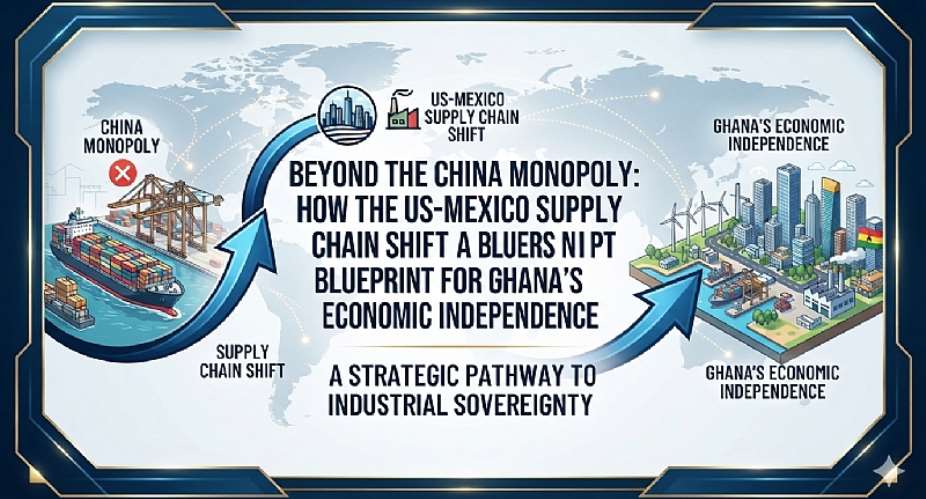
Breaking Foreign Dependencies through Strategic Nearshoring and Local Production.
"This article is structured and meticulously cited with current economic metrics."
As global economic superpowers quietly reshape their trade strategies, developing nations like Ghana stand at a critical crossroads. For decades, the world relied blindly on China as its primary factory. However, rising geopolitical friction, targeted industrial blockades, and strict export controls have forced the United States to pivot toward its own neighbors—sparking an unprecedented nearshoring boom in Mexico and Canada. This shift is not just an American story; it is a global masterclass in resource sovereignty and supply chain resilience.
For Ghana, a nation currently witnessing record-breaking performance in its extractive sector yet grappling with fundamental fiscal retention, this transformation provides a vital economic blueprint. To avoid becoming collateral damage in superpower trade wars, Ghana must urgently transition from a passive exporter of raw minerals into an active, regional manufacturing powerhouse.
Part 1: The Invisible Squeeze—Why Global Superpowers Cannot Simply "Cut Off" Trade
- The Refinement Monopoly: The primary barrier to decoupling trade from China is not raw mining volume, but midstream refinery dominance; China processes over 90% of the world's heavy rare-earth elements.
- The Substrate Chokepoint: Essential technologies—ranging from everyday consumer electronics and electric vehicle (EV) permanent magnets to advanced military guidance electronics—depend entirely on specific refined substrates like neodymium, dysprosium, and gallium.
- Pharmaceutical Vulnerability: Beyond advanced tech hardware, global healthcare systems remain deeply vulnerable, as a vast majority of the core active pharmaceutical ingredients (APIs) for generic antibiotics originate in Chinese chemical hubs.
- The Time and Capital Barrier: Constructing independent, vertically integrated processing infrastructure requires decades of specialized expertise and billions of dollars in state-backed capital, making a rapid trade break impossible without triggering hyperinflation.
Part 2: The Nearshoring Blueprint—How Mexico Capitalized on the Shift
- Exploiting Geopolitical Realignment: Rather than stopping trade entirely, the U.S. adopted a policy of "de-risking," which systematically moved sensitive hardware assembly pipelines away from East Asia and closer to home under the USMCA trade pact.
- Aggressive Infrastructure Upgrades: Mexico positioned its northern border cities as primary beneficiaries, capturing massive investments by aligning local logistics, customs workflows, and industrial parks directly with American manufacturing corridors.
- The High-Tech Assembly Transformation: By moving past simple manufacturing, Mexico catalyzed an immense high-tech boom; U.S. imports of Mexican assembled computer hardware surged by over 108% year-over-year, hitting $15 billion monthly.
- The Bilateral Resource Shield: Through their recent critical minerals action plan, Mexico successfully negotiated border-adjusted price floors and joint investment frameworks, protecting its domestic ecosystems from being undercut by state-subsidized foreign competitors.
Part 3: The Cold Hard Numbers—Ghana's Raw Export Reality
While global superpowers alter their industrial geometry, Ghana's macroeconomic indicators reflect an extraction landscape of unprecedented proportions. However, an analysis of the structural composition of these values reveals that Ghana continues to fall into the classic raw commodity trap.
- The Staggering Gold Paradox: Backed by historically high global commodity prices, Ghana’s gold export earnings soared to a record $20.98 billion. This massive figure represents a 103.3% near-doubling from the $10.31 billion recorded previously. Yet, the Institute for Fiscal Studies (IFS) explicitly warns that while export values doubled, state mineral royalties only grew by a modest 21%—climbing from $364 million to just $441 million.
- The Rise of Small-Scale Producers: In an unprecedented historical shift, small-scale and artisanal miners extracted 3.11 million ounces of gold. This alone accounted for $10.8 billion (or 51.5%) of national gold export revenue, surpassing large-scale mining multinationals for the first time in over a century. Shockingly, data from the Minerals Income Investment Fund (MIIF) indicates that the royalties collected came entirely from large-scale mines, exposing massive regulatory and revenue leakages from local extraction.
- The Heavy Volume, Low Value Baseline: Beyond precious metals, Ghana continues to push vast physical volumes of bulk minerals with little local processing. The country's projected industrial mineral output includes 5.0 to 6.0 million tonnes of manganese and 2.5 to 3.0 million tonnes of bauxite. These unrefined, raw shipments yield minimal fiscal margins compared to their eventual refined values on international markets.
- The Critical Frontier—The Lithium Race: With the official ratification of the Ewoyaa Lithium Project granting a 15-year mining right to Atlantic Lithium, Ghana has entered the global critical minerals race. The state secured a 13% free-carried equity stake and a 5% to 12% sliding royalty regime. Yet, if this lithium leaves the shores of Takoradi as raw spodumene concentrate rather than refined, battery-grade lithium hydroxide, Ghana will simply replicate its gold vulnerabilities in the green energy transition.
Part 4: Sovereign Security—The Rebuild of Advanced Technology Inside the U.S.
- Eliminating Midstream Bottlenecks: The U.S. Department of Defense is heavily subsidizing native mining firms like MP Materials to expand their operations past raw ore extraction into downstream chemical separation and finished magnet fabrication.
- Prioritizing Strategic Industries: Early output from these domestic refineries is strictly ringside-fenced and prioritized for national security sectors, including Unmanned Aerial Systems (UAS), precision-guided munitions, and aerospace radar arrays.
- Strict Domestic Resource Rules: To protect nascent local supply loops, new export controls legally restrict the outward shipment of manufacturing scrap and recycled battery "black mass," ensuring essential industrial materials remain inside the country.
- The Ultimate Corporate Trade-Off: This ongoing transition highlights a critical reality: while decoupling creates sovereign industrial security, it forces companies to navigate highly volatile component costs and strict, multi-tiered compliance audits.
Part 5: Actionable Recommendations and Suggestions for Ghana
- Enforce Strict Local Value-Addition Timelines: Government must aggressively implement its phased ban on unprocessed mineral exports. To protect the domestic economy from revenue drops, Ghana must establish operational refinery mandates, guaranteeing that no gold, lithium, or bauxite can leave the country past designated deadlines unless it has undergone a specified percentage of local upgrading.
- Formalize and Collect from the Artisanal Sector: Following the warnings from the IFS, the Ministry of Lands and Natural Resources and the Ghana Gold Board must urgently build a comprehensive fiscal infrastructure to capture fair returns from the small-scale sector. This requires formalizing artisanal supply lines, eradicating illicit smuggling syndicates, and linking small-scale output directly to domestic goldsmithing and local industrial centers.
- Establish Targeted Eco-Industrial and Refining Free Zones: Partner with global infrastructure developers to build high-capacity industrial hubs along key logistics paths (like the Tema or Takoradi ports). These zones must be supported by dedicated, cost-competitive green energy grids and specific tax incentives to directly attract midstream chemical refiners and electronic component assemblers.
- Leverage regional value chains via the AfCFTA: Ghana must move past individual resource policies. By using the framework of the African Continental Free Trade Area (AfCFTA), Ghana can lead cross-border action plans—such as combining its domestic bauxite and lithium with regional manufacturing components—to build localized automotive electronics and battery assembly factories for the wider African market.
- Mandate Specialized Engineering and Technical Skilling: The state should fund advanced chemical engineering and metallurgical training programs across public universities. Aligning academic research with practical processing requirements ensures that Ghanaian engineers can directly operate automated refineries, midstream separation plants, and high-tech quality compliance centers.
The rapid transformation of U.S.-Mexico trade dynamics proves that geographical size and historical patterns do not permanently dictate an economy's destiny. True national sovereignty is won or lost in the midstream links of the global supply chain—in the refineries, precision assembly lines, and high-tech packaging plants. Ghana’s historic record of $20.98 billion in gold exports demonstrates the vastness of its natural endowment, but the concurrent revenue lag proves that volume without value-retention is a losing strategy.
Ghana can no longer afford to sit comfortably at the bottom of the value curve as a passive provider of raw, unrefined earth. By taking proactive cues from international nearshoring trends, enforcing strict local transformation rules, and leveraging regional trade agreements like the AfCFTA, Ghana can intentionally transform its economic architecture. The window of opportunity to capture diversifying global capital is open now; Ghana must build its own industrial engines today, or remain permanently dependent on the manufacturing choices of foreign superpowers tomorrow.
✍️ Submitted by:
Retired Senior Citizen
For and on behalf of all Senior Citizens of the Republic of Ghana 🇬🇭
Teshie-Nungua
[email protected]


 Ghana's missing billions: What 16 years of Auditor-General reports show
 'Go ahead and imprison me because of my friendship with Bawumia, I will come bac...
 Prayer must not replace action and accountability in GoldBod debate — Karbo to D...
 'NPP will win 2028 elections if we are united' – Bawumia
 Health Minister cautions Boards against interfering in day-to-day management
 President Mahama wants Ghana where no woman dies giving birth – Deputy Health Mi...
 One dead after tanker and Toyota Voxy collide on Kasoa-Winneba road
 20-year-old man drowns while crossing Ghana-Togo border river in Tempane
 Ghana’s currency is long overdue for security refresh to curb counterfeiting — M...
 Declining enrolment, poor infrastructure justified 70-year-old Tendamba School d...

