




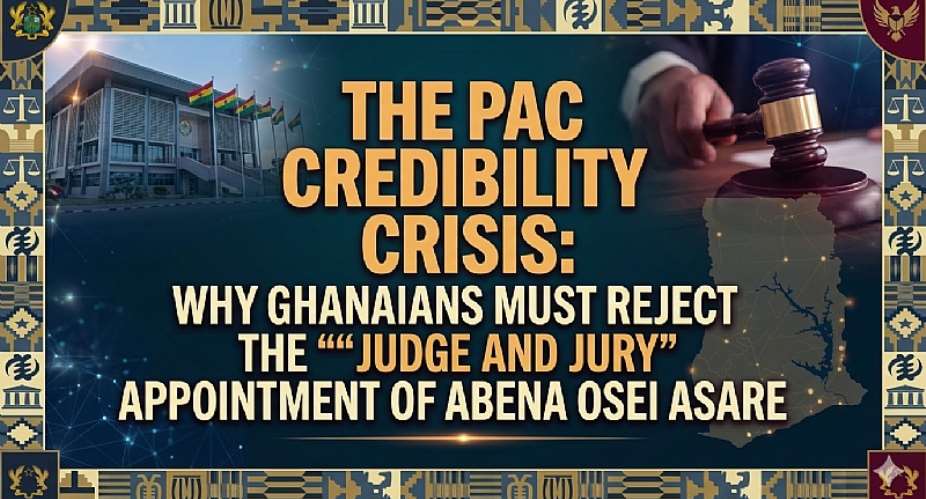
In the architecture of Ghana's democratic governance, the Public Accounts Committee (PAC) stands as the ultimate shield for the taxpayer. It is the sacred chamber where transparency is enforced, public officers are held to account, and the Auditor-General’s reports are meticulously cross-examined. However, the integrity of this vital oversight institution faces an unprecedented threat that has triggered a strong, abhorrent, and highly apprehensive movement across the country.
The appointment of Hon. Abena Osei Asare, the Member of Parliament for Atiwa East, to chair the PAC has sparked justified outrage and fierce resistance. For eight agonizing years, Mrs. Osei Asare served as the Deputy Finance Minister under Ken Ofori-Atta in the Akufo-Addo administration. To place her at the head of a committee tasked with investigating the very financial transactions, procurement irregularities, and economic policies she oversaw is a textbook definition of a conflict of interest. It is an insult to the collective intelligence of Ghanaians to have the co-architect of our fiscal management sitting as the judge and jury over her own legacy. This appointment must be vehemently opposed by every well-meaning citizen who demands genuine accountability.
Powerful Reasons to Oppose the Appointment
- A Flawed System of "Self-Grading": A student cannot sit in an exam room, write their papers, and subsequently pick up the red pen to grade their own performance. The majority of the state institutions, ministries, and financial reports currently appearing before the PAC date back to her active tenure at the Ministry of Finance.
- Undermining Parliamentary Integrity: The PAC derives its authority from public trust. Having a former executive actor who approved, disbursed, and managed these state funds lead the committee completely erodes the dignity of Parliament, making public hearings look like a choreographed whitewashing exercise.
- The Witness Seat vs. The Gavel: Major controversial financial irregularities occurred directly under her ministerial watch. She belongs in the witness seat answering tough, uncompromising questions from the committee regarding her eight years in the executive branch, rather than holding the parliamentary gavel.
- Severe Scandals Under Investigation: Her tenure is directly tied to highly scrutinized state transactions, including the Strategic Mobilization Limited (SML) contract, the ECG-Beijing Jao agreement, and the Service Ghana Auto ambulance procurement. These massive controversies are under active investigation by the Office of the Special Prosecutor (OSP), yet she remains positioned to oversee public accounts related to them.
- Ineffectiveness of Temporary Recusals: While parliamentary defenders point to standing orders that allow her to temporarily cede the chair to a Ranking Member during Ministry of Finance queries, this piecemeal approach fails completely. The Ministry of Finance’s footprints are embedded in almost every single state institution's budget, rendering partial recusals logistically ineffective and morally bankrupt.
- A Culture of Protected Impunity: Allowing political actors to glide seamlessly from executive management to legislative oversight establishes a dangerous precedent where politicians protect their own, leaving the public to shoulder billions in unrecovered financial leaks.
Practical Recommendations and Suggestions
- Citizen Petitions and Mobilization: Civil society organizations (CSOs), political activists, and ordinary citizens must amplify the formal petitions already sent to the Speaker of Parliament, Rt. Hon. Alban Bagbin, demanding her immediate and complete removal from the PAC leadership.
- The Speaker's Direct Intervention: The Speaker must exercise his structural influence to protect the dignity of the house by advising the leadership of the respective caucus to withdraw her and select a non-conflicted member.
- Legislative Amendment of PAC Rules: Parliament must permanently amend its standing orders to explicitly bar any Member of Parliament who served as a substantive Minister, Minister of State, or Deputy Minister within an administration from chairing the PAC for at least five years after leaving executive office.
- Opposition and Independent MP Boycotts: If the appointment is forced through, independent and conscientious Minority MPs on the committee must consider boycotting sessions presided over by a conflicted chairperson to deny the proceedings artificial legitimacy.
Ghana’s democracy cannot survive on a foundation of compromised oversight. The persistent economic hardship suffered by everyday citizens is the direct result of loose financial monitoring, unexamined state procurement, and a refusal to enforce consequences. To allow Hon. Abena Osei Asare to steer the PAC is to reduce state accountability to a political theatrical performance.
The public consensus remains intensely divided, but for those who value accountability, the line is clear: we cannot allow those who presided over financial irregularities to sit in judgment over them. It is time for Ghanaians to rise above partisan lines, sound the alarm on the Modern Ghana platform and beyond, and demand a completely independent chairperson who owes allegiance only to the public purse.
✍️ Submitted by:
Retired Senior Citizen
For and on behalf of all Senior Citizens of the Republic of Ghana 🇬🇭
Teshie-Nungua
[email protected]


 Okoe Boye wins NPP Greater Accra Regional Chairmanship election
 Bagré dam nears spillway threshold as water level rises to 77.35%
 Sunyani Paramount Chief warns chiefs against sale of cemetery lands
 President Mahama announces US$10bn ‘New Economy’ investment programme
 Sustained peace will restore Bawku to its former glory – Mahama
 Plans advanced for University of Science and Technology in Damongo – Haruna Iddr...
 Inmate Peter Kyeremeh escapes from prison
 COKA floors Kokofu to win NPP Ashanti Regional chairmanship
 Abronye retains Bono NPP Chairmanship in Regional Executive Elections
 I accept responsibility for NPP’s poor performance in Greater Accra Region – Out...

