




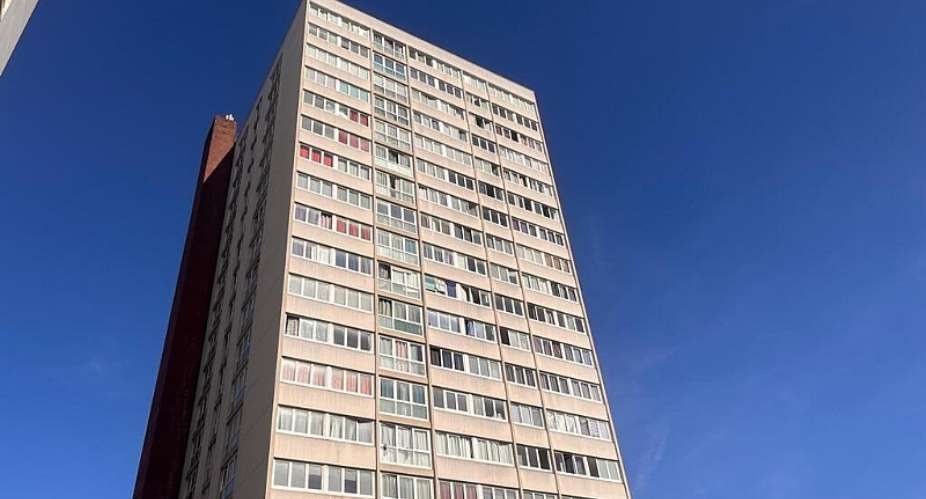
Nadia lives in the town of Aubervilliers, just north of Paris.
At noon, she returns from her night shift at the hospital. Upon arriving at her apartment building, in a public housing complex built in the 1970s, she takes the only one of the four lifts still in service.
As she opens the door to her apartment, the heat that escapes is in stark contrast to the relative cool of the hallway. All the windows in Nadia's apartment face the street and, she tells RFI: "The sun beats down from 7am until 7pm."
As France experiences its fifth heatwave since May, the situation is becoming particularly difficult for people like Nadia, who live in urban heat islands like Aubervilliers, Saint-Denis and La Courneuve – all commuter towns just outside Paris.
In these densely built-up neighbourhoods, characterised by concrete surfaces and a lack of vegetation and green spaces, asphalt absorbs sunlight during the day and traps heat, which is then slowly released after nightfall.
Consequently, nighttime temperatures in these areas can remain high, while daytime heat is intensified. In Aubervilliers, after sunset, temperatures are up to four degrees higher than in neighbouring areas with lower building density. A pharmacy sign displays a temperature of 46.5 degrees Celsius on a Paris street on 25 June.
"I only have my lined curtains. There are no blinds, no shutters. In the morning, it's already 27 degrees inside my place," says Nadia.
Her 45-year-old neighbour, Afida, dreams of moving. "We feel trapped," she says. "Luckily, I have air conditioning – one of my neighbours gave it to me after seeing that the place was an oven."
While some people take advantage of the summer to escape the intense heat by leaving town, a lack of means confines many to the neighbourhood – and their homes, many of them in social housing that is rarely suited to such high temperatures.
What does 50C feel like? Touring 'heat chamber' allows French people to find out
"I come from a hot country, but I can't stand the heat [here]," remarks Nadia. "In Guadeloupe, you can create a cross-breeze in the apartments, or take shelter under a tree."
"We used to have a green space right downstairs," Afida adds. "I didn't understand why they tore it all out to give us a concrete area instead. Mothers can't sit down, kids can't play."
Building materials
France's national weather service Météo France has studied the phenomenon of urban heat islands in 42 French cities, with Paris at the top of the list.
On average, temperatures in the city are 4 to 5 degrees higher than in the surrounding countryside, and in some neighbourhoods the difference can be up to 10 degrees, according to its study.
From food to transport, how cities are rewriting the climate playbook
"It really comes down to materials," Sylvain Mondon, director of Météo-France for the Île-de-France region, told RFI.
"It is mineral materials – stone, concrete, asphalt – that heat up and stay hot for a long time, unlike trees. Trees get hot while exposed to sunlight, but as soon as the sun is gone, the temperature of the wood or vegetation drops rapidly."
The city absorbs heat from the sun's rays during the day – as well as heat from car engines and industry – and does not cool down once night falls. Once the temperature at night exceeds a certain threshold – around 20°C – the term "tropical night" is used.
While sensitivity to these tropical nights varies between individuals, they pose a health risk.
"The body fails to recover, and with a succession of hot nights – exacerbated by urban heat islands – people become fatigued or even physically exhausted, potentially leading to emergency room visits," warns Mondon.
In Europe, more than 200,000 people have died as a result of the heat in the last four years, according to the World Health Organization.
Re-greening cities
Experts warn that adaptation is crucial, as heatwaves become more frequent and intense due to global warming.
Air conditioning is not necessarily the solution – at least not everywhere, as air conditioners expel heat outdoors, exacerbating the urban heat island effect.
Mondon says various other solutions exist, depending on the climate and the city.
"In a public square, you can remove the asphalt or stone paving and plant trees" for the shade and cooling moisture they provide. "Doing so can lower the temperature by five to six degrees," he says. The "urban forest" being planted in front of Paris City Hall, 19 April, 2025.
In June 2025, Paris city council unveiled a mini forest in front of its Town Hall as part of its "Paris 50 Degrees" plan to combat the effects of urban heat islands – in reference to the temperature that could be reached in the French capital within just 25 years, according to scientists.
"I think we're already seeing temperatures four to eight degrees lower thanks to these first trees that have been planted," said Christophe Najdovski, former Paris deputy mayor in charge of greening, who said three more mini forests were due to be planted.
More than 40,000 trees have been planted or replanted in Paris over the past five years under the council's greening plan.
This article has been adapted from the original version by RFI's French service.


 'God will deal with all those pushing for Mahama's third term; they want to dest...
 NPP regional elections: 'It's a family affair, no violence' – Afenyo-Markin tell...
 COKA joins NPP women to fry eggs at Ashanti regional election centre
 I accept responsibility for NPP’s poor performance in Greater Accra Region – Out...
 NPP Upper West regional elections disrupted as Nandom delegates interrupt voting
 'Our election 2028 victory largely depends on candidates you are about to pick t...
 NPP regional executive elections underway nationwide
 NPP Accra Chairman Election: ‘I'll be a servant, not a boss' — Okoe Boye rejects...
 NPP Northern Regional elections: ‘No one can bribe or influence us’ – Election C...
 GRIDCo announces power interruption in parts of Accra for emergency transmission...

