




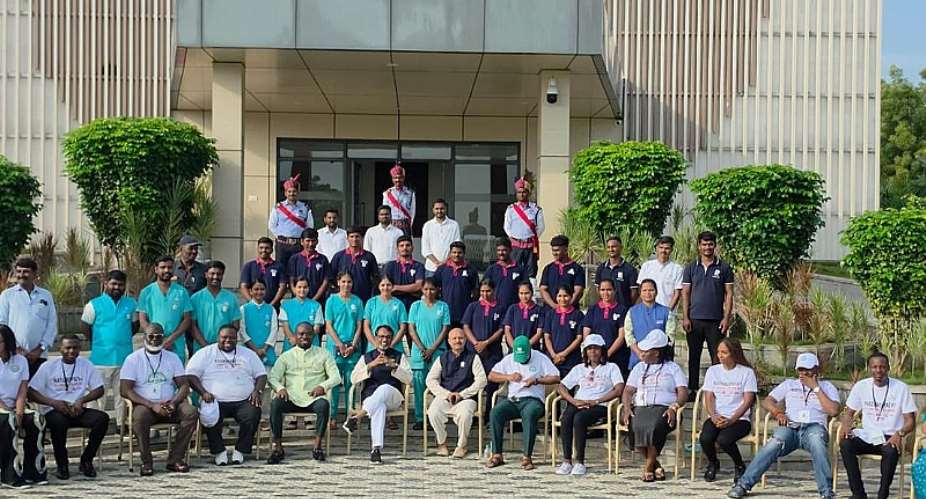
KALABURAGI, INDIA — August 15, 2026: As India celebrates its Independence Day, a group of Ghanaian naturopaths undergoing clinical training in Karnataka has used the historic occasion to make what they describe as a symbolic “Declaration of African Naturopathic Independence and Development,” signalling a new phase in the professionalisation, education and international development of naturopathy in Africa.
The declaration comes during the historic hosting of 16 Ghanaian naturopaths from Nyarkotey College of Holistic Medicine, Ghana, by Arujiva Ayurveda and Naturopathy Hospital in Kalaburagi, Karnataka, India, for an intensive clinical training and educational exchange programme.
The Ghanaian delegation is led by Prof. Raphael Nyarkotey Obu, President of Nyarkotey College of Holistic Medicine and founding President of the African Naturopathic Federation (ANF).
The programme represents an important milestone because it brings a Ghanaian cohort of trained naturopaths to India for structured clinical exposure involving naturopathy, Ayurveda, Yoga, nutrition and integrative healthcare.
For the delegation, the programme goes beyond an international study visit. It represents a deliberate effort to strengthen an emerging African model of naturopathic education and practice through clinical exposure, competency development, international collaboration and respect for Africa's own indigenous healing knowledge.
A Historic Ghana–India Naturopathy Connection
India occupies a unique position in the global development of traditional and complementary medicine. Indigenous systems of healthcare have been institutionalised within education, clinical practice, research and public policy, providing important lessons for African countries seeking appropriate pathways for developing their own traditional and complementary healthcare professions.
The hosting of the Ghanaian naturopaths by Arujiva Ayurveda and Naturopathy Hospital therefore represents a new chapter in Ghana–India cooperation in traditional, complementary and integrative healthcare.
During their stay in India, the practitioners are being exposed to theoretical and practical aspects of naturopathy, Ayurveda, Yoga, nutrition and integrative clinical practice. Their programme includes clinical observation and assessment as well as exposure to therapies such as hydrotherapy, mud therapy, fasting approaches, dietary interventions and other natural healthcare modalities.
The programme has also subjected the Ghanaian practitioners to assessments intended to evaluate the knowledge and competencies acquired during the training.
This makes the visit significant not merely as educational tourism, but as a structured attempt to bridge classroom education, professional practice and international clinical exposure.
Why This Matters to Ghana
The India programme comes at a critical period in the development of naturopathy in Ghana.
Ghana has witnessed growing interest in naturopathy, herbal medicine and other complementary healthcare practices. However, the long-term development of the profession requires stronger educational standards, clinical competencies, research, professional ethics and appropriate regulatory frameworks.
Nyarkotey College of Holistic Medicine has been involved in efforts to develop formal competency standards for naturopathy and holistic medicine in Ghana. The India programme provides another dimension by exposing practitioners to a country where traditional systems of healthcare have developed substantial educational and institutional structures.
For Ghana, therefore, the significance of the programme lies in the possibility of translating international exposure into improved clinical education, stronger professional standards, research collaborations and culturally appropriate naturopathic practice.
It could also strengthen the case for African practitioners to receive advanced clinical exposure without abandoning the cultural and therapeutic knowledge found within their own societies.
African Naturopathic Independence Declared in India
One of the most symbolic moments of the visit occurred when the Ghanaian delegation visited a site associated with India's national history and reflected on the meaning of independence for the development of African naturopathy.
The delegation subsequently adopted the language of “African Naturopathic Independence” to describe a new intellectual and professional direction for naturopathy on the continent.
The declaration does not imply separation from international naturopathy. Rather, it represents a call for African naturopathy to move beyond the wholesale imitation of foreign models and develop an identity that combines internationally accepted naturopathic principles with African realities, indigenous knowledge, scientific evidence, competency-based education and appropriate legal regulation.
Prof. Nyarkotey explained that Africa can learn significantly from India's experience.
“India achieved political independence and has continued to demonstrate confidence in its indigenous knowledge systems. Africa must equally develop the confidence to research, standardise, teach and professionalise its own natural and traditional healthcare knowledge. African naturopathy must learn globally but develop locally.”
According to the delegation, African Naturopathic Independence should therefore be understood as independence in education, scholarship, research, clinical development, professional identity and policy thinking.
From Imported Naturopathy to an African Model
Historically, much of formal naturopathic education available to African practitioners has been influenced by European and North American models. These traditions have made important contributions to modern naturopathic philosophy and education, but African practitioners operate within a different cultural, epidemiological, economic and healthcare environment.
The emerging African naturopathic movement is consequently seeking to contextualise the profession.
An African model could incorporate evidence-informed natural medicine, nutrition, lifestyle medicine, hydrotherapy, physical modalities and other established naturopathic approaches while scientifically investigating relevant African medicinal plants, indigenous dietary practices and traditional health knowledge.
The objective is not to replace conventional medicine or traditional African medicine. Rather, proponents envision a professionally educated naturopathic discipline capable of operating responsibly within pluralistic African healthcare systems and collaborating appropriately with other health professions.
India as an Important Lesson for Africa
The timing of the declaration on India's Independence Day, August 15, gives the initiative additional symbolic significance.
India's experience demonstrates how indigenous knowledge can form part of national development when supported by institutions, education, research and policy.
For the Ghanaian delegation, India's experience raises an important question: if countries such as India can preserve and systematically develop indigenous healthcare traditions while participating in modern medical science, why should Africa not invest more seriously in researching and developing its own knowledge systems?
African naturopathic independence therefore calls for African universities, professional bodies, governments, researchers and practitioners to become producers of knowledge rather than merely consumers of theories and curricula developed elsewhere.
It also calls for greater African participation in naturopathic research so that clinical practice on the continent can increasingly be informed by evidence generated from African populations and healthcare environments.
A Continental Vision
The significance of the India programme extends beyond Ghana.
The formation of the African Naturopathic Federation has provided a continental platform for conversations about educational standards, professional competencies, research, ethics, policy and the future recognition of naturopathy across Africa.
The experiences gained from the Ghana–India clinical programme could therefore contribute to wider discussions on how African naturopathic education should evolve.
The long-term vision is an African naturopathic profession that is academically credible, clinically competent, ethically responsible, scientifically engaged and culturally relevant.
Such a profession would also require collaboration rather than isolation. Partnerships with institutions in India and other countries could provide important opportunities for faculty development, student exchanges, research, clinical training and comparative studies.
African naturopathic independence, therefore, should not mean closing Africa to the world. It means entering global naturopathy with a distinctive African contribution.
Ghanaian Naturopaths Making History
For the 16 Ghanaian practitioners currently in Kalaburagi, the significance of their journey may ultimately extend beyond the certificates and clinical experiences they acquire.
They represent an emerging generation of African naturopaths seeking stronger clinical education and international exposure while participating in the construction of a professional identity for naturopathy on the continent.
Their presence at Arujiva Ayurveda and Naturopathy Hospital is being celebrated by the delegation as a historic milestone in Ghanaian naturopathic education and a demonstration of what international institutional partnerships can achieve.
It is also a reminder that the future of African naturopathy will depend not simply on recognition, but on the quality of its practitioners, educational institutions, research, ethical standards and clinical training.
Independence Must Produce Development
The declaration in India therefore carries a second and perhaps more important word: development.
Independence without educational development, research capacity, clinical competence and credible institutions would have little practical meaning.
The African naturopathic movement must consequently invest in textbooks written from African perspectives, peer-reviewed research, competency-based curricula, clinical training centres, professional examinations, ethical frameworks and appropriate legislation.
It must also encourage collaboration between naturopaths, traditional medicine practitioners, biomedical professionals, universities, scientists, policymakers and legal experts.
The ultimate measure of African naturopathic independence will not be slogans or ceremonies. It will be whether Africa can build safe, credible and sustainable institutions capable of training practitioners who contribute meaningfully to healthcare.
A New Chapter Begins in India
As India marks another anniversary of independence, the Ghanaian delegation's declaration provides a striking intersection between India's national history and Africa's emerging naturopathic journey.
For India, August 15 commemorates freedom and national self-determination.
For the Ghanaian naturopaths currently studying in Kalaburagi, August 15, 2026, may also be remembered as the day they publicly articulated a vision of African naturopathic independence — an Africa that learns from India and the rest of the world but increasingly develops its own educational, clinical, research and regulatory pathways.
The historic clinical training at Arujiva Ayurveda and Naturopathy Hospital could therefore represent more than the first chapter of a Ghana–India naturopathic partnership.
It may be remembered as one of the moments when a new generation declared that African naturopathy must no longer merely participate in the global naturopathic movement — Africa must also help shape its future.
Happy Independence Day to India.
And from India, a new call has emerged: African Naturopathic Independence, Development and Global Collaboration.
 Trump says record Navy deployment in Iran operations 'not nearly long enough'
 Cambridge’s Youngest Black Professor Jason Arday Found Dead Days After Resignati...
 Govt disburses GH¢23.1 billion to clear road contractors' arrears - Roads Minist...
 Mahama commissions Paga SHS E-Block
 Ghana to expand pharmaceutical manufacturing capacity - Mahama
 Wiawso College of Education student produces raincoat and umbrella from empt wat...
 We will hold referendum on proposed constitutional amendments in 2027 - Mahama
 Roads Minister announces 267km of road projects for Upper East Region
 Feed Ghana Programme drives sharp fall in food inflation to 2.2% — Agric Ministe...
 Government to establish Ghana Scholarships Authority to improve scholarship admi...

