




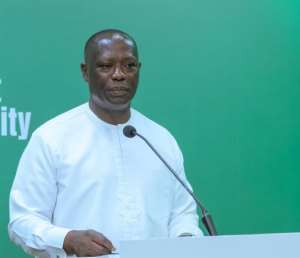
Minister for Lands and Natural Resources Emmanuel Armah Kofi Buah has mounted a forceful defence of regulatory action against Adamus Resources, insisting that no mining company should be allowed to operate as though it is more powerful than the Ghanaianstate.
Kofi Buah said the action followed regulatory findings which, according to him, raised serious concerns about mining without the required permits, alleged involvement of unauthorisedoperators, non cooperation with investigations and other statutory obligations.
He made the disclosures duringa strategic working visit and policy dialoguebetween the Ministry of Lands and Natural Resources and the IMANI Centre for Policy and Education in Accra.
The engagement followedan August 10, 2026 requestby IMANI for a fact finding dialogue on the Ministry’s inherited baseline, policy direction, operational challenges, reforms and performance.
Present at the meetingwere Kofi Buah,senior officials of the Ministryand representatives of agencies under it, including the Minerals Commission, Forestry Commission, Lands Commission and Ghana Geological Survey Authority.
The IMANI delegation was led by Franklin Cudjoe, Founding President and CEO of IMANI, and included SelormBranttie, Vice Presidentfor Strategy; Kay Codjoe, writer and IMANI associate; and Ransford Brobbey, IMANI associate.
Addressing what he described as a current issue involving AdamusResources, Kofi Buah saidthe Minerals Commission had an obligation to act as regulator of the miningindustry and could not ignore serious breaches reported by its inspectors.
“We have a country. We have institutions. The MineralsCommission is supposedto be the policeman in the industry,” he said.
According to the Minister, concerns were first raised through a report by the Chief Inspector of Mines in the region, after which a separate team from Accra was sent to independently verify the findings.
Kofi Buah said the secondassessment found the situation to be even more serious.
He allegedthat some miningactivities had taken place without the necessary permitsand further claimed that areas had been given to persons operating illegally.
The Minister argued that if peoplefound mining unlawfully were subsequently claimed by a licensed company as persons workingon its behalf, the distinction between such activityand the illegal mining government was fighting became difficult to defend.
“If you do not have that permit,you are illegal,” he said in substance.
He added that the company had, inhis account, failed to fully cooperate with committees established to investigate the matter and had not provided all information requested by regulatory authorities.
Kofi Buah arguedthat government couldnot prosecute smallscale illegal minerswhile appearing reluctant to act when alleged breaches involved a major mining company.
“If we are prosecuting the small guys for committing some acts, everybody must respect the institutions,” he said.
The Ministeralso said the investigation subsequently raised broader questions beyond the original environmental and operational concerns.
He referred to issues involving taxes, royalties, annual statutory fees and financial obligations involving government institutions, although the meeting did not provide the underlying documents or detailedamounts necessary to independently establish each claim.
Kofi Buah maintained that the decisionstaken by the Ministry and regulators were justified.
“As we speak today, I am convinced I made the right decisions,” he said.
He nevertheless acknowledged that institutions with lawful authority to review the Ministry’s decisions could reach a different conclusion and said government would cooperate with any such process.
The discussion, however, also produceda significant intervention from IMANI on how the dispute could proceed.
Franklin Cudjoe urged the Minister to consider offering Adamus Resources a final pathway throughwhich the companycould be shepherded by the Ministryto correct identified breaches and do what is required under any future agreement.
Cudjoe’s positionwas that strong regulation and investor protection need not be mutually exclusive.
He stressed that where an investor is prepared to remedy identified breaches and comply with the law, the State should retain room for constructive engagement rather than automatically closing the door.
Cudjoe also emphasised that Ghanaian investors in themining industry deservethe same level of institutional protection, fairness and opportunity to regularise their operations that the country would ordinarily extend to foreign investors.
The intervention placed another issue at the centre of the Adamus dispute:whether Ghana’s regulatory system can simultaneously enforce its mining laws firmly while providing predictable and equitable treatment for both local and foreign capital.
Kofi Buah responded positively to the proposal.
He said the Ministrywould be willingto engage where the companydemonstrated a genuine willingness to make the necessary corrections and ensure that the problems identified by regulators did not recur.
In essence, the Minister maintained the legitimacy of the regulatory action while leavingopen a potential route towards compliance.
The Adamuscontroversy therefore presentsa wider test of regulatory credibility.
If the Ministry’s allegations are supported by theunderlying regulatory records,the case could demonstrate whether Ghana is prepared to apply mining laws equally to small operators and major companies.
But fairnessmust operate in both directions.
A company accused of regulatory breaches must be required to answer those allegations, while legitimate investors, particularly Ghanaian investors, should also be assured that enforcement will be predictable, proportionate and accompanied by a reasonable opportunity to correct remediable breaches.
The allegations remain the Minister’s account of the regulatory disputeand require a substantive response from Adamus Resources.
For the full publicrecord, the companyshould be asked to respond specifically to claims concerning permits, alleged unauthorised mining activity, cooperation with regulatory investigations, taxes, royalties, statutory fees and any financial obligations cited by the Minister.
The core principle articulated by Kofi Buah was unmistakable:
A mining licence does not placea company above the regulator, and the size of an investor should not determine whether Ghana’s mining laws are enforced.
But the intervention from IMANI added an equally important qualification:
No mining company should be bigger than Ghana, but Ghana must also ensure that its regulatory power protectslegitimate local investors with the same seriousness it extends to foreign capital.
Kay Codjoe, IMANI Associate

 Trump says record Navy deployment in Iran operations 'not nearly long enough'
 Cambridge’s Youngest Black Professor Jason Arday Found Dead Days After Resignati...
 Govt disburses GH¢23.1 billion to clear road contractors' arrears - Roads Minist...
 Mahama commissions Paga SHS E-Block
 Ghana to expand pharmaceutical manufacturing capacity - Mahama
 Wiawso College of Education student produces raincoat and umbrella from empt wat...
 We will hold referendum on proposed constitutional amendments in 2027 - Mahama
 Roads Minister announces 267km of road projects for Upper East Region
 Feed Ghana Programme drives sharp fall in food inflation to 2.2% — Agric Ministe...
 Government to establish Ghana Scholarships Authority to improve scholarship admi...

