




Ghana has spent years defending VALCO as a strategicnational asset. The uncomfortable question now is whether the country is protecting the company or merely preserving its ownership while the asset deteriorates.
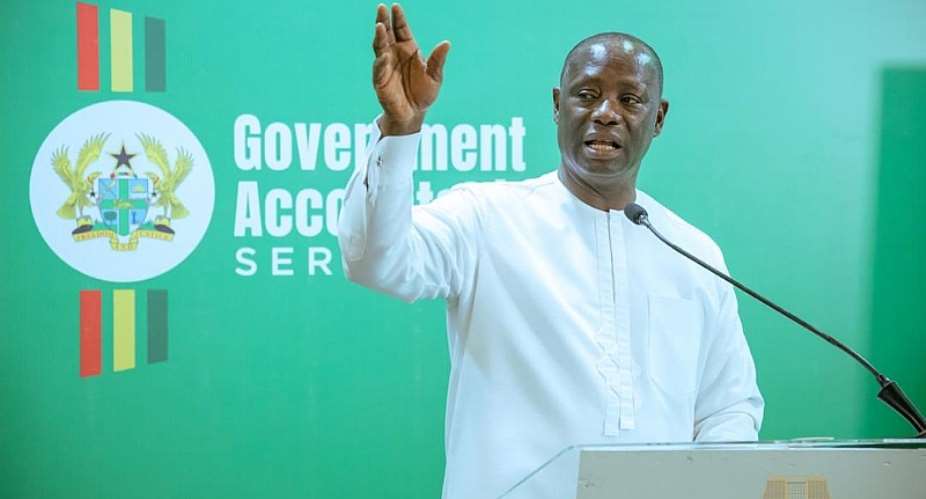
Minister for Lands and Natural Resources Emmanuel Armah Kofi Buah says the current situation cannot continue, warning that VALCO is operating far below its potential while the state carries costs it cannot indefinitely sustain.
His prescription is a strategic investor.
Kofi Buah says government intends to press ahead with efforts to attract capital capable of rehabilitating VALCO’s production capacity and restoring the smelter to a meaningful position within Ghana’s long promised integrated aluminium industry.
“It is bleeding,it is bleeding,” the Minister told a policyengagement in Accra, arguing that sentiment about state ownership cannot become a substitute for making the company productive.
The comments were made during a strategic working visit and policydialogue between the Ministry of Lands and Natural Resources and the IMANI Centre for Policy and Education, where the Minister and senior officials presented the state of Ghana’s lands, mining, forestry and mineral development sectors.
The engagement followed an August 10, 2026 request by IMANI for a fact finding dialogue covering the Ministry’s inheritedbaseline, performance, operational challenges, reforms and major policy interventions.
Present at the meetingwere Kofi Buah,senior officials of the Ministryand representatives of agencies under it, including the Minerals Commission, Forestry Commission, Lands Commission and Ghana Geological Survey Authority.
The IMANI delegation was led by Franklin Cudjoe, Founding President and CEO of IMANI, and includedSelorm Branttie, Vice President for Strategy; Kay Codjoe, writer and IMANI associate; and Ransford Brobbey, IMANI associate.
Kofi Buah told the meeting that VALCO still possesses enormousindustrial potential but is operating far below what its infrastructure was designed to deliver.
He referredto the smelter’s five potlines, noting that only a fraction of the facility’s capacity was currently functioning.
The Minister argued that the central government does not have unlimited fiscal space to continue injecting the capital necessary to rehabilitate the company whilesimultaneously carrying the consequences of inefficient operations.
His conclusion was unusually direct.
“You need to find a strategicinvestor.”
Kofi Buah said the alternative was to preservea state assetin name while allowing its productive capacity to deteriorate.
The Minister challenged what he described as an emotional attachment to maintaining the existing ownership and operating arrangement simply because VALCO is a state company.
In his view, the more importantconsideration should be whetherthe asset is producing enough value for Ghana.
That raisesa larger politicaleconomy question.
At what point does defending state ownership stop being economicpatriotism and become expensive sentiment?
VALCO occupiesan important place in Ghana’slong standing ambition to move from exporting raw bauxite towards an integrated aluminium industry.
The Ministry’s broaderstrategy is to align thecountry’s bauxite resources, GIADEC and downstream processing so Ghana captures more value from its minerals rather than remaining principally an exporter of raw materials.
Within that chain, a functioning aluminium smelter becomescritical.
Kofi Buah argued that reviving VALCO could createsignificantly more employment and economic activity than preserving a severely constrained operation.
He suggested that restoring more of the potlines alone could dramatically change the productive capacity and commercial outlook of the facility.
The Ministeralso described resistance that has sometimesaccompanied attempts to introduce prospective investors or partners to the company.
He recounted an occasion when a groupintended merely to visit and inspect the facility encountered opposition from workers.
For Kofi Buah, that revealed the tension at the heart of the VALCO debate.
Ghana wants the companypreserved, but preservation without investment may itself threaten the company’s future.
The policyquestion is therefore not simply whetherVALCO should remain state owned.
It is what Ghana shoulddemand from any strategic investor.
A crediblepartnership would have to demonstrate more than the ability to inject cash.
It would need to answer questions about how much capital will be invested, how many potlines will be rehabilitated, what productive capacity will be restored, how much employment will be created, what ownership interest Ghana will retain, what guarantees will exist for local contentand downstream manufacturing, how electricity costs will be managed without transferring excessive liabilities back to the state, and whether the agreement will strengthen Ghana’saluminium value chain or merely rescue one company.
Those questionsmatter because a poorly designedstrategic partnership could simply replace one form of inefficiency with another.
But refusinginvestment because of the symbolism of state ownershipcarries its own cost.
A smelterthat Ghana owns but cannot fullyoperate is not necessarily more patriotic than one in which the State partners with capital capable of making the asset productive.
Kofi Buah’sargument is therefore likelyto reopen a much older national debate.
The real choice may not be between state ownershipand privatisation.
It may be betweenan asset Ghana owns sentimentally and an asset Ghana makes work economically.
And on VALCO, the Minister’s positionis clear: the status quo cannot continue.
By Kay Codjoe, IMANI Associate

 Trump says record Navy deployment in Iran operations 'not nearly long enough'
 Cambridge’s Youngest Black Professor Jason Arday Found Dead Days After Resignati...
 Govt disburses GH¢23.1 billion to clear road contractors' arrears - Roads Minist...
 Mahama commissions Paga SHS E-Block
 Ghana to expand pharmaceutical manufacturing capacity - Mahama
 Wiawso College of Education student produces raincoat and umbrella from empt wat...
 We will hold referendum on proposed constitutional amendments in 2027 - Mahama
 Roads Minister announces 267km of road projects for Upper East Region
 Feed Ghana Programme drives sharp fall in food inflation to 2.2% — Agric Ministe...
 Government to establish Ghana Scholarships Authority to improve scholarship admi...

