




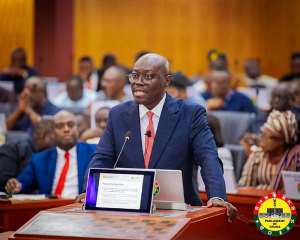
When Finance Minister Dr. Cassiel Ato Forson presented Ghana's 2026 Mid-Year Budget Review to Parliament on July 23, the message was clear: government spending remains largely on track, but priorities are shifting.
Rather than seeking additional funding through a supplementary budget, the government has opted to reallocate existing resources to accelerate key infrastructure and economic transformation projects. The strategy reflects a transition from economic stabilization to targeted investments aimed at sustaining long-term growth.
The latest economic indicators suggest that Ghana's recovery is gaining momentum. The economy expanded by 6.4 percent in the first quarter of 2026, inflation fell to 5.3 percent in June—within the Bank of Ghana's target range—and public debt declined to 45 percent of GDP from 61.6 percent at the end of 2024.
These improvements have created fiscal space, allowing government to redirect expenditure toward the Accelerated Economic Transformation Agenda and the flagship Big Push Infrastructure Programme rather than increasing overall spending.
Energy
One of the strongest performers during the first half of the year was the energy sector. Revenue from the Energy Sector Levy reached GH¢7.7 billion, significantly exceeding the projected GH¢4.2 billion. According to the Finance Minister, the Energy Debt Recovery Levy alone generated more than GH¢1 billion each month, providing critical resources to reduce debts owed by state-owned utilities and improve electricity supply.
Government also reported substantial savings from replacing imported light crude oil with domestically produced natural gas. The policy reduced fuel costs by approximately GH¢3.08 billion, equivalent to about US$268.5 million, during the first six months of the year.
While these gains are encouraging, the bigger question is whether they will translate into better services for Ghanaians, particularly communities that continue to experience unreliable electricity supply. The Mid-Year Review reaffirmed plans to construct a 1,200-megawatt gas-fired power plant and a second gas processing plant to support industrial development.
However, energy experts, including the African Centre for Energy Policy, have consistently argued that investments in large-scale generation must be complemented by increased funding for rural electrification, mini-grids and off-grid solar systems. Without sustained investment in clean energy solutions for underserved communities, universal electricity access will remain difficult to achieve.
Infrastructure
Infrastructure remains central to government's growth agenda. The Mid-Year Review provided fresh details on the proposed 176-kilometre Accra-Kumasi Expressway, one of the country's largest road projects. To avoid the financing constraints that have delayed major projects in the past, government has secured US$1.7 billion, which has been ring-fenced in a dedicated Bank of
Ghana account until procurement is completed and the construction contract is awarded.
This financing model marks a significant departure from previous approaches, where projects often commenced without adequate funding and later stalled due to financial shortfalls. Ring-fencing the funds before construction begins is intended to ensure uninterrupted project execution.
However, disciplined financing alone will not guarantee success. The real test lies in completing feasibility studies, engineering designs and competitive procurement within the planned timelines. Delays at this stage could leave the funds idle while commuters continue to endure one of the country's busiest transport corridors.
Government says preparatory works are already underway, with the Ghana Armed Forces having cleared 122 kilometres of the required right-of-way—about 70 percent of the project corridor—in just 12 weeks.
Beyond the flagship expressway, government is also investing in roads that support agricultural production. The planned Adawso-Ekye Amanfrom Bridge is expected to improve access to the Afram Plains, one of Ghana's key food-producing regions, reducing travel time and post-harvest losses. Though far smaller than the expressway, the bridge could have an equally significant economic impact by improving food distribution and helping moderate market prices.
Agriculture
Agriculture remains at the heart of government's strategy to reduce imports, strengthen food security and create jobs. The Feed Ghana Programme, alongside the Ghana Grains Development Project, the Vegetable Development Project and the Nkoko Nkitinkiti poultry initiative, is expected to boost domestic food production and support commercial agriculture.
The Mid-Year Review indicates that government is moving beyond traditional subsidy programmes by expanding access to financing for farmers and agribusinesses while reducing the risks associated with agricultural lending.
Yet financing alone will not determine the programme's success. Farmers also require reliable roads, electricity, storage facilities and timely access to seeds and fertilizer. These complementary investments are essential to sustaining lower food prices and keeping inflation under control.
Implementation remains a key concern. Reports that some farmers had not received agricultural inputs during the planting season underscore the importance of efficient delivery. Government has maintained that distribution is being aligned with regional crop calendars, but the effectiveness of that approach will be judged by results on the ground rather than policy explanations.
Transparency will also be critical. Questions surrounding procurement under the Big Push Programme and subsequent government reviews have highlighted the need for strong accountability mechanisms. Regardless of differing conclusions, the episode reinforces the importance of ensuring that public funds are spent through transparent and competitive processes.
Delivery
Overall, the 2026 Mid-Year Budget Review presents an encouraging picture of an economy regaining stability through stronger growth, lower inflation and improved fiscal discipline. However, the true measure of success will not be found in macroeconomic indicators alone.
The revenues generated from the energy sector must continue to improve electricity supply while expanding access to underserved communities. The funds committed to the Accra-Kumasi Expressway must translate into timely construction rather than prolonged procurement delays.
Likewise, the Feed Ghana Programme must deliver practical support that enables farmers to increase production, reduce post-harvest losses and improve market access.
As Ghana exit the three-year IMF Extended Credit Facility and transition to a non-financing Policy Coordination Instrument, the country's progress will increasingly be judged by implementation rather than policy announcements.
Ultimately, the success of the Mid-Year Budget Review will depend on whether these fiscal decisions produce better infrastructure, stronger industries and tangible improvements in the lives of ordinary Ghanaians.
Story by
Angela Eia Dzidzornu, Christian Kpesese, Sulemana Zakaria, Wilfred Lamtaaba Sa-Ambo. The Authors of this review are fellows of the 2026 Media Fellowship for Fiscal Accountability Programme, implemented by the Africa Centre for Energy Policy (ACEP)
 Police arrest man captured assaulting handcuffed suspect in viral video
 President Mahama begins two-day working tour of Upper East Region
 11 killed, 13 injured in multiple-vehicle crash on Ofankor-Pokuase stretch
 Five reported dead in multiple-vehicle crash at Ofankor barrier
 About 82,500 people in Ghana use drugs – NACOC
 'Stop using unqualified staff to manage patient data' – Allied Health Profession...
 ‘Unfinished business requires exceptional leadership’ — GHAPRO backs Mahama for ...
 Sedina Tamakloe-Attionu released after state withdraws stay application
 Bunkpurugu Police suspend funeral musketry over security concerns
 Police launch manhunt for man captured assaulting suspect in viral video

