




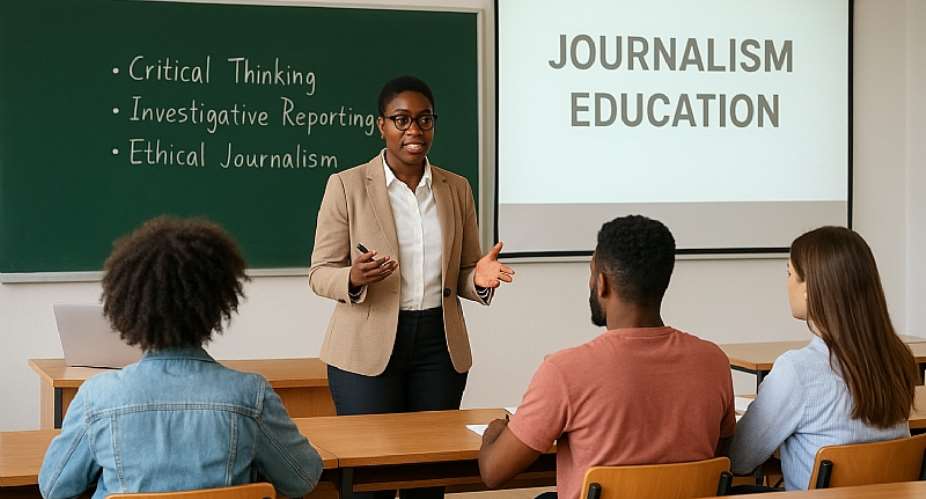
“A critical, independent and investigative press is the lifeblood of any democracy,” former South African President Nelson Mandela once said. This reminder is not only for newsrooms but also for journalism classrooms where future reporters are shaped.
Journalism is fundamentally rooted in inquiry. Students are expected to interrogate ideas, challenge assumptions, verify claims and demand evidence. Yet in some learning environments, those who ask difficult questions or express differing views are sometimes labelled disrespectful or disruptive. This reflects a misunderstanding of the essence of learning.
As an African proverb reminds us, “Wisdom is like a baobab tree; no one individual can embrace it.” Learning is strengthened through shared ideas, constructive debate and intellectual openness, not silence or fear.
A student who seeks clarification or challenges an argument is not being disrespectful; they are demonstrating critical thinking. University education should therefore extend beyond memorisation and examination preparation. It should cultivate independent thought, analytical reasoning, dialogue and intellectual courage.
This is especially vital in journalism training, where questioning is a core professional competency. Ghana’s 1992 Constitution guarantees freedom of speech and expression under Article 21(1)(a), as well as media freedom under Article 162(1). These provisions should not remain abstract legal principles but must be reflected in classroom practice and culture.
However, freedom of expression does not imply disrespect. Disagreement must be expressed through reasoned argument, evidence and respectful engagement. As another African saying goes, “A single bracelet does not jingle.” Meaningful dialogue requires multiple voices, not the silencing of dissent.
Students can challenge ideas without attacking individuals. They can question arguments without insulting their authors. They can disagree without resorting to ridicule or intimidation. The purpose of academic discourse is not to suppress opposing views, but to strengthen understanding through evidence and reasoned exchange.
Group work, in particular, should embody this principle. It is intended to foster collaboration and teamwork, not dominance or the suppression of voices. Disagreement is natural, but it should lead to refinement of ideas rather than fear of participation.
A classroom in which students are afraid to express themselves cannot produce confident journalists. This is especially concerning because journalism students are being trained to question authority, investigate wrongdoing and amplify marginalised voices. If they cannot speak freely in class, how can they effectively defend press freedom in society?
As the proverb goes, “He who asks questions does not lose his way.” Encouraging inquiry is not a weakness in education; it is its strength.
If an argument is weak, it should be challenged with evidence. If a question is unclear, it should be clarified. If information is missing, it should be provided. The focus must remain on ideas, not personal attacks.
The habits developed in journalism school often shape professional conduct later in life. A student who learns to engage respectfully with opposing views is more likely to become a journalist who fairly represents all perspectives. A student encouraged to question responsibly may grow into an investigative reporter who holds power to account.
Conversely, a student who is silenced or ridiculed may become hesitant to ask important questions in the future. This would represent a loss not only to the individual but to society as a whole.
Journalism thrives on diversity of thought. As the saying goes, “Two heads are better than one.” Different perspectives strengthen understanding and improve outcomes. What is required in journalism education is not uniformity, but respectful intellectual engagement.
Journalism training institutions, including UNIMAC and the University of Education, Winneba, must therefore foster environments where students can speak freely, question boldly and disagree respectfully without fear of intimidation.
Today’s student asking a difficult question may become tomorrow’s journalist exposing corruption. Today’s student challenging an idea may become tomorrow’s reporter giving voice to the voiceless.
We should not teach such students to fear questions. We should teach them to refine them, sharpen them and use them responsibly.
Let journalism students speak.
By Sambiiru Duut Elijah

 Police arrest man captured assaulting handcuffed suspect in viral video
 President Mahama begins two-day working tour of Upper East Region
 11 killed, 13 injured in multiple-vehicle crash on Ofankor-Pokuase stretch
 Five reported dead in multiple-vehicle crash at Ofankor barrier
 About 82,500 people in Ghana use drugs – NACOC
 'Stop using unqualified staff to manage patient data' – Allied Health Profession...
 ‘Unfinished business requires exceptional leadership’ — GHAPRO backs Mahama for ...
 Sedina Tamakloe-Attionu released after state withdraws stay application
 Bunkpurugu Police suspend funeral musketry over security concerns
 Police launch manhunt for man captured assaulting suspect in viral video

