




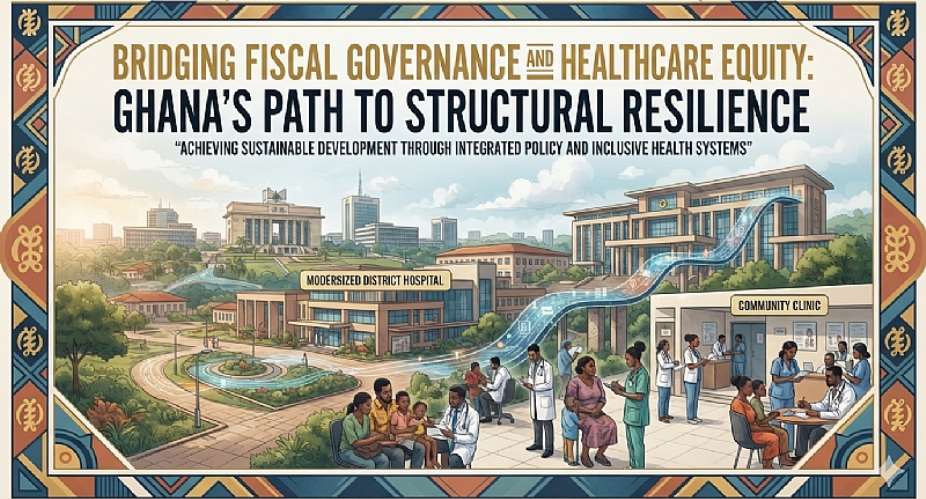
Ghana is undergoing an important structural transition. Having successfully concluded its three-year, US$3 billion Extended Credit Facility (ECF) bailout arrangement with the International Monetary Fund (IMF), the nation is shifting away from direct financial dependence on multilateral lending. The activation of a new 36-month non-financing Policy Coordination Instrument (PCI) signals an evolution toward institutional self-reliance and policy consistency. Crucially, the country is actively leveraging this macroeconomic stability to address deep-seated gaps in public welfare. Through the newly launched Free Primary Health Care (FPHC) Programme—capitalized by an initial 1.5 billion Ghana Cedis—the state is engineering an ambitious framework to reduce out-of-pocket medical expenditure and prioritize preventive care.
To maximize this momentum, policymakers, civic institutions, and corporate entities must look past high-level statistics and focus on regional execution, operational transparency, and systemic equity.
The Economic Landscape: Anchoring Growth and Private Sector Access
Ghana’s macroeconomic recovery is progressing through institutional reforms, though structural pressures remain high for the average household.
- Macro-Stabilization Milestones: Tightened monetary enforcement has successfully cooled headline inflation to 5.3%, a sharp drop from historic peaks above 50%. The primary fiscal balance has transitioned into a 2.1% GDP surplus.
- The Transition to the IMF PCI Framework: Highlighting the policy shift, Finance Minister Dr Cassiel Ato Baah Forson stated, "Ghana will build upon the stability to create resilience and development through a 'new economy' programme." He noted that the country is not rushing back to international capital markets.
- Foreign Reserves and Currency Defense: Driven by strong commodity values yielding an $8 billion trade surplus—anchored by gold and crude oil—gross international reserves have climbed to $14.5 billion, giving the Bank of Ghana an expanded buffer to manage Cedi volatility.
- Unlocking Domestic Corporate Capital: As the state curbs domestic debt issuance to preserve its fiscal targets, commercial banks are moving away from government treasury bills. This forces financial institutions to offer affordable credit lines to local corporate enterprises.
- The Youth Unemployment Challenge: Despite a strong 6.4% GDP growth trajectory, the nation’s 30% youth unemployment rate remains a critical vulnerability. This underscores the need for structural policy reforms that convert macroeconomic stability into immediate, private-sector job creation.
The Regional Health Landscape: Hotspots and Vaccine Interventions
Public health entities are addressing active localized outbreaks while implementing large-scale clinical solutions to reduce under-5 child mortality.
- Mpox Regional Trends: The Ghana Health Service (GHS) has recorded 1,075 cumulative confirmed cases nationwide. Dr. Patrick Kuma-Aboagye, Director-General of the GHS, stated, "The health system remains on high alert, and adequate measures are in place to manage and contain the outbreak."
- The Impact on the Ashanti Region: The Ashanti Region continues to face dual challenges, balancing rising Mpox surveillance demands in its urban centers with a high baseline burden of non-communicable diseases (NCDs). The region is a primary focus for the distribution of the targeted 33,600 vaccine doses deployed to contain community transmission.
- The Impact on the Northern Region: In the Northern Region, endemic malaria remains a major hurdle. However, peer-reviewed clinical trial data published in The Lancet confirms that real-world deployment of the RTS,S malaria vaccine has slashed all-cause child mortality by 13% across regional hubs. It has successfully averted roughly 1 in 8 eligible child deaths even under non-perfect coverage rates.
- The Impact on the Volta Region: The Volta Region is seeing targeted infrastructural improvements under the current healthcare layout. Local networks are being adjusted to address a rise in chronic lifestyle conditions like hypertension and diabetes, which now cause 43% to 45% of all national deaths. This highlights the need to shift from hospital-centric curative care to community-centric wellness.
- Upholding Health Data Sovereignty: Demonstrating strict regulatory compliance, health officials rejected a $300 million international assistance package due to contract clauses requiring the sharing of citizen health records. This action underscores Ghana's commitment to its local data protection laws.
The Free Primary Health Care (FPHC) Strategic Roadmap
The Free Primary Health Care (FPHC) Programme operates on a phased deployment schedule to build structured, sustainable health access.
- Phase 1 (Active — Extending into Early 2027): Operations focus on 150 prioritized, underserved districts. The Ministry of Health has deployed 24,000 essential hardware units—including incubators, diagnostic kits, and maternal health equipment—directly to community CHPS compounds and polyclinics.
- Phase 2 (Mid-2027 – Late 2027): The network scales up to absorb remaining districts. This expansion coincides with the official commissioning of three new regional referral hospitals in the Savannah, Oti, and Western North regions to bridge historic geographical infrastructure gaps.
- Phase 3 (2028 Horizon): Full nationwide operational alignment. The goal is to provide basic preventive, curative, and maternal health care free of charge at the primary level. The National Health Insurance Scheme (NHIS) will serve as the financing anchor for specialized secondary and tertiary hospital referrals.
Strategic Recommendations for Sustainable Development
To ensure that high-level fiscal targets and structural health frameworks translate into lasting welfare improvements for all Ghanaians, the following actions are recommended:
- Optimize FPHC Financing Mechanisms: The Ministry of Finance and the Ministry of Health must establish ring-fenced, statutory funding pathways for the FPHC to ensure its annual budget obligations remain insulated from shifting political cycles.
- Strengthen Medical Workforce Retention: To safeguard the rollout of primary healthcare, the government should immediately address salary backlogs and improve working conditions for frontline medical staff. This will help curb the ongoing migration of skilled health workers abroad.
- Expand Localized Manufacturing Ecosystems: Leveraging the upgraded 'B' sovereign credit rating, the Ministry of Trade and Industry should attract private investment into domestic pharmaceutical and vaccine manufacturing hubs in Accra and Kumasi. This will build self-reliance for future outbreak responses.
- Enhance Civic Utilization of Preventive Care: Civil society organizations and local assemblies should run continuous public education campaigns. These should encourage citizens to actively use free local CHPS screenings for blood pressure and glucose levels, catching chronic NCDs early.
- Deploy Corporate Capital for Employment: Private enterprises should take advantage of a stabilizing Cedi and cheaper bank credit lines to expand supply chains in agro-processing and digital logistics. This will help directly lower the 30% youth unemployment rate.
Ghana’s exit from direct IMF financial dependence marks a key milestone in its journey toward economic autonomy and mature public governance. True developmental success is not defined by macroeconomic statistics alone; it is measured by the health, economic security, and resilience of its citizens. By investing fiscal gains directly into social protections like Free Primary Healthcare and life-saving child immunization programs, the nation is building a sustainable model for growth.
While challenges like youth unemployment and regional outbreak management require ongoing attention, the country's structural foundation is stable. Sustaining this progress demands a shared commitment: institutional transparency from the state, proactive investments from the private sector, and active engagement with preventive healthcare from the public. Together, Ghanaians can ensure that economic resilience and healthcare equity become the baseline for national progress.
✍️ Submitted by:
Retired Senior Citizen
For and on behalf of all Senior Citizens of the Republic of Ghana 🇬🇭
Teshie-Nungua
[email protected]


 Busia has been treated unfairly in Ghana’s political history — Kufuor
 Government upholds Adamus mine lease revocation, assures workers of job security
 SDA partners government to complete selected Agenda 111 projects
 I never met Asante Berko or received money from him — Kwabena Donkor denies brib...
 Cabinet grants approval for resumption of work on stalled theatre projects in Ku...
 IGP promotes 25 police officers who helped bust robbery syndicates, intercept co...
 Will President Mahama Stop Deceiving Ghanaians And Tell Us What Happened To The ...
 Ghana Maritime Authority facilitates repatriation of 12 stranded seafarers
 Invite me to Parliament and let me expose your lies about GoldBod — Sammy Gyamfi...
 Let's not make former TOR MD bribery case NDC-NPP issue — Vicky Bright

