




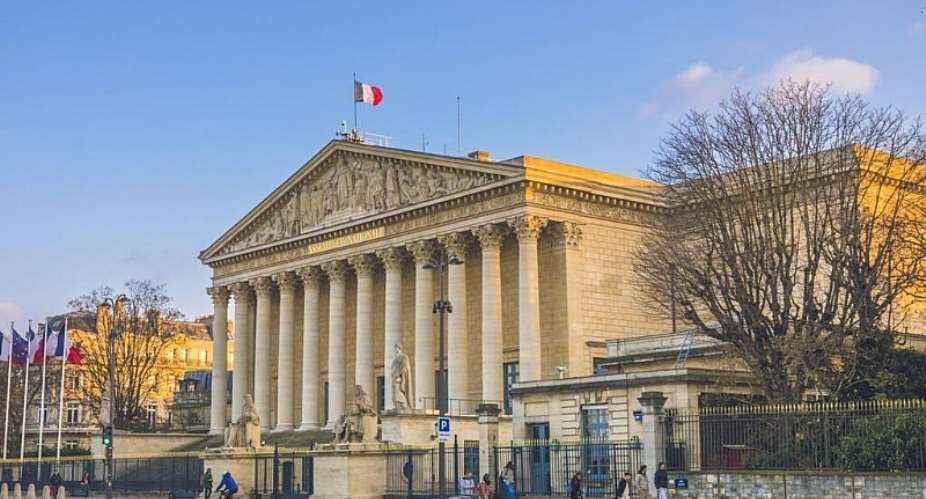
A controversial plan to build a new visitor reception pavilion at France's parliament building in Paris has returned to the spotlight after city authorities gave their backing to a key planning change in July.
The project, designed to improve access for a growing number of visitors, would replace the existing pavilion adjoining the Palais Bourbon, home of the lower house of parliament.
The Assembly first submitted a building permit in 2025, but the project was later put on hold while permission was sought to excavate beneath one of the site's courtyards.
Because the Palais Bourbon stands in an area of Paris with protected architectural heritage, the scheme requires a series of approvals involving the French state, Paris city authorities and the Architectes des Bâtiments de France, the body responsible for safeguarding historic buildings and their surroundings. Proposed new public reception pavilion for the National Assembly, designed by the Moatti-Rivière architecture firm.
Louvre security concerns 'pushed aside' in favour of prestige projects
Paris approval revives debate
In mid-July, the City of Paris issued a favourable opinion on a proposed change to the relevant planning rules, bringing the project another step forward.
However, city hall stressed that the decision represented only “one stage in the procedure”, which is expected to continue for several more months.
It does not amount to planning permission or final approval of the architectural design, the city said.
The move nevertheless prompted renewed criticism from the far-right National Rally (RN).
RN MP Sébastien Chenu, who has opposed the project since it was first announced, called on Wednesday for the National Assembly's governing bureau to vote on the proposal again.
In a joint statement with fellow RN MP Hélène Laporte, Chenu described the scheme as “questionable and inappropriate”.
The office of National Assembly president Yaël Braun-Pivet rejected suggestions that MPs had not been properly consulted.
“All the groups approved this project, since they were all represented on the bureau” when it was unanimously approved in September 2024, a source close to Braun-Pivet said.
Opposition to the project has also focused on the appearance of the proposed building and the demolition of the existing pavilion.
The heritage association Sites & Monuments launched a petition against the development in 2025, warning that it would contribute to the “disfigurement of Paris”.
By Friday, the petition had attracted 90,000 signatures.
French artist to give Notre-Dame's stained-glass windows a modern makeover
Price tag questioned
The National Assembly says it is continuing to work with state and Paris authorities to adapt the plans to meet architectural, environmental and heritage requirements.
“We will comply with everything,” a source close to Braun-Pivet told news agency AFP.
The projected €53 million cost of the development has also drawn criticism.
Braun-Pivet's office said the work would be “self-financed” from the National Assembly's reserves rather than through additional public funding.
It also defended spending already committed to accessibility studies, saying the work would have been necessary in any case and would still be used as the project evolves.
(with newswires)

 James Agalga named majority leader following Mahama Ayariga's ministerial appoin...
 Omane was a true friend, a younger brother and a loyalist — Mahama eulogises lat...
 'My focus is on delivering the mandate' — Prof. Opoku-Agyemang responds to rumou...
 US appeals court halts construction of Trump’s $400 million White House ballroom...
 Saudi Arabia, Pakistan and Turkey sign mutual defence agreement
 Rwanda in talks with Italy to take in migrants trying to reach EU
 Threat against the President can't be described as exercise of free speech — Pro...
 'Failure to stop galamsey will make August 6 deaths meaningless' — Solomon Owusu
 Jailed Wontumi still in NPP national chairmanship race — Dr Palgrave Boakye-Danq...
 Mahama reshuffles cabinet, nominates Zanetor Rawlings and Mahama Ayariga to Envi...

