




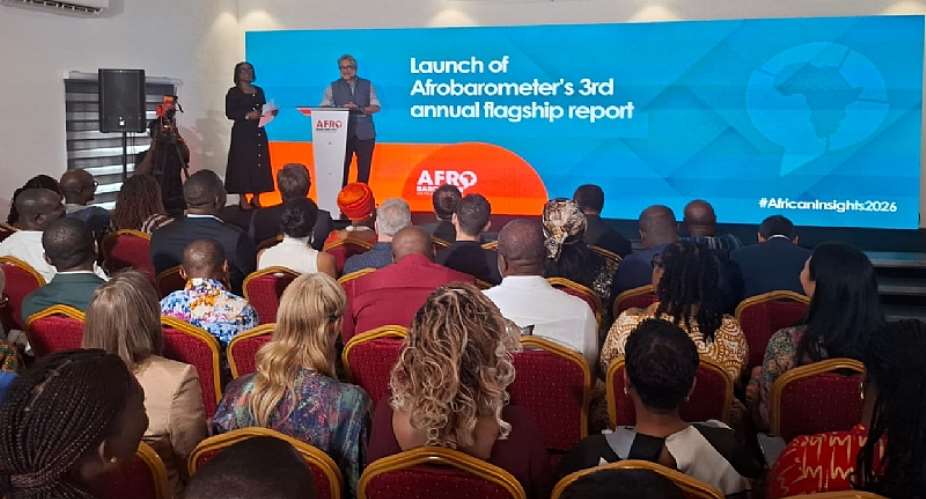
Low public awareness of the African Continental Free Trade Area (AfCFTA) threatens effective implementation of the continent’s flagship trade agreement, a new study has found.
The study found that average awareness of the agreement stood at 13 per cent across 38 African countries, despite widespread public support for the policy, which has been in force for about five years.
The findings are contained in the third ‘African Insights’ report by Afrobarometer, launched in Accra on Wednesday under the theme: “Beyond borders: Citizen perspectives on a shifting global order.”
The report said the AfCFTA had the potential to boost intra-African trade, industrialisation and employment by creating a single market linking about 1.4 billion people across 54 countries with a combined Gross Domestic Product of more than US$3.4 trillion.
It found that awareness in West Africa, which hosts the AfCFTA Secretariat, averaged 13 per cent, the same as East Africa. Southern Africa recorded 11 per cent awareness, North Africa five per cent and Central Africa 17 per cent.
The 2026 study further observed that knowledge of the agreement remained concentrated among political and business elites, with respondents who had post-secondary education demonstrating higher awareness than less educated citizens.
Mr Niloy Banerjee, Ghana Resident Representative of the United Nations Development Programme (UNDP), described the 13 per cent awareness level as a dangerous gap between policymakers and citizens.
“Communication must improve,” asking, “why is the common person on the street not aware of this free trade agreement?” and recommended that governments showed that AfCFTA is working by fixing customs, tariffs, visas, and currency issues.
“Farmers, manufacturers and traders need to see that trading across borders is easier and more profitable than staying in one zone, which means a lot of homework needs to be done,” the Resident Representative said.
Mr Banerjee said the challenge extended beyond communication, stressing that countries must improve cross-border movement of goods, visa issuance, customs administration and the removal of non-tariff barriers for the agreement to deliver its intended benefits.
Expressing confidence in the long-term prospects of the agreement, he said, “the European Union did not become one single market overnight. It took work, negotiations, counter negotiations.”
Dr Joseph Asunka, Chief Executive Officer of Afrobarometer, said the disconnect between policy implementers and citizens posed a threat to the successful implementation of the continental trade agreement.
“The policy was agreed at the elite level among educated people and yet the citizens for whom this initiative is being implemented are unaware. That’s a gap that must be filled. Policymakers need to think about how we can bring citizens along on the issue of the continental free trade,” he stated.
Dr Asunka urged African governments to strengthen collaboration to translate the AfCFTA into practical outcomes that would create opportunities for young people and businesses.
“Young people want to be entrepreneurs, but businesses can only thrive if you have a larger market by creating the infrastructure base. Countries should not go into road construction and airline industry development by themselves. There should be some collective action,” he advocated.
Ms Josephine Sanny, Director of Communications at Afrobarometer, said additional survey findings showed that although many Africans supported expanding trade across the continent, enthusiasm declined when it came to cross-border movement.
“About 56 per cent of Africans support free movement within their sub-region to work or trade, while 40 per cent want governments to limit it to protect local jobs, the survey of 38 countries found,” she stated.
Ms Sanny said the survey interviewed between 1,200 and 2,400 adults in each of the 38 participating countries, with a 95 per cent confidence interval and a margin of error of between two and three per cent. She said the data was intended to ensure that citizens’ views informed policy decisions.
She said although the treaty had been signed, implementation remained the greater task, adding that “without awareness, infrastructure and results, AfCFTA risks being underestimated and underused.”
GNA

 US appeals court halts construction of Trump’s $400 million White House ballroom...
 Saudi Arabia, Pakistan and Turkey sign mutual defence agreement
 Rwanda in talks with Italy to take in migrants trying to reach EU
 Threat against the President can't be described as exercise of free speech — Pro...
 'Failure to stop galamsey will make August 6 deaths meaningless' — Solomon Owusu
 Jailed Wontumi still in NPP national chairmanship race — Dr Palgrave Boakye-Danq...
 Mahama reshuffles cabinet, nominates Zanetor Rawlings and Mahama Ayariga to Envi...
 Ministerial reshuffle: Kenneth Adjei replaces Omane Boamah as substantive Defenc...
 NUGS proposes social media ban for children under 15 to tackle indiscipline
 Bekwai Court jails Cobbler 15years for armed robbery

