




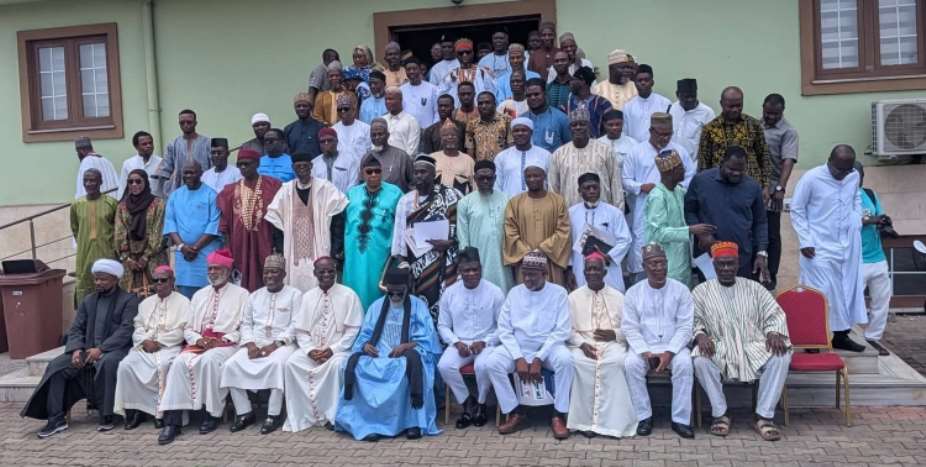
The 4th Annual Dialogue between the Ghana Catholic Bishops' Conference (GCBC) and the Office of the National Chief Imam has once again turned the spotlight on the growing crisis of indiscipline in Ghana's schools, with religious leaders, academics, and government officials converging at the National Mosque in Kanda, Accra, to interrogate the causes and chart a path forward.
Held under the theme "Addressing the Challenges of Rising Indiscipline in Our Schools: The Role of Faith-Based Organizations," the dialogue brought together the National Chief Imam, Sheikh Osman Nuhu Sharubutu, and the President of the Catholic Bishops' Conference, Most Rev. Matthew Kwasi Gyamfi, alongside senior government officials, academics, and representatives of various faith traditions, including members of the traditional religion.
Breakdown of the Family System
A recurring thread through the discussions was the erosion of the traditional family structure as the root of the problem. Rashid Ibrahim, a legal practitioner and member of the National Union of Ghana Students (NUGS), told the gathering that parental control had weakened considerably, and that this breakdown was compounded on school campuses by inadequate supervision and insufficient staff to manage growing student numbers.
Lucille Hewlett Annang, Secretary to the National Commission on Civic Education (NCCE), linked the trend to Ghana's tightening economic conditions, noting that parents were increasingly forced to leave home early and return late, leaving little room for oversight of their children's conduct.
Character Formation Versus Academic Focus
Rev. Professor Cosmas Sarbah, a senior lecturer at the Department for the Study of Religions, University of Ghana, Legon, argued that the education system's near-exclusive focus on academic achievement, at the expense of character formation, was itself contributing to the crisis.
Dr Haruna Saed, a lecturer at the University of Ghana, proposed that mission schools be given greater autonomy to run their affairs and institute their own disciplinary frameworks, a call that echoes longstanding tensions between mission school authorities and central education administration over how much latitude faith-founded schools should retain.
The Corporal Punishment Debate
The dialogue's guest of honour, Ahmed Ibrahim, Minister of Local Government, Chieftaincy and Religious Affairs, broke from the panel's emphasis on structural and parental factors to call for the reintroduction of corporal punishment in schools. Drawing extensively from both the Bible and the Qur'an, the minister argued that corporal discipline was not an outmoded practice but one with firm scriptural grounding in both traditions.
His position places him at odds with prevailing child-protection frameworks in Ghana's education policy, which have progressively moved away from corporal punishment in favour of positive discipline approaches, and is likely to reignite debate among educationists and child-rights advocates.
The "Five Cs" Framework
Prof. Adallah Ali-Nakyea, Associate Professor of Tax Law and Policy at the University of Ghana School of Law, offered a more structural response, recommending the inculcation of five research-backed traits into the school system: clarity, consistency, communication, caring, and character. He urged school administrators, teachers, and parents to place character formation on par with academic performance, stressing that religious difference among students should never be a source of conflict on campus.
A Shared Abrahamic Foundation
Reflecting on the creation narratives common to both the Bible and the Qur'an, the Chief Imam and Bishop Gyamfi jointly underscored that Muslims and Christians share an Abrahamic lineage, and that doctrinal differences should not become grounds for division. Both leaders affirmed that respect for human dignity underpins justice, peace, and national cohesion, and described faith-based organizations as indispensable partners in shaping the moral development of Ghana's youth. They further stressed that education remains a shared responsibility, requiring sustained collaboration between parents, teachers, and the state.
Analysis
This 4th edition of the Catholic-Muslim dialogue continues a platform that has, in previous years, helped resolve friction points between religious communities and the Ghana Education Service, including disputes over religious accommodation in mission schools. That the conversation has now shifted toward school discipline reflects wider public anxiety in Ghana over youth conduct, campus violence, and examination malpractice, concerns the GCBC has raised in other fora over recent years.
The divergence between the panel's structural diagnosis, weak parenting, overstretched teachers, and an academics-only curriculum, and the minister's call for corporal punishment illustrates a broader unresolved tension in Ghana's education discourse: whether indiscipline is best addressed through punitive measures or through the kind of sustained, values-based mentorship that faith communities are positioning themselves to provide.
Mustapha Bature Sallama.
Medical/ Science Communicator,
Private Investigator, Criminal investigation and Intelligence Analysis.
International Conflict Management and Peace Building.USIP
[email protected]
+233-555-275-880
References
Kenu, D. (2026, August 6). "Strengthen family values, teacher supervision to curb indiscipline Panellists." Graphic Online.
https://www.graphic.com.gh/news/...to-curb-indiscipline-panellists.html


 'Don't underestimate NPP's comeback power' — Anthony Karbo tells NDC
 NSA sets August 14 deadline for defaulters, private candidates to apply for serv...
 Category A schools to receive GHS250 million infrastructure boost under 2027 GET...
 Bono REGSEC seizes galamsey equipment
 'We remain grateful for the enduring legacies they left behind' — Families of he...
 ‘The street is for Bawumia now’ - Aggrieved Ghanaians join NPP 'Democracy Under ...
 Kwame-Danso Police Station closed after attack on police and judicial staff
 'The impression is simply false' - Kwaku Azar rejects claims Chief Justice handp...
 Franklin Cudjoe appointed to Ghana’s Joint National-United Nations Steering Comm...
 Government holds national inter-faith memorial service to mark one year since Au...

