




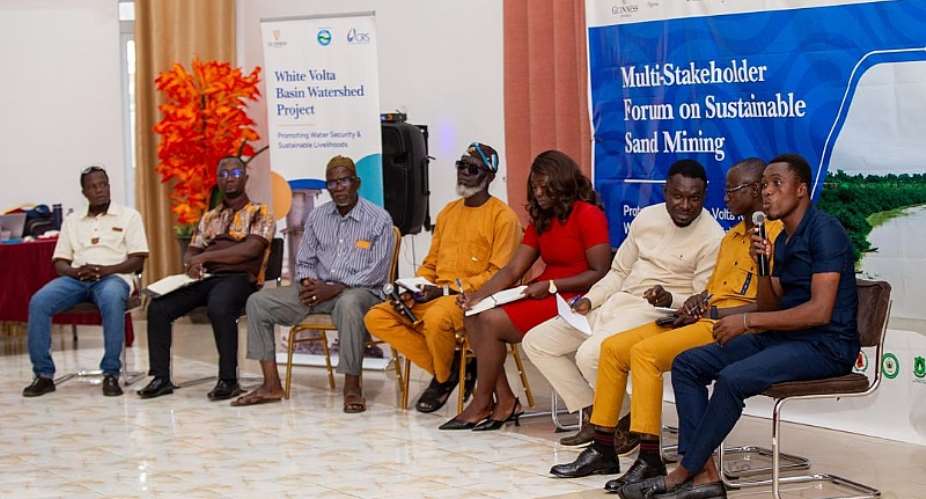
Key stakeholders have met in Tamale to advance efforts to regulate sand mining activities and protect the ecological integrity of the White Volta River Basin while safeguarding livelihoods that depend on the resource.
The second Regional Stakeholders Forum on Sustainable Sand Mining, held over two days, was organised by Catholic Relief Services (CRS) in partnership with the Northern Regional Coordinating Council (NRCC), the Water Resources Commission (WRC) and the Minerals Commission.
The forum forms part of an ongoing initiative funded by Guinness Ghana, Diageo Nigeria and The Nature Conservancy to restore the White Volta River Basin, improve water security and promote sustainable livelihoods for communities within the basin.
More than 120 participants, including representatives of the NRCC, traditional authorities, Metropolitan, Municipal and District Assemblies (MMDAs), regulatory institutions, academia, civil society organisations, tipper truck unions, excavator owners and the media, attended the engagement.
A major focus of the forum was the presentation and validation of the Draft Integrated Regulatory Framework on Sustainable Sand Mining, developed by the Technical Working Group on Sustainable Sand Mining (TWGSSM). The proposed framework is intended to guide environmentally responsible and community-based sand mining practices within the Nawuni sub-catchment and across the wider White Volta River Basin.
Participants also held plenary discussions on the challenges and opportunities associated with sand mining in the basin, while action-planning sessions were used to agree on implementation strategies, responsibilities and the next steps toward adopting the framework.
The engagement builds on recommendations from an earlier stakeholder forum held this year and seeks to establish a coordinated regulatory regime for sand mining in the region.
Covering an estimated 400,000 square kilometres, the White Volta River Basin is a vital water source for millions of people across northern Ghana. However, uncontrolled sand mining, unsustainable farming practices and the degradation of riparian vegetation have significantly affected water quality and quantity, increased water treatment costs and heightened the vulnerability of communities.
A study conducted by CRS and the Water Resources Commission estimated that more than 15 million cubic metres of sand have accumulated within the Nawuni sub-catchment, highlighting the need for regulated extraction to balance environmental protection with economic activity.
Speaking at the forum, the Head of Programming at CRS Ghana, Mr Francis Gumah, described the engagement as a significant milestone in efforts to build consensus on responsible sand mining practices.
“This forum is a pivotal step in building consensus around sustainable sand mining,” he said.
“By making inputs and validating the draft regulatory framework and engaging diverse stakeholders, we lay the foundation for resilient watershed management and sustainable livelihoods.”
The Northern Regional Minister, Mr Ali Adolf John, represented by Principal Development Planning Officer at the NRCC, Mr Eric Ofori Arthur, reaffirmed the Regional Coordinating Council's commitment to tackling illegal sand mining.
“The Northern Regional Coordinating Council is fully committed to supporting the fight against illegal sand mining across the White Volta River Basin,” he said.
He stressed that protecting the White Volta River, the main source of water for Tamale, required close collaboration among district assemblies, traditional leaders and regulatory agencies to ensure effective implementation of the proposed regulatory framework.
Mr Arthur added that the framework provides a clear roadmap for regulating sand mining in a manner that is environmentally sustainable while supporting local economic development.
Also addressing the forum, the Northern Regional Water Quality Manager of Ghana Water Limited, Mr Sulemana Alhassan, warned that uncontrolled sand mining had already increased the cost of treating water supplied to residents of Tamale.
“The deteriorating water quality caused by unregulated sand mining has already increased treatment costs for communities in Tamale,” he said.
He noted that collaboration among district assemblies, miners and traditional authorities has demonstrated that sand mining can be conducted in a way that protects the environment while supporting economic activity.
The forum concluded with stakeholders endorsing the revised Draft Integrated Regulatory Framework, agreeing on the development of district-level by-laws to regulate sand mining and committing to work together to implement the framework across the White Volta River Basin.

 'Don't underestimate NPP's comeback power' — Anthony Karbo tells NDC
 NSA sets August 14 deadline for defaulters, private candidates to apply for serv...
 Category A schools to receive GHS250 million infrastructure boost under 2027 GET...
 Bono REGSEC seizes galamsey equipment
 'We remain grateful for the enduring legacies they left behind' — Families of he...
 ‘The street is for Bawumia now’ - Aggrieved Ghanaians join NPP 'Democracy Under ...
 Kwame-Danso Police Station closed after attack on police and judicial staff
 'The impression is simply false' - Kwaku Azar rejects claims Chief Justice handp...
 Franklin Cudjoe appointed to Ghana’s Joint National-United Nations Steering Comm...
 Government holds national inter-faith memorial service to mark one year since Au...

