




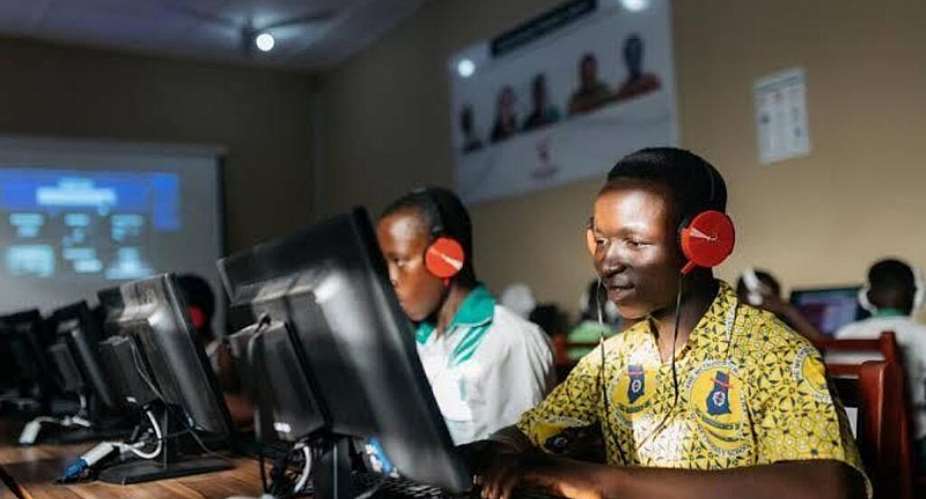
The reform, announced by Education Minister Haruna Iddrisu, is part of a broader overhaul of the Ghana's education system, aimed at equipping children with digital skills from an early age while strengthening science, technology, engineering and mathematics (STEM) education.
The revised curriculum will also include electronics and technical and vocational education and training (TVET), as well as ethics and civic education, reflecting the government's ambition to prepare young Ghanaians for a technology-driven economy.
'Smart start' for pupils
Speaking at the launch of the initiative, Iddrisu said the curriculum had been redesigned to create what he described as a "Smart Start curriculum."
As Africa rapidly goes digital, it becomes a prime target for hackers
"The revision of our curriculum is to ensure a Smart Start curriculum for greater integration of technology, science, engineering and mathematics. We have promised to introduce coding, electronics, artificial intelligence and TVET into the basic education curriculum. This will be the new addition," he said. Haruna Iddrisu, Minister of Education, Ghana.
The minister said the reforms were intended to prepare pupils for a future increasingly shaped by digital technology.
"One of the most significant decisions we took as a government was to revise our education curriculum, from kindergarten to junior high school, to better prepare pupils for a technology-driven world."
He added that Africa should not be left behind as artificial intelligence transforms education and the global economy.
Solar investment surges as Ghana races to hit renewable targets
"The goal is to prepare learners for a future driven by e-learning and emerging technologies. Africa must not be left behind in the digital revolution."
Alongside digital skills, the revised curriculum will place greater emphasis on ethics, patriotism and civic responsibility.
"More importantly, ethics and ethical values, how the child grows up, knowing what the state's resources are, knowing how to be patriotic and responsible, and knowing how to be civically responsible, will be an integral part of our revised curriculum."
Pupils welcome the change
Nhyiraba Asiedua Asiedu Otchere, a pupil at Orange Star Roman Catholic Basic School Complex in Mampong-Akuapem, told RFI that introducing AI into classrooms would help pupils better understand lessons and improve independent learning.
"Artificial intelligence is already part of our daily lives. AI and coding can improve pupils' academic performance. If some learners do not fully understand what they are taught in class, AI tools can help them revise and learn more quickly," she said, adding that AI could simplify complex concepts, making them easier for pupils to understand.
How women are paving their own way through Africa's tech sector
"I am very excited that the government is introducing artificial intelligence and coding into our school curriculum. It will help us learn new technology, improve our problem-solving skills, and prepare us for future jobs in a digital world," said Isaac Siaw, a pupil at Susec Model School in Sunyani, in the Bono Region.
Experts urge investment alongside reform
Education experts have also welcomed the reform but cautioned that its success will depend on adequate investment.
Peter Anti, executive director of the Institute for Education Studies (IFEST), described the initiative as timely and in line with global education trends.
"The introduction of AI into Ghana's basic school curriculum is a timely and commendable initiative. It aligns Ghana with global education trends and will help equip learners with the digital competencies, critical thinking and problem-solving skills needed to remain globally competitive in an AI-driven world," he said.
However, he warned that curriculum reform alone would not guarantee success. Significant investment in electricity, internet connectivity, digital devices and teacher training would be essential to ensure pupils across the country benefited equally, he said.
"Without these investments, schools in rural and underserved communities could fall further behind their better-resourced urban counterparts, potentially widening educational inequalities rather than narrowing them," he cautioned.


 The new cocoa laws are unconstitutional, breach property rights — Kofi Bentil
 Barker-Vormawor commends govt for separating Attorney-General from Justice Minis...
 As AU Chair I will push for inclusion of Caribbean in AfCFTA — Mahama
 Petrol pegged at GH¢14.53 as NPA announces new price floors for first pricing wi...
 Overnight rains trigger flooding in Sandema, disrupt traffic
 NDC gov't keeps deflecting when Ghanaians are suffering — Miracles Aboagye
 UAE introduces police clearance requirement for Ghanaians seeking employment vis...
 'Establish independent regulator to handle examination result appeals' — Eduwatc...
 Ukrainian drone strikes on Russia kill at least six, spark fire at Wildberries w...
 25 US states sue Trump administration over sweeping new tariffs

