




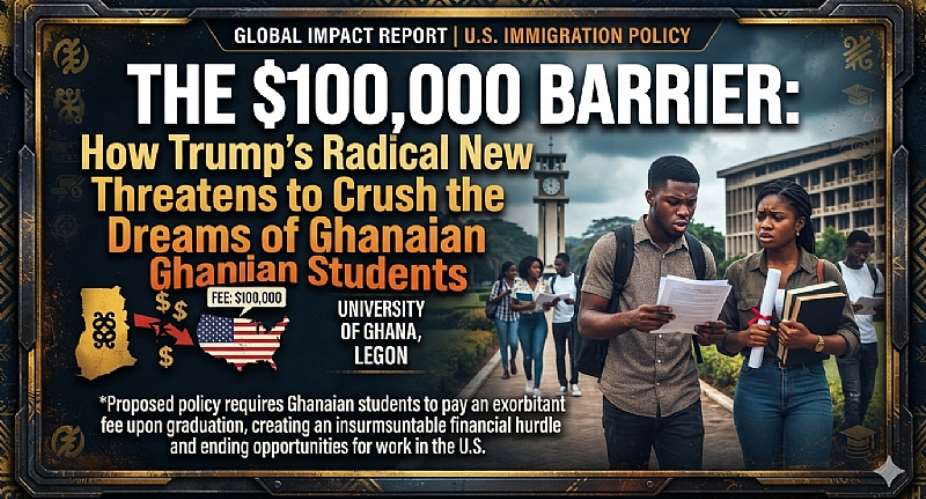
The proposed levy exposes a harsh new reality for West African talent, but strategic shifts into IT and nursing can help prospective scholars outmanoeuvre Washington’s latest protectionist hurdles.
The celebrated "American Dream" is rapidly morphing into an exclusive playground for the ultra-wealthy. In a move that has sent shockwaves through global education sectors, the Trump administration is actively preparing an unprecedented policy: charging international graduates a staggering $100,000 fee to legally remain and work in the United States post-graduation.
This punitive levy directly targets the Optional Practical Training (OPT) program, the vital legal bridge that allows foreign students to work in America for up to three years after earning their degrees. For thousands of Ghanaian families who routinely liquidate life savings, sell lands, or take on crippling high-interest loans to finance an American education, this proposed policy does not just shift the goalposts—it burns down the stadium.
The strategy behind this policy is transparently hostile. By attempting to attach a six-figure price tag to post-grad work, Washington is aiming to price out brilliant but underfunded minds from developing nations. It is a diplomatic slap in the face to global talent, disguised as domestic job protection. However, Ghanaian educational consultants warn that while the situation is grim, panicking is not an option. Instead, applicants must adopt a fiercely pragmatic approach to their academic and career choices.
The Financial Death Sentence for Ghanaian Ambition
At current market rates, a $100,000 fee translates to over 1.5 million Ghanaian Cedis. This represents a complete breakdown of the financial equation that makes studying in the US worthwhile for a Ghanaian student.
- The Return-on-Investment Collapse: Historically, Ghanaian students justify the exorbitant cost of US tuition because the OPT program allows them to earn US dollars post-graduation, clear their educational debts, and build global capital. Forcing a graduate to find an extra $100,000 just to start working entirely destroys this economic liftoff.
- Corporate Sponsoring Sabotage: Even if the policy allows American corporate employers to foot the bill instead of the student, the reality remains bleak. Given the choice, US companies—especially mid-sized firms and cash-strapped public institutions—will simply stop interviewing foreign applicants to avoid the massive financial penalty.
- A Short-Sighted American Self-Injury: American universities heavily rely on international students, who pay full, un-subsidised tuition rates that effectively keep local college campuses afloat. Denying these graduates the right to work will trigger a massive drop in international enrollment, starving US universities of vital funding and robbing the American economy of essential global talent.
The New Battlefield: Information Technology vs. Healthcare
The impact of this proposed fee will not be felt equally across all sectors. For Ghanaians eyeing the US, the choice of major is now a high-stakes gamble where only specific fields stand a chance of surviving the financial barrier.
- Information Technology and AI: The US technology sector faces a chronic shortage of advanced talent in software engineering, cybersecurity, and artificial intelligence. Because tech conglomerates possess massive cash reserves, IT graduates may still find elite Silicon Valley firms willing to absorb the $100,000 fee as a cost of doing business. However, competition among foreign tech graduates for these heavily vetted corporate slots will become viciously cutthroat.
- The Nursing and Healthcare Crisis: Unlike the tech sector, the American healthcare system is decentralized, with many hospitals operating on razor-thin margins. While America desperately needs nurses, average hospitals and regional clinics simply cannot afford a $100,000 penalty to hire a foreign nurse. Ghanaian nursing students who previously used the US as a primary destination must recognize that this fee could effectively shut them out of the American medical workforce entirely.
National Burden: The Crisis Facing Ghanaian State Funding
This policy does not just harm individual families; it presents a severe crisis for the state institutions tasked with funding human resource development in Ghana.
- The Scholarships Secretariat Dilemma: The Ghana Scholarships Secretariat, which sponsors hundreds of elite students abroad annually, will face an unsustainable financial strain. If state-sponsored students cannot work in the US post-graduation to gain experience or offset costs, the Secretariat will see the return on its taxpayer-funded investments drastically diminished.
- The GNPC and GETFund Crunch: Major public financiers like the Ghana National Petroleum Corporation (GNPC) Scholarship Foundation and the Ghana Education Trust Fund (GETFund) must urgently re-evaluate their portfolios. Continuing to funnel scarce public foreign exchange into American universities under these hostile terms is fiscal irresponsibility. State agencies must pivot their institutional funding away from the US.
A Call to Action: The Ministry of Foreign Affairs Must Take the Lead
Ghana cannot afford to sit idly by while the educational and economic prospects of its citizens are systematically dismantled by unilateral foreign policies.
- Initiate Urgent Bilateral Talks: The Ministry of Foreign Affairs and Regional Integration must immediately summon diplomatic channels to engage the US Department of State. Ghana, alongside fellow ECOWAS and African Union nations, must register a formal, collective diplomatic protest against policies that target and exploit the financial vulnerabilities of developing world students.
- Demand Fair Reciprocity or Exemptions: Ghana’s foreign ministry must push for bilateral exemptions or structured concessions for African scholars. If the US expects to maintain robust trade, diplomatic partnerships, and security alliances with West Africa, it cannot simultaneously build financial blockades against our finest minds.
A Reality Check for Ghanaian Banks: Re-Engineering Student Loan Structures
The proposed US policy introduces an existential risk to local financial institutions. Ghanaian commercial banks must immediately overhaul how they underwrite and structure international student credit lines, or face a catastrophic wave of non-performing loans (NPLs).
- Halt the Assumption of Post-Grad US Dollar Income: For years, local banks have granted high-interest loans to families based on the predictable assumption that the graduate would secure high-paying US dollar jobs under the OPT program to service the debt. If the $100,000 fee blocks that employment avenue, those loans will default instantly, dragging down local bank balances.
- Pivot to Multi-Jurisdiction Risk Assessment: Credit risk departments must aggressively adjust their criteria. Loans intended for students bound for the US must now be scrutinized with extreme rigidity, demanding higher collateral or proof of full institutional funding from the American university. Conversely, banks should lower interest rates and ease borrowing terms for students targeting cheaper, tuition-free European destinations where post-grad employment barriers do not exist.
- Introduce Flexible Local Grace Periods: To protect their own assets, local financial institutions must design innovative loan restructuring frameworks. This includes extending moratoriums and grace periods for graduates forced to return home to Ghana immediately after their studies, allowing them to slowly repay their debts in local currency as they transition into the domestic economy.
Bypassing Washington: Tuition-Free European Alternatives
As the US signals that it is pricing out West African talent, Ghanaian students must aggressively pivot to European nations that offer zero tuition fees and welcoming post-study work frameworks.
- Germany (The IT Powerhouse): Public universities in Germany charge zero tuition for international students, requiring only a nominal semester fee of around €150 to €300. Programs in advanced computing, AI, and engineering are heavily taught in English, and Germany offers an 18-month post-study visa to look for a job, making it the premier alternative for Ghanaian IT talent.
- Norway and Public EU Institutions: While Norway has introduced fees for some non-EU students, specialized English-taught nursing and global health programs across public universities in Finland and Estonia offer heavily subsidized or tuition-free pathways via scholarships. These nations face severe nursing shortages and offer structured integration programs for foreign medical professionals.
- The French and Belgian Healthcare Options: For francophone Ghanaians or those willing to learn, France and Belgium offer world-class medical and nursing training at a fraction of US costs, paired with immediate placement into their public healthcare systems upon graduation.
Expert Insight: What Ghanaian Consultants Are Saying
Accra-based international education advisors are urging families to wake up to the shifting geopolitical reality and stop viewing the US as the sole destination for academic success.
- A Shift in Global Strategy: "We must be brutally honest with parents now," says Joseph Ansah, a veteran educational consultant in Accra. "If this policy passes, sending a child to the US without a full, ironclad scholarship is an extreme financial risk. The American government is explicitly telling us they want our tuition money, but they do not want our graduates in their workforce."
- The Necessity of Diversification: "Ghanaians have an unhealthy obsession with the US, but the ground rules have changed," explains Amina Osei, an international admissions strategist. "If you are studying IT, you can look to Germany, where tuition is virtually free and the tech ecosystem is hungry for talent. If you are a nurse, the UK and Canada have structured, welcoming pathways that do not treat African professionals like a financial burden."
Pragmatic Advice for Prospective Ghanaian Scholars
The era of casually applying to American universities and hoping for the best is over. To survive this hostile shift in US policy, Ghanaian applicants must completely rewrite their playbook.
- Demand Institutional Funding: Never accept an admission offer from a US university that requires you to fund the majority of your tuition through private loans, under the assumption that you will easily pay it back during post-grad work. If the university does not offer heavy institutional funding or graduate assistantships, walk away.
- Pivot to Welcoming Economies: Actively redirect your applications to countries with stable, welcoming post-study work frameworks. Canada’s Post-Graduation Work Permit (PGWP) and the UK’s Graduate Visa route remain highly functional and free of arbitrary six-figure penalties.
- Build In-Demand Local Leverage: If you must go to the US, ensure your field of study is so highly specialized that employers have no choice but to pay the premium to hire you. Focus on advanced STEM research, niche tech sectors, and specialized medical fields rather than generic business or humanities degrees.
The Silver Lining of "Brain Gain" for Ghana
While Washington's protectionist hostility feels like a door slamming in the faces of our youth, it may inadvertently spark the catalyst that Ghana’s local industries desperately need. For decades, Ghana has suffered from a debilitating "brain drain," losing its sharpest IT minds and most experienced nurses to Western economies.
If the $100,000 barrier forces Ghana’s brilliant youth to return home or stay within regions that respect their worth, our local economy stands to inherit an unprecedented "brain gain." Reclaiming this top-tier talent could revitalize our local tech startups, fortify our domestic hospitals, and drive the industrialization of the Republic. Washington's exclusion could be Accra's greatest economic windfall—forcing us to build our own powerhouse rather than exporting our finest minds to build theirs.
✍️ Retired Senior Citizen For and on Behalf of all Senior Citizens of the Republic of Ghana 🇬🇭 Teshie-Nungua [email protected]


 Cameroon government says President Biya's prolonged absence no cause for concern
 'Every Ghanaian must reject attempts to make presidential tenure five years' — E...
 'The economy is naked again after IMF programme' — Gideon Boako
 Ghana Embassy in Tokyo issues safety advisory as Typhoon Dolphin approaches Japa...
 High Court approves EOCO order freezing Dennis Miracles Aboagye’s assets
 GH¢2 diesel price cut demonstrates Mahama's care for ordinary Ghanaians — Edudzi...
 Mahama orders GH¢2 cut in diesel price to avert transport fare hikes
 August 3: Cedi sells at GHS12.30 on forex market, GHS11.68 on BoG interbank
 Ejisu Assembly Members suspend no-confidence vote against MCE after Mahama's int...

