




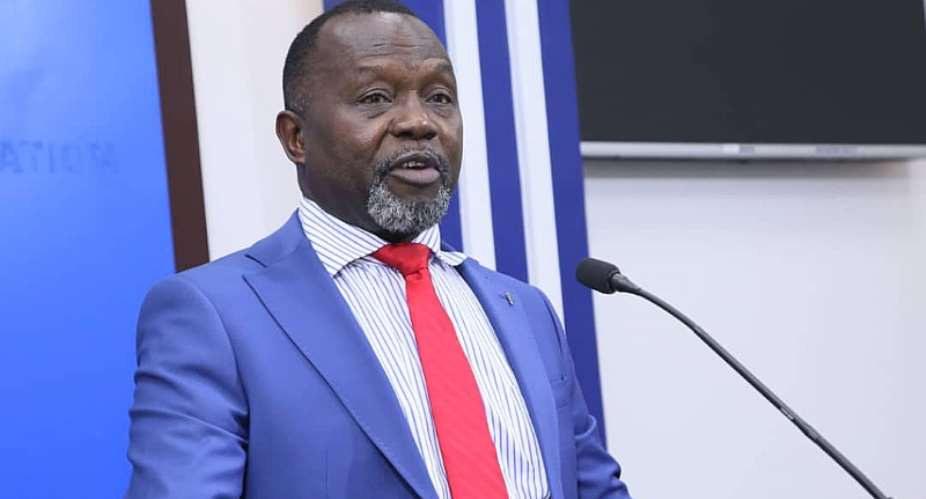
The government has accepted far-reaching constitutional reforms that will separate the Office of the Attorney-General from the Ministry of Justice, ending the long-standing arrangement under which the Attorney-General also serves as Minister for Justice.
Attorney-General and Minister for Justice, Dr. Dominic Ayine, announced the proposal on Thursday, July 30, 2026, while presenting the government's White Paper on the recommendations of the Constitutional Review Committee (CRC).
As part of the proposed reforms, Article 88 of the 1992 Constitution will be amended to remove the requirement that the Attorney-General must also be appointed as a Minister of State.
“The government proposes that Article 88 be amended to remove the requirement that the Attorney-General be a minister of state.”
Under the new arrangement, a standalone Minister for Justice will be appointed to oversee the justice and legal sector, while the Attorney-General will remain the Republic's chief legal adviser and retain responsibility for the state's prosecutorial functions.
“A separate portfolio of Minister of Justice will be established to oversee the justice and legal sector. The Attorney-General will remain the principal legal adviser of the Republic and the repository of the prosecutorial authority of the state but will cease to be a minister of state and a member of Cabinet.”
Dr. Ayine said the objective of the reforms is to strengthen the independence of the Attorney-General by insulating the office from political and executive influence.
To further safeguard that independence, the government is proposing an amendment to grant the Attorney-General the same terms and conditions of service as a Justice of the Supreme Court.
“To guarantee the prosecutorial independence of the office, a new clause will be inserted in Article 88 to give the Attorney-General the same terms and conditions of service as a Justice of the Supreme Court.”
He explained that the reforms would also enhance the security of tenure of future Attorneys-General by making their removal subject to the same constitutional procedure applicable to Justices of the Superior Courts.
“Whoever is appointed Attorney-General after these amendments come into effect, if you want to remove that person, you have to go through the procedure enumerated under Article 146 of the Constitution.”
Article 146 of the Constitution outlines the process for removing Superior Court judges, including the submission of a petition and a determination of whether a prima facie case has been established before further proceedings can commence.
Describing the proposal as one of the most significant institutional reforms contained in the White Paper, Dr. Ayine said the changes would fundamentally reshape the legal structure of the Executive.
“This is a significant restructuring of the legal architecture of the executive and I believe history will judge it kindly.”
The Attorney-General also disclosed that the government has accepted, in principle, the Constitutional Review Committee's recommendation to establish an independent anti-corruption institution.
However, instead of creating the body through a constitutional amendment, the government intends to establish a Public Ethics Commission through the Conduct of Public Officers Bill currently before Parliament.
According to Dr. Ayine, the proposed commission will be empowered to investigate allegations of corruption and conflicts of interest involving public office holders and, in appropriate cases, prosecute offences independently of executive control.

 Govt backs constitutional reforms to separate Attorney-General's Office from Jus...
 Govt approves proposal to allow dual citizens to hold most public offices
 Government approves CRC proposal to cap Parliament at 300 seats
 Govt approves constitutional cap of 60 ministers
 Godfred Dame demands explanation from AG over Sedina Tamakloe acquittal
 High Court ruling that jailed Sedina Tamakloe 10 years had merit — Attorney-Gene...
 Gov't accepts proposal to extend presidential term to five years, sets minimum a...
 NPP to communicate position on Sedina Tamakloe's 'shocking' acquittal in due cou...
 We will appeal Sedina Tamakloe's acquittal, file stay of execution— Attorney-Gen...
 Appeal Sedina Tamakloe's acquittal if you want to protect your legacy — Brako-Po...

