




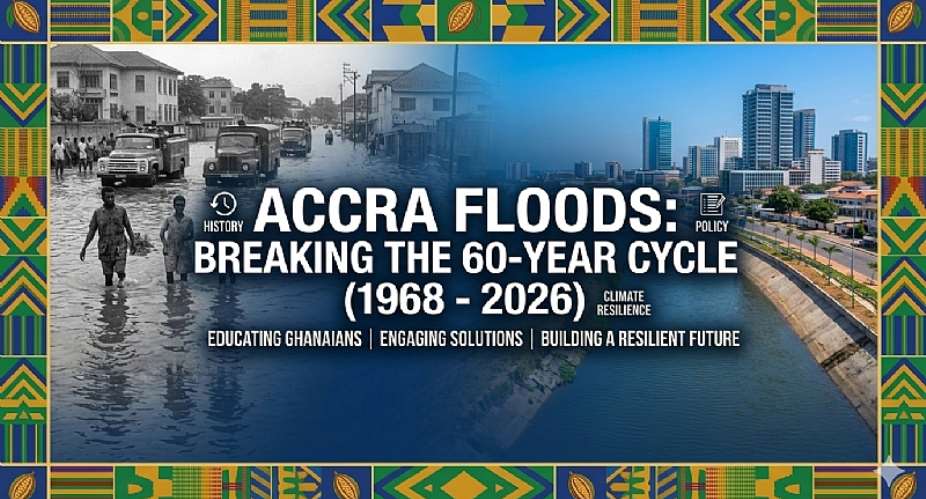
In July 1968, archival cameras captured a submerged Accra: military helicopters rescuing desperate citizens from rooftops, roads swallowed by raging torrents, and families displaced by over five inches of relentless rainfall. Today, nearly six decades later, the headlines remain tragically identical. Despite millions of dollars poured into engineering projects, seasonal rains continue to turn our capital’s economic hubs—from Kwame Nkrumah Circle to Kaneshie and Alajo—into dangerous, waterlogged disaster zones.
Flooding in Accra is no longer just a seasonal inconvenience; it is a profound structural, economic, and humanitarian crisis that threatens Ghana's development. While the historic 1968 flood was largely an act of nature, modern flooding is an artificial catastrophe driven by human activity, weak regulatory enforcement, and clogged infrastructure. To build a resilient Ghana, we must look beyond reactive military rescues and temporary dredging. This article bridges the gap between historical data and modern urban planning, offering actionable recommendations to transform Accra from a city under water into a beacon of climate-resilient development.
The Historical and Academic Reality: What the Data Tells Us
To solve Accra’s flooding problem, we must first understand the unique geographical and human factors that drive it:
- The Topographical Trap: Accra sits on a natural coastal incline nestled between the Akwapim Ridge to the north and the Gulf of Guinea to the south. Rainwater from the northern hills naturally surges downward through a network of rivers and streams—including the Odaw and Onyasia rivers—meaning low-lying areas will always bear the brunt of heavy storms.
- The Death of Natural Buffers: Rapid, unchecked urban land reclamation has destroyed the city's natural retention basins. Recent satellite mapping from the Greater Accra Resilient and Integrated Development (GARID) project reveals that the KJO stream feeding the Kushi Lagoon has been choked from its original width of 261 meters down to a mere 10.6 meters due to aggressive illegal building.
- The Solid Waste Stranglehold: Public drainage networks across the capital are routinely used as informal dumping sites for plastic and household refuse. This solid waste solidifies inside underground culverts, drastically reducing the volume of water the drainage system can handle during peak runoff periods.
- A 60-Year Policy Inertia: Academic reviews frequently point out that Accra's flood crisis is decades old and entirely predictable. While early historical disasters were driven by pure meteorological volume, modern floods are severely magnified by our collective failure to align urban migration with sustainable zoning.
Current Mitigation Efforts: Progress and Performance Pitfalls
Ghana is currently executing several major civil engineering overhauls, but systemic bottlenecks continue to slow down our progress:
- The GARID Project Extension: The flagship $350 million World Bank-backed GARID project, designed to mitigate risks in the Odaw River basin, has seen its timeline formally extended to 2027. Silt clearing and dredging along the critical Odaw River channel are only slightly above 40% complete, leaving major choke points exposed.
- Aggressive Buffer Enforcements: The National Flood Mitigation Task Force—spearheaded by the Ministry of Works and Housing alongside the Ghana Armed Forces—has shifted to a zero-tolerance policy. High-profile demolitions have recently flattened illegal structures blocking waterways in East Legon (Tesa Dam enclave), Airport Hills (New England), and the Oyarifa channels.
- The Slum Strategy Framework: The state has introduced the National Slum Upgrading and Prevention Strategy (2026–2035) to address the root cause of waterway encroachment by planning formal, affordable housing alternatives for low-income urban migrants.
- The Fiscal Bottleneck: Despite high-level engineering blueprints, field operations have faced setbacks due to strict fiscal control measures and funding caps from the Ministry of Finance, which have occasionally delayed contractor payments and halted field operations.
Actionable Recommendations for a Flood-Resilient Accra
To break this vicious cycle, Ghana's policymakers, traditional leaders, and citizens must collaborate on a multi-pronged strategy:
- Enforce Zoning Laws Without Political Interference: Municipal and District Assemblies (MMDAs) must strictly enforce building permits. Any structure erected on a designated wetland, riverbed, or natural flood buffer must be demolished immediately, regardless of the owner's political affiliation or social standing.
- Accelerate and Decentralize the GARID Project: The Ministry of Finance must prioritize the consistent release of funds to GARID contractors. Furthermore, the model used for the Odaw River basin must be expanded to secondary and tertiary drainage networks across peripheral districts like Ga East and Ga West.
- Implement a Circular Economy for Plastic Waste: The government should introduce aggressive fiscal incentives for plastic recycling companies. Transitioning from standard waste disposal to a localized "cash-for-trash" plastic collection system will naturally prevent plastics from entering and clogging our gutters.
- Introduce Punitive Sanitation Bye-Laws: Local assemblies must transition from gentle public education to strict legal prosecution. Individuals and businesses caught dumping refuse into open drains must face steep, non-negotiable fines or mandatory community service.
- Mandate Permeable Paving in Urban Architecture: Future building codes for commercial properties in Accra should mandate the use of permeable pavements and green spaces rather than solid concrete. This allows rainwater to seep directly into the ground rather than compounding surface runoff.
The archival echoes of July 1968 should serve as an urgent warning, not a permanent blueprint for Accra's future. For over half a century, Ghana has treated flooding as an unpredictable natural emergency rather than what it truly is: a systemic failure of urban governance and civic discipline. Engineering solutions like the GARID project are vital, but they cannot save a city that actively builds over its own rivers and chokes its own drains with plastic waste.
Accra's transformation requires an unyielding political will to enforce zoning laws, an uninterrupted flow of state funding for infrastructure, and a radical shift in our collective sanitation culture. We must honor the memory of those lost in past disasters by building a capital city that stands resilient against the changing climate. The blueprints, the academic data, and the historical lessons are all readily available. It is time to stop managing the disaster and start engineering the solution.
✍️ Retired Senior Citizen
For and on behalf of all Senior Citizens of the Republic of Ghana 🇬🇭
📍 Teshie-Nungua
📧 [email protected]


 NAIMOS arrests 19 in Mpohor Fiase anti-galamsey operation
 ECOWAS, partners reaffirm commitment to advancing gender equality and women’s em...
 Court of Appeal acquits and discharges former MASLOC CEO Sedina Tamakloe, overtu...
 WAEC releases BECE 2026 results, cancels entire results of 105 candidates
 Infantino defends FIFA investment plan amid mounting backlash
 US carries out 'powerful' strikes on Iran after attacks on bases and regional al...
 Ayariga Hails Supreme Court Ruling on Delegate System… But Warns of Rising ‘Mone...
 Government must come clean on VALCO's future — Minority
 Supreme Court ruling abolishing delegate system creates more problems than it so...
 “End of the cocoa season pandemic” — Barker-Vormawor hails SC ruling on delegate...

