




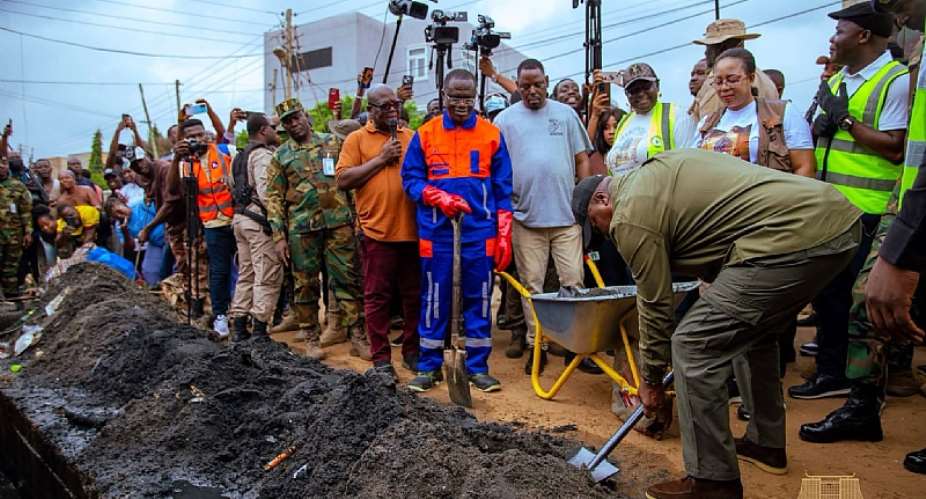
The recent calls for communal clean-up exercises are welcome, but let us not deceive ourselves: cosmetic and ad hoc clean-ups alone will never solve Ghana’s sanitation crisis.
We have been here before.
Chairman Jerry John Rawlings championed similar exercises in the 1980s. While they created public awareness and temporarily cleaned our communities, they did not fundamentally change attitudes, behaviours, or the institutions responsible for maintaining sanitation. Decades later, we continue to grapple with the very same problems.
I have just returned from my late-afternoon walk, wearing a sweat-inducing sauna jacket as part of my fitness routine. My walk took me through a local park here in the UK, where I witnessed a simple but powerful lesson in civic responsibility.
A lady approached with her pet dog. The dog stopped to answer nature’s call, leaving a sizeable mess on the grass. Without hesitation, the owner slipped a plastic bag over her hand, picked up the waste, tied the bag securely, and disposed of it in a designated dog-waste bin nearby. It was an ordinary act—yet it spoke volumes.
The point of this story is not to glorify Britain or to criticise Ghana for its own sake. It is to illustrate the difference that culture, institutions, and law enforcement can make.
I still remember the first piece of advice my late aunt gave me when I arrived in Britain. In her characteristic Cape Coast Fante, she said, “Here in the UK, you can’t just stand anywhere in public to urinate ooo.” That simple warning reflected a society where people understand that public spaces belong to everyone—and that keeping them clean is a shared responsibility.
Such habits did not develop overnight, nor did they emerge simply because people pray more or attend church or mosque more frequently. They evolved because governments invested in sanitation infrastructure, established clear rules, educated the public, and—above all—consistently enforced the law.
People obey sanitation regulations because they know the law applies to everyone. Whether rich or poor, influential or ordinary, there are consequences for violating public health and environmental regulations. That consistency has shaped behaviour over generations.
The lesson for Ghana is obvious.
Government must move beyond periodic communal clean-up campaigns and adopt a comprehensive national sanitation policy backed by sustained investment. Adequate waste bins, reliable refuse collection, modern disposal facilities, sanitation personnel, environmental inspectors, and public education must become permanent features of our communities—not occasional political events.
At the same time, citizens must be required to obey sanitation laws, and those laws must be enforced fairly and consistently. Without accountability, no amount of public exhortation will produce lasting behavioural change.
Until we build the institutions, provide the necessary resources, and enforce the rules without fear or favour, our sanitation campaigns will remain exactly what they have always been—cosmetic, reactive, and short-lived.
Ghana deserves better. Clean communities are not created by one-day exercises. They are built through effective governance, responsible citizenship, and the unwavering enforcement of the law.


 Mahama wants Ghanaian football talents retained longer to revive premier league
 No businessman will sponsor NPP again because of its ‘evil and greedy nature’ – ...
 Failure to jail corrupt NPP officials will haunt NDC in election 2028 – Hopson A...
 Mamprugu Youth calls for crackdown on fake Facebook accounts over alleged false ...
 Mahama appoints Dr Abdul-Baasit Aziz-Bamba as Acting Director-General of Value f...
 2024 teacher recruits’ salary arrears processed — GES
 NPP's failure to continue E-blocks projects worsened SHS placement crisis — Tank...
 "Fix SHS placement bottlenecks for BECE graduates" — Patricia Appiagyei tells go...
 Dr Ayew Afriye secures police enquiry bail for Efya Royal
 UK stranded Barosky to receive psychological, financial support after his repatr...


Comments
Such a great and well thought out take!