




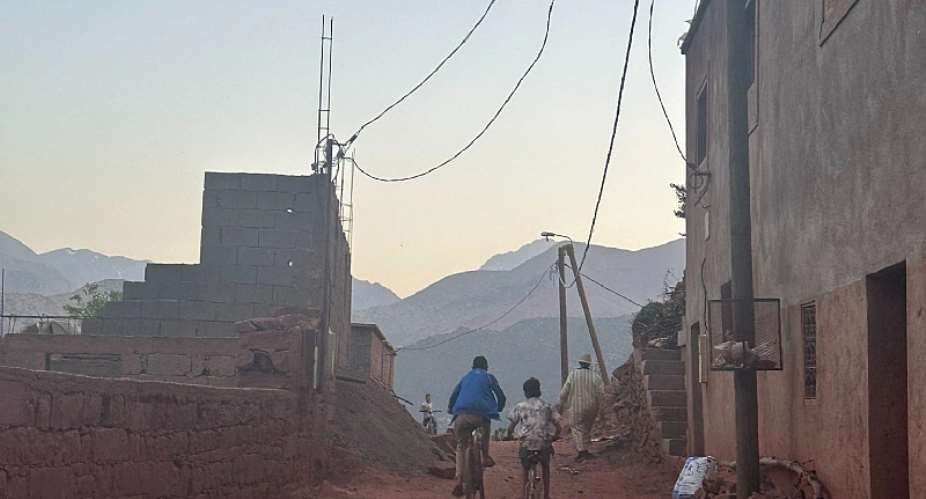
Across Morocco, thousands of young people leave rural communities each year in search of greater opportunity. While some migration is both natural and beneficial, many villages are increasingly losing the generation that will determine their future. This raises an important question: what makes a rural community a place where people can choose to build their future?
The urgency of this question is reflected in Morocco’s changing demographics. Approximately four million Moroccans have migrated internally from rural areas to urban centers, and the country's rural
population is projected to decline from 13.7 to 12.5 million people by 2040. Many factors contribute to this trend, but research suggests that rural youth often leave in search of greater educational and economic opportunities unavailable in their home communities.
There is no single solution for slowing this rural exodus. Water security, resilient agriculture, quality education, healthcare, cell service, and economic opportunity all shape whether people feel they can build a meaningful life. During my work with the High Atlas Foundation this summer, I found that digital infrastructure was often discussed in terms of internet connectivity and telecommunications. But there was a level missing to this conversation: I increasingly came to see connectivity not as an end in itself, but as a foundation that makes many other forms of development possible.
That foundation is still missing for millions of Moroccans. As of 2024, approximately three million Moroccans living in remote and mountainous communities still lacked reliable digital coverage. Although Morocco’s Digital Morocco 2030 strategy aims to expand mobile internet to more than 1,800 rural localities, the significance of these investments extends beyond connectivity alone. Reliable digital infrastructure can strengthen access to education, healthcare, markets, financial services, and entrepreneurship, making it less a competing development priority than an investment that reinforces many others.
Education and women's economic empowerment provide two examples of how digital infrastructure can help people access new opportunities within their communities, reducing some of the pressures that may drive people to leave.
Many students in Morocco’s rural communities face significant barriers to accessing quality education. Long travel distances to secondary schools, limited school availability in remote areas, economic hardship, and teacher shortages all contribute to higher dropout rates and lower educational attainment.
For many families, these barriers mean that pursuing higher levels of education often requires leaving one's community altogether. Educational opportunities remain concentrated in larger towns and cities, forcing many young people to choose between staying close to home and accessing the education needed to pursue their goals.
While digital infrastructure cannot replace classrooms or teachers, it can help reduce some of these barriers. Reliable internet connectivity allows students to access online courses, digital libraries, educational videos, teacher support, and supplemental learning resources regardless of where they live.
As AI-powered educational tools continue to develop, they may further enhance digital learning opportunities by providing personalized explanations, adaptive practice, and individualized academic support. Although these technologies cannot replace in-person instruction, they can help narrow the educational gap between rural and urban students, making it easier for young people to pursue educational opportunities while remaining in their communities.
Women’s economic empowerment serves as another poignant example. Across rural Morocco, women’s cooperatives have become an important source of income, allowing women to earn independent
livelihoods while preserving traditional crafts and agricultural products. However, starting these cooperatives and businesses is more challenging than we may think. During our visit to the village of Anamer, a young woman in an empowerment workshop said she had the dream to start her own clothing brand but felt it was beyond reach. She did not know how to create a business plan, train her employees, and go about selling the clothes.
Reliable internet connectivity could help reduce some of the administrative barriers and make ambitions like hers more attainable. With access to AI-powered business tools that could provide guidance on developing business plans, create marketing materials, translate product descriptions into multiple languages, and reach customers through online marketplaces, more women could feel empowered to start cooperatives.
Building strong infrastructure, however, is only part of the challenge. Many communities have little exposure to the ways in which technology could support their development goals. Without that understanding, communities are inevitably less likely to advocate for investments in digital connectivity or incorporate technology into their initiatives. Digital literacy is not simply about teaching people how to use technology, but also to help imagine what they can achieve with it. This could be another piece of the empowerment workshops.
Digital literacy and strong infrastructure must go hand in hand. People need the knowledge to recognize new opportunities, but they also need the connectivity that allows those opportunities to become reality. This is where organizations like the High Atlas Foundation could play an important role. Alongside its existing development initiatives, HAF could explore partnerships with telecommunications providers and technology companies to expand digital connectivity. Just as its carbon credit program has created innovative partnerships around environmental sustainability, a similar collaborative model could help attract investment in digital infrastructure.
Ultimately, stronger digital infrastructure will not stop every young person from leaving rural Morocco for more urban areas, and it should not. Migration will always be an inevitable part of economic and social change. If rural communities are to remain places where people choose to build their futures, connectivity must be viewed not simply as technology, but as development infrastructure. Paired with the digital literacy to use it well, it can become one important foundation for making opportunity more accessible across rural Morocco.
Lidia Zur Muhlen is a rising third-year Jefferson and Echols Scholar at the University of Virginia pursuing an interdisciplinary major focused on the politics, economics and ethics of emerging technologies. She spent the summer interning with the High Atlas Foundation in Morocco.

 Post-clean-up exercise: Military, other services to continue dredging waterways ...
 Mahama calls for monthly national clean-up exercises to tackle flooding
 Supreme Court must dismiss presidential term limit suit outright — Prof Prempeh
 Firefighters rescue driver after vehicle crashes into ECG pole at Anfoega-Adame ...
 Forestry Commission Youth Champions lock-up Tamale office over unpaid walaries
 I will use any MMDCE who authorise construction on waterways as scapegoat — Lind...
 EPA shuts down fuel station in Kasoa over choked drains
 Presidency to demolish encroaching structures around Tesa Dam, East Legon to red...
 Ghanaians in Nigeria urge Mahama, Tinubu to intervene in JonahCapital dispute
 President Mahama joins Tse Addo residents for National Clean-up Exercise

