




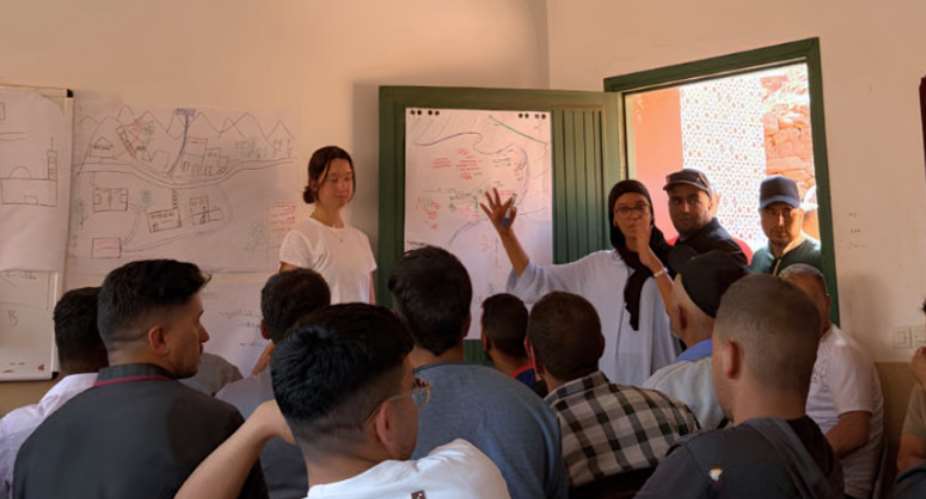
During my time in Morocco, I saw teens engaging with and planning for the “real world” in ways that back in the states took me at least until my university years to tap into. In a community mapping activity in Anamer, teens worked with men who could’ve been their grandfathers to identify the most pressing needs of their communities. In a workshop with Camp Alima (STEM camp for girls) and the High Atlas Foundation (nonprofit working at the intersection between participatory development and climate awareness), one young girl remarked about her plans to go to university in Germany: “Yeah, it’s scary. But isn’t that just more of a reason to do it?”.
These instances of adolescence I observed exemplify some of the best of the adolescent developmental time frame, namely intellectual curiosity, risk taking, and attunement to roles where they get to play a real role. However, I soon learned that the youth purposefulness I saw in these two instances were, at least somewhat, an exception to the rule in Morocco. Demographic research behind the significant Moroccan “NEET” (not in employment, education, or training) cohort indicates that the country struggles to help adolescents make the jump to adulthood. 33.6% of Moroccan youth aged 15 -29 years old were estimated to be NEET in 2023, and recent reports suggest that percentage has stabilized rather than decreased in the most recent years.
These statistics on youth unemployment are concerning for obvious economic and psychosocial reasons. Will recent graduates get jobs? And what will happen if they do not? However, perhaps the question we should be asking more frequently focuses on the teens coming of age in a context that tells them that little “real life” starts until the mid or late 20s. If getting jobs and becoming an adult has been pushed to the 20s, what are adolescents supposed to be doing? In the presence of such unemployment, what is adolescence’s purpose? Morocco’s unemployment rates put teens at risk of the symptoms of what American psychologists Joe and Claudia Allen have termed an “endless adolescence”, turning the teen years into a sort of waiting room before the rest of real life starts right as youth are developing the skills to take on real life.
Across the globe, “adolescence” has come to represent a very distinct age range and peer culture, set apart from the rest of the lifespan before and after it. And yet, it’s incredibly ambiguous when this very specific and yet ubiquitous developmental stage ends. While the onset of puberty may mark its beginning, there’s no clear biological indicator that adolescence has run its course. The ending of this “distinct” developmental stage may shape, stretch, and respond to the society and culture in which it exists, irregardless of reflecting when teens become cognitively or physically “adults”.
This ambiguity has pretty significant implications. While many years ago the context surrounding adolescence placed it within a developmentally reasonable time frame, now it seems that adolescence may stretch long after teens are developmentally adult. If Morocco’s teens are staying home after high school and graduates remain unemployed for years at a time, it’s clear that sociocultural factors have extended adolescence beyond its appropriate length. American psychologists may have originally coined the term based on a U.S. context, but this adolescent integration problem shares striking features across international contexts: the developmental and professional tasks that should characterize adolescence have been pushed to later in the lifespan, leaving Moroccan adolescents at home, biding their time until such tasks begin.
In other words, this “endless adolescence” trend matters because it strips adolescents of their developmental tasks, leaving them hopelessly far away from entering the real workforce, with few pathways to express their growing abilities and desire for responsibility, autonomy, and independence. Externalizing and internalizing problems may crystallize as alluring alternative pathways for teens to establish their incoming adulthood. In their book Escaping the Endless Adolescence: How We Can Help Our Teenagers Grow Up Before They Grow Old, Allen and Allen also cite teens revealing that the rewards of education were too far off to work hard in school, that disordered habits give them control in a way little else can, and that deviancy is a way to express adult-like abilities in an isolated adolescent context.
By removing the developmental stage’s purpose, Morocco’s unemployment rates risk these kinds of outcomes for their teens. The youth employment problem in Morocco is pressing for a number of reasons. But to forget about the teens that this problem leaves behind is only to add another psychosocial layer to the issue. Without re-establishing the purpose of adolescence, youth will enter an already difficult job market without the social and professional skills they were supposed to learn in their teen years.
Thankfully, diagnosing an endless adolescence also provides a path forward. If an endless adolescence is the problem, then the solution is to recognize that adolescence serves a distinct purpose for a distinct time frame. It is a developmental period with specific tasks that align with the strengths that teens specifically bring to the table: their awkwardness, their frustrating inclination towards conflict, but also their desire to do something real and to matter, to explore, to take risks, and to build lasting connections with peers, as demonstrated by both the youth in Anamer and with Camp Alima. Moroccan teens already have the inclination towards growth, they just need programs to give them real responsibility and purpose, now. Reclaiming adolescence as a meaningful, specific time frame fills it with the purpose that teens need.
Mary Roper is a fourth year student at the University of Virginia studying Youth and Social Innovation and Psychology. She is interning with the High Atlas Foundation in Marrakech, Morocco over the summer.

 Ridge Hospital seeks relatives of unidentified woman injured in accident
 Kasoa: Firefighters pelted with stones over faulty fire tenders, 15 shops destro...
 Obuasi SHTS headmaster arrested over sexual misconduct allegations – Muntaka
 GoldBod says 76% of gold exported since August refined locally
 15 errors out of 1,964 names of South Africa evacuees due to pressure, we deserv...
 'No disturbances again' — Asiedu Nketiah urges calm over late Ahafo Ano South-We...
 Govt to distribute first batch of 129 vehicles to MMDCEs in 12 regions
 UG Vice-Chancellor calls for oral exams, project-based assessment to deal with A...
 'I will use everything I have to clear my name' – Obuasi SHTS headmaster fights ...
 'It's a curse on you' – Water Minister badmouths 'malware' workers sabotaging Gh...


