





Ghana's overall economic activity has grown year-on-year in every one of the 27 months measured (January 2024 – March 2026), averaging 6.0% annual growth, with no month showing a contraction.
The services sector has been the most consistent driver of growth, expanding year-on-year in all 27 months and averaging 7.2% growth, faster than agriculture (4.8%) or industry (5.1%).
Industry activity slowed sharply through 2025, averaging just 2.3% year-on-year growth, down from 7.5% in 2024, before rebounding to an average of 6.9% in the first quarter of 2026.
Agriculture is by far the most volatile sector, swinging by as much as 58 index points between its highest reading (November 2024) and its lowest (April 2025), more than double the swings seen in industry or services.
Early 2026 data show total growth running slightly above the same period a year earlier (6.4% versus 6.1%), suggesting the broader expansion carried into the new year.
Why This Matters
Sustained, broad-based growth in Ghana's real economy is relevant to businesses planning investment, workers, and government revenue projections. Consistent services growth supports urban employment and trade, while agriculture's large swings complicate food-price and rural-income planning, since they are associated with seasonal harvest timing rather than a clear directional trend. Industry's shift from strong 2024 growth to weak 2025 growth and back to strong early-2026 growth is relevant to manufacturers, energy planners, and construction and mining firms tracking demand cycles.
Policymakers at the Ministry of Finance and Bank of Ghana use these monthly readings, alongside inflation and trade data, to judge whether growth is broad-based or concentrated in a few sectors. Investors and ratings agencies watching Ghana's economic recovery will be watching whether industry's early-2026 rebound holds, given how sharply the sector slowed the year before.
Detailed Analysis
Finding 1: A sustained, unbroken expansion.
Total economic activity, as captured by the MIEG, posted positive year-on-year growth in all 27 months from January 2024 through March 2026, averaging 6.0% and ranging between 2.7% and 10.8%. Not a single month in this period recorded an outright year-on-year contraction in the total index.
This pattern is associated with resilience across the measured period rather than a single strong sector masking weakness elsewhere, since growth was recorded across a range that never dipped below zero even during months when individual sectors like industry or agriculture weakened.
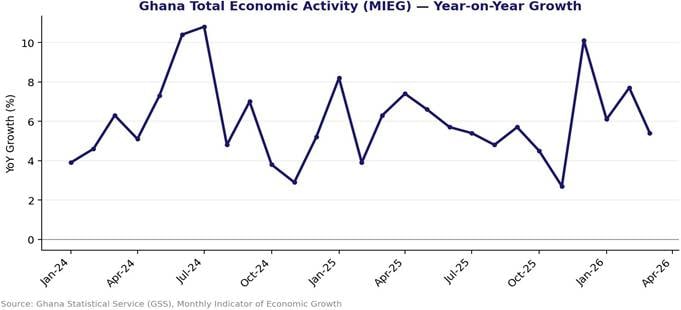
Source: Ghana Statistical Service (GSS), Monthly Indicator of Economic Growth
Finding 2: Services is the most consistent growth driver.
Services recorded positive year-on-year growth in every one of the 27 months, averaging 7.2% and ranging from 1.9% to 15.1%, the only sector with a perfect record of positive readings. Services' index level also shows the strongest statistical association with the total index (correlation of 0.85), compared with 0.76 for industry and 0.74 for agriculture.
This close association suggests that movements in the total index are more closely tied to what happens in services than in the other two sectors, consistent with services' role as the largest and steadiest component of measured activity.
Finding 3: Industry slowed sharply in 2025, then rebounded.
Industry growth averaged 7.5% in 2024 but fell to just 2.3% across 2025, including four months of outright year-on-year contraction (December 2024, March, July, and November 2025). Growth then recovered to an average of 6.9% in the first quarter of 2026.
The size and timing of this swing is associated with a distinct 2025 slowdown followed by a distinct early-2026 pickup, rather than a smooth or steady trend across the three years of available data. 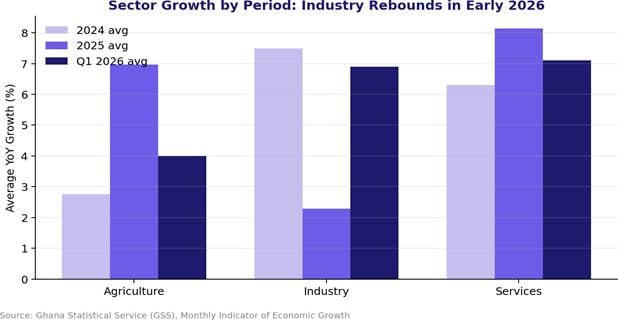
Source: Ghana Statistical Service (GSS), Monthly Indicator of Economic Growth
Finding 4: Agriculture is the most volatile sector by a wide margin.
Agriculture's monthly index level has a standard deviation of 15.95, more than double that of industry (6.27) or services (7.71). Its index ranged from a high of 135.5 (November 2024) to a low of 77.6 (April 2025), a swing of nearly 58 points.
These large, repeating swings are associated with the sector's seasonal harvest cycle rather than a sustained upward or downward trend, since high and low readings recur at similar points across each of the three years in the dataset. 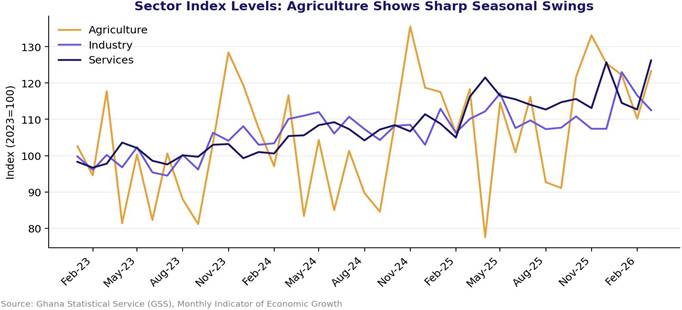
Source: Ghana Statistical Service (GSS), Monthly Indicator of Economic Growth
Finding 5: Early 2026 momentum is running slightly ahead of last year.
Total year-on-year growth for the first quarter of 2026 averaged 6.4%, compared with 6.1% for the same three months in 2025. This uptick is associated with gains in both industry (6.9%) and services (7.1%), while agriculture's contribution was smaller (4.0%) but still positive.
Because all three sectors posted positive growth in the first quarter of 2026, the early-year reading is associated with broad participation across the economy rather than a single sector driving the total figure.
Recommendations
- Ghana Statistical Service: Publish a seasonally-adjusted agriculture series alongside the raw index, since large month-to-month swings are associated with harvest timing and can obscure the sector's underlying trend for readers.
- Bank of Ghana and Ministry of Finance: Track industry sub-components (manufacturing, mining, construction, utilities) monthly to assess whether the Q1 2026 rebound reflects a durable recovery or a temporary bounce, given the sharp 2025 slowdown.
- Association of Ghana Industries and manufacturers: Factor industry's demonstrated year-to-year volatility into investment and production-timing decisions rather than extrapolating from any single quarter.
- Development partners and investors: Weigh services-sector consistency as a more stable near-term signal of economic momentum than industry, given services' unbroken record of positive growth.
- Ghana Statistical Service: Release a disaggregated breakdown of the industry sub-index to help identify which specific components (e.g., mining, manufacturing) drove the 2025 decline and 2026 rebound.
Methodology Snapshot
This brief draws on the Monthly Indicator of Economic Growth (MIEG) published by the Ghana Statistical Service, which indexes agriculture, industry, and services activity to a 2023=100 base. The analysis covers 39 months of index levels (January 2023–March 2026) and 27 months of year-on-year growth rates (January 2024–March 2026). Sector volatility was
measured using the standard deviation of monthly index levels, and each sector's association with total growth was assessed using Pearson correlation between sector and total index levels over the full period.
Limitations
- The MIEG is a monthly activity indicator and is not a substitute for Ghana's official quarterly GDP figures; the two series can diverge.
- No seasonally-adjusted series was available, so agriculture's swings partly reflect harvest timing rather than underlying momentum.
- The dataset does not break industry into manufacturing, mining, construction, and utilities, limiting diagnosis of the 2025 slowdown's specific source.
- Only 27 months of year-on-year data are available, which is a short window for establishing longer-run cyclical patterns.
- All findings describe association and timing between series, not the underlying causes of sector performance.
Authors: Yussif Mohammed, Andy Sevordzi, Rudolph Djirackor, Franklin Owusu Kwakye
Sources / References
• Ghana Statistical Service (GSS), Monthly Indicator of Economic Growth (MIEG) dataset, January 2023 – March 2026.
 Post-clean-up exercise: Military, other services to continue dredging waterways ...
 Mahama calls for monthly national clean-up exercises to tackle flooding
 Supreme Court must dismiss presidential term limit suit outright — Prof Prempeh
 Firefighters rescue driver after vehicle crashes into ECG pole at Anfoega-Adame ...
 Forestry Commission Youth Champions lock-up Tamale office over unpaid walaries
 I will use any MMDCE who authorise construction on waterways as scapegoat — Lind...
 EPA shuts down fuel station in Kasoa over choked drains
 Presidency to demolish encroaching structures around Tesa Dam, East Legon to red...
 Ghanaians in Nigeria urge Mahama, Tinubu to intervene in JonahCapital dispute
 President Mahama joins Tse Addo residents for National Clean-up Exercise

