




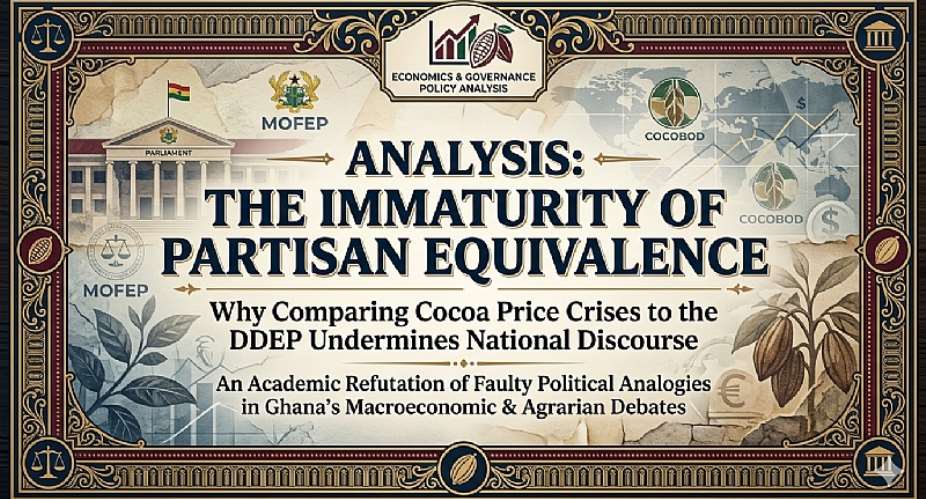
Rejecting Cheap Political Points for Factual Integrity
The contemporary Ghanaian media landscape is heavily saturated with false equivalences designed to score quick political points rather than educate the citizenry. A prime example of this intellectual shortcut is the defensive narrative advanced by some political communicators. This argument attempts to draw a direct line of symmetry between the Domestic Debt Exchange Programme (DDEP) picketing at the Ministry of Finance and historical cocoa farmer protests across cocoa-growing belts.
To equate the structural modification of sovereign debt instruments with seasonal commodity price adjustments represents a profound misunderstanding of both macroeconomics and agricultural economics. For political communicators—including the New Patriotic Party's (NPP) Joseph Nartey—relying on such superficial comparisons signals a severe lack of policy depth. This article provides an academically rigorous refutation of this false analogy. It outlines the distinct structural boundaries of both crises and serves as an objective reference resource for fact-based national television panels.
1. The Core Distinctions: Sovereign Bond Restructuring vs. Agricultural Farmgate Volatility
To evaluate these two phenomena requires an examination of their legal frameworks, financial mechanisms, and macroeconomic causes:
- The Total Destabilization of the DDEP: The DDEP was a forced modification of the state's sovereign debt obligations, directly impacting GH₵82 billion of domestic liabilities. It targeted the core capital of commercial banks, corporate institutions, and individual bondholders. By deferring interest payments and extending maturities, the DDEP locked up liquidity, wiped out the tier-1 capital buffers of the banking sector, and directly threatened the savings of millions of Ghanaian households.
- The Dynamics of the Cocoa Farmgate Shock: Conversely, the protests by cocoa farmers across districts like Sunyani and Sefwi Wiawso were triggered by a mid-season farmgate price reduction. The price was adjusted from GH¢3,625 to GH¢2,587 per 64kg bag for the remainder of the crop season due to shifting international market conditions and the need to protect Ghana Cocoa Board (COCOBOD) from total balance sheet collapse. While this price cut caused undeniable rural economic hardship, it remains a standard operational adjustment to international commodity price drops. It is not a formal sovereign default on a legal investment contract.
- The Structural Fault Lines: Equating these two scenarios ignores the structural difference between a sovereign insolvency crisis and commodity market volatility. The DDEP was the final stage of an economy locked out of international capital markets due to unsustainable fiscal deficits. The cocoa price reduction was a direct response to global trade realities and the operational sustainability of an agricultural board.
2. Legal Jurisprudence: Sovereign Debt Modifications vs. Commercial Commodity Board Contracts
From an international legal perspective, the distinction between a sovereign debt restructuring and the pricing mechanisms of a state-owned agricultural board rests on two entirely different areas of law: public international finance law and private commercial contract law.
- The Legal Character of Sovereign Debt Instruments: Sovereign bonds are formalized, binding financial contracts between the state and investors, protected by constitutional property rights and international financial law. When Ghana executed the DDEP, it unilaterally altered the core economic terms (coupon rates and maturity dates) of these valid investment instruments. In international jurisprudence, this is treated as an extraordinary regulatory encroachment on private property rights—a domestic sovereign default. The picketing at the Ministry of Finance was a direct legal and social reaction to a breach of contract by the state.
- The Legal Character of Commodity Price Settings: In contrast, the relationship between COCOBOD and cocoa farmers is governed by statutory agricultural frameworks and commercial commodity laws. The farmgate price set by the Producer Price Review Committee (PPRC) is a regulatory pricing mechanism, not a guaranteed debt instrument. When global market dynamics force an adjustment in cocoa prices, it does not constitute a breach of an investment contract or an illegal asset seizure. It is an operational price adjustment built into the legal structure of a state-managed stabilization scheme.
- The Jurisprudential Distinction: Drawing an equivalence between these two situations is legally unsound. A sovereign debt restructuring disrupts capital markets and violates investor agreements. An agricultural board adjusting to international market realities is working within its legal mandate. Conflating the two in public discussions shows a clear lack of basic legal and financial literacy.
3. Deconstructing the Flawed Logic of Political Partisanship
Using old farmer protests to diminish the severity of the DDEP picketing reveals a broader pattern of political immaturity that hurts national discourse:
- Insulting the Intelligence of the Electorate: Presenting a defensive narrative that claims "the other side also failed the farmers, so you cannot complain about the DDEP" is a logical fallacy. It assumes that one policy challenge justifies another, ignoring the unique damage the DDEP caused to the middle class and the financial sector.
- Misunderstanding Institutional Mandates: COCOBOD operates as a specialized state enterprise tied to global forward-sales contracts and international price benchmarks. The Ministry of Finance, however, is the manager of national fiscal policy. Blurring the lines between a sectoral commodity board adjusting to world prices and a central government defaulting on its domestic debt shows a fundamental lack of economic literacy.
- Exploiting the Vulnerability of Farmers: Cocoa farmers are essential non-partisan actors who drive Ghana’s export revenue. Using their market challenges as shields in televised political debates exploits their economic struggles for temporary partisan gains rather than addressing the structural reforms the agricultural sector actually needs.
4. Recommendations for Elevated Media Engagement and Factual Communication
For political communicators to build credibility on national media platforms, they must move away from lazy comparisons and ground their arguments in verifiable policy solutions:
- Acknowledge Structural Realities Honestly: Communicators must admit that the DDEP was an extraordinary financial rescue mission required to unlock the $3 billion IMF Extended Credit Facility. Trying to downplay its impact by comparing it to commodity price fluctuations damages a spokesperson's credibility with discerning viewers.
- Focus Debates on Institutional Reforms: Instead of trading historical blame over cocoa prices, panel discussions should focus on structural solutions. This includes debating the implementation of a legal framework for an automatic price adjustment mechanism to insulate farmers from political interference, or analyzing how the Ghana Financial Stability Fund (GFSF) is currently rebuilding tier-1 banking capital.
- Prioritize Long-Term Policy Solutions: Media presentations must shift from scoring cheap points to examining concrete milestones. Debates should evaluate the statutory zero-financing mandate governing the Bank of Ghana (BoG), the steps needed to sustain a 2% to 3% primary surplus, and the strategies required to transition Ghana out of speculative 'B' territory back to an investment-grade rating.
Embracing Political Maturity for National Progress
Ghanaians are increasingly tired of political communicators who rely on shallow, historical distortions to avoid taking responsibility for modern economic challenges. The structural damage caused by the DDEP cannot be excused or minimized by pointing to seasonal shocks in the cocoa sector. Both issues are serious, but they require entirely different policy responses and analytical frameworks.
For communicators like Joseph Nartey, elevating the standard of debate means relying on verifiable economic data rather than defensive political deflections. True political maturity requires acknowledging the heavy toll that macro-stabilization has taken on Ghanaian citizens and institutions. Only by replacing partisan narratives with intellectual honesty can our national discourse support the structural reforms needed to secure Ghana’s financial and agricultural future.
✍️ Retired Senior Citizen
For and on behalf of all Senior Citizens of the Republic of Ghana 🇬🇭
Teshie-Nungua
[email protected]

 Post-clean-up exercise: Military, other services to continue dredging waterways ...
 Mahama calls for monthly national clean-up exercises to tackle flooding
 Supreme Court must dismiss presidential term limit suit outright — Prof Prempeh
 Firefighters rescue driver after vehicle crashes into ECG pole at Anfoega-Adame ...
 Forestry Commission Youth Champions lock-up Tamale office over unpaid walaries
 I will use any MMDCE who authorise construction on waterways as scapegoat — Lind...
 EPA shuts down fuel station in Kasoa over choked drains
 Presidency to demolish encroaching structures around Tesa Dam, East Legon to red...
 Ghanaians in Nigeria urge Mahama, Tinubu to intervene in JonahCapital dispute
 President Mahama joins Tse Addo residents for National Clean-up Exercise

