




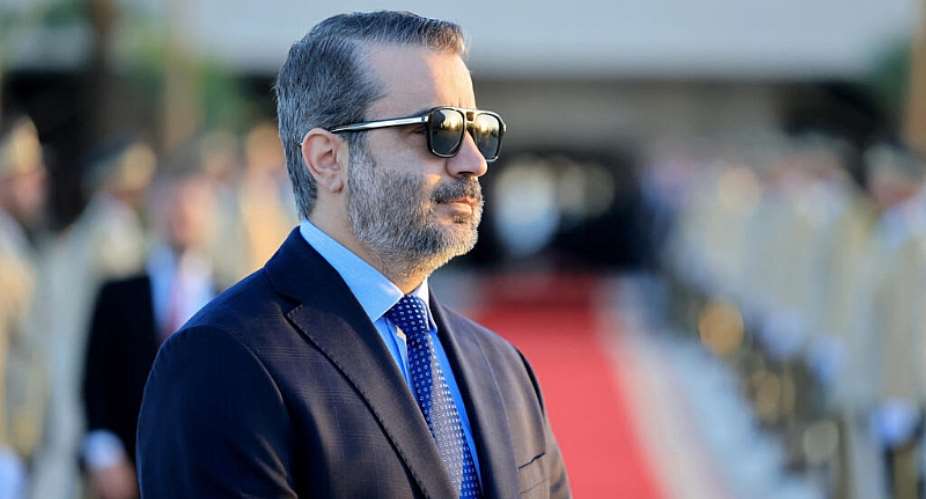
The rockstar welcome on the streets of the northern Lebanese city of Tripoli started in the late afternoon on Thursday, July 2, and continued well after sundown, with flares and bonfires illuminating the night sky as the crowds roared.
Syrian Foreign Minister Asaad al-Shaibani was visiting, and his motorcade could barely make its way through the packed streets of Lebanon's second-largest city. When it finally reached the gates of Dar al-Fatwa, Lebanon's highest Sunni religious institution, Syria's top diplomat, dressed in his now de rigueur dark suit, emerged from the car – and was promptly carried aloft on the shoulders of his supporters. Syria's Foreign Minister Asaad al-Shaibani greets supporters in the northern Lebanese city of Tripoli on July 2, 2026.
Two days later, Shaibani was in Doha, meeting his Qatari counterpart. Next, he was on the tarmac of the Damascus International Airport, welcoming French President Emmanuel Macron, the first major Western leader to visit Syria since the fall of the Assad regime. On Wednesday, the Syrian foreign minister was in the room as his boss, President Ahmed al-Sharaa, met US President Donald Trump on the sidelines of a NATO summit in Turkey.
By the end of a long day, Shaibani had finally shed his coat and tie to pose with Sharaa inside a plane with a diplomatic prize: a letter from Trump initiating the process of removing Syria from the US list of state sponsors of terrorism. Syria's Foreign Minister Asaad al-Shaibani and President Ahmed al-Sharaa display US President Donald Trump's letter on July 8, 2026.
Done and dusted, all in a week.
Syria's spectacular transformation on the international stage after decades of sanctions and isolation under the Assad regime is the stuff of diplomatic legend. Headlines have duly noted the Sharaa government's achievements since former president Bashar al-Assad was ousted in December 2024 and news magazine features have detailed Sharaa's improbable rise from jihadist fighter to Syrian president.
One man has stood alongside Sharaa at the heart of the centrifugal force whipping up change in Syria. He's been a steady presence during every diplomatic breakthrough, jetting across the world to prepare the way for his charismatic boss, getting the message across without stealing the spotlight. The hero's welcome on the streets of Tripoli, Lebanon's Sunni heartland city, was a rare display of fandom for a man who has worked quietly behind the scenes to break with more than half a century of Syrian diplomatic tradition under the Assad family.
First diplomatic domino
In his acknowledgment of the Trump administration's move to get Syria off the US list of state sponsors of terrorism, Shaibani noted that, “we have closed a dark chapter in Syria's history by lifting the classification imposed on it in 1979 due to the policies of the defunct regime,” in a post in Arabic on X.
The 39-year-old foreign minister has played a critical role in Syria's new outreach to the West and its attempts to revamp the old way of conducting regional relations. In Lebanon, a tiny country that has been a playground for the geostrategic games of its more powerful neighbours, that attempt is appreciated.
“During that visit to Tripoli, Shaibani got a treatment almost equal to a visiting head of state. The people who follow Syria know him. They know that he's one of the inroads into the new Syrian government,” said Mohamad Bazzi, director of the Hagop Kevorkian Center for Near Eastern Studies and a professor at New York University. “It's safe to say that he has a bit more power than any Syrian foreign minister under the Assad regime. There have been well-known foreign ministers, but they didn't really have power in that system under both the father and the son,” added Bazzi, referring to Syria's former strongmen Hafez al-Assad and his son, Bashar.
Shaibani's first trip abroad as foreign minister came barely two weeks after his appointment, when he landed in Saudi Arabia on January 1, 2025. Riyadh had severed ties with Damascus at the start of the 2011 Syrian revolution and Shaibani's visit to the oil-rich Gulf powerhouse marked a new way of doing business.
It yielded dramatic results. On May 14, 2025, Trump was on a visit to Saudi Arabia when he stunned the world with his announcement that the US would lift sanctions on Syria. Trump credited Saudi Crown Prince Mohammed bin Salman (MBS) for Washington's reach-out. “Oh, what I do for the crown prince,” quipped the US president.
By the next day, Shaara had flown into Riyadh and was meeting the US president. Sitting in the room by Shaara's side was the man who had nudged the first diplomatic domino into place: Foreign Minister Shaibani. Syrian Foreign Miister Asaad al-Shaibani (extreme left) shown in Riyadh with US President Donald Trump and Saudi Crown Prince Mohammed bin Salman on May 14, 2025.
The Sharaa administration has “conducted a foreign policy of smart pragmatism”, Bazzi said. “They realised that Trump responds well to strongmen, and so Sharaa was presented as a strong leader who was able to take control of Syria and instigate the fall of Assad,” he added. “And the use of MBS seemed critical, because MBS brokered that initial meeting between Trump and Sharaa.”
Rebel diplomat with a nom de guerre
From rebel ranks in northern Syria to the world's halls of power, it's been a dramatic journey for Sharaa and the loyal comrade who oiled the wheels along the way.
Born in 1987 into a Sunni Muslim family in the northeastern Hasaka province, Shaibani moved with his family to the Syrian capital, where he graduated from Damascus University with an English literature degree in 2009. Not long after the anti-Assad uprising erupted in 2011, Shaibani met Sharaa when the two young men belonged to the al Qaeda-linked Nusra Front.
By the time Sharaa, as leader of the Nusra Front, severed ties with al Qaeda, the two men were close associates. The Nusra Front then gave way to Hayat Tahrir al-Sham (HTS), a Sunni Islamist umbrella organisation that merged several militant groups in 2017 and gained full control of the northwestern Idlib province, where a rebel administration branded the “Salvation Government” was established.
In the spring of 2023, Wassim Nasr, FRANCE 24's specialist on jihadist movements, traveled to Idlib, where he met Sharaa and Shaibani, becoming one of the few international journalists who met the two men before the fall of Assad.
Shaibani – then known as “Zaid al-Attar”, one of several noms de guerre adopted during the Syrian civil war – was head of the rebel administration's political affairs bureau at that time. Nasr had an hour-and-a-half-long meeting in Idlib with Shaibani, which he later learned was a sort of vetting process before he was taken to meet Sharaa, the HTS leader then known as “Abu Mohammed al-Jolani”.
More than three years later, Nasr vividly remembers his first meeting with Shaibani. “He was a very secretive personality, which made him very efficient,” revealed Nasr. “He had clear ideas. He was always assessing my questions and then assessing his answers before answering quickly. He's thoughtful, not very talkative and gets straight to the point.”
Their meeting didn't exactly get off to a comfortable start. “One of the first things he told me was, 'you're a jihadi movements specialist. We are not a jihadi movement anymore. Why should I talk to you?'” recalled Nasr with a chuckle.
Read more Reporter's notebook: Idlib, the last Islamist rebel bastion in Syria
At that time, HTS was trying to shed its image as a jihadist group. Having severed ties with al Qaeda, its leaders were at pains to end the group's international pariah status by displaying their new local administrative skills, such as by establishing a education ministry using a UNICEF-programmed curriculum and ordering the loathed morality police off the streets.
Shaibani was “the architect of the diplomacy under Hayat, when Hayat started to reach out to the world. Then, when they took power [in Damascus in December 2024], it worked out for him because international actors knew him already,” explained Nasr. “He was never under sanctions. He was one of the rare Hayat personalities who used to travel outside Syria. He was the main person interacting with all the NGOs and institutions. So, when they took over power, he was already doing exactly the same job.”
From Idlib to Damascus – and Moscow
But Idlib is around 300 kilometres and a world away from Damascus. The HTS leadership “prided themselves on their technocratic capability and accomplishments in Idlib. That was one of their big selling points when this group came to power,” Bazzi said. “But Idlib is a province. The central government in Damascus is very different.”
The security and geopolitical complexities of running Syria – a country with a multifaith population of around 25 million sharing borders with five countries – presents domestic and foreign policy challenges.
Shortly after sweeping into Damascus in December 2024, when Nasr once again interviewed Sharaa, now the new president, “he said, literally, 'we want zero problems with our neighbours.' And the only country he cited by name was Israel,” recounted the FRANCE 24 expert.
Syria's outreach to Israel started in earnest in the summer of 2025, when Shaibani arrived in Paris at the head of a team conducting US-mediated negotiations. More talks followed in France, Azerbaijan and the UAE, but little progress was made, according to experts.
“They've conducted a smart foreign policy,” Bazzi said. “But the one place that hasn't yielded is Israel. They seem eager to make a deal with Israel, but Israel isn't as eager. That negotiating track has gone cold, and Israel keeps occupying more of Syria. All the friendship and good vibes with Trump... well, Trump hasn't put a stop to it.”
Hours after Assad's regime collapsed on December 8, 2024, Israeli forces launched a large-scale ground operation into southern Syria aimed at capturing a buffer zone between the two countries. Israel has since kept up a steady campaign of military expansion, according to monitoring groups.
The Israeli expansion sparked the new Syrian administration's most dramatic display of a balancing, pragmatic foreign policy, according to some experts.
In July 2025, Shaibani raised eyebrows in Western diplomatic circles when he visited Moscow, where he met with President Vladimir Putin. Months later, Sharaa himself made his first trip to Moscow. The Kremlin had stood firmly with Assad during the brutal civil war until the very end, when Moscow flew the embattled Syrian strongman into exile in Russia. Sharaa was risking the ire of Syrians who suffered death, displacement and destruction during the uprising by talking to the enemy.
But in the new Syria, necessity fuels pragmatism. “The main goal of Damascus's new rapprochement with Russia is to try to find at least some kind of counterweight to Israel,” wrote Nikita Smagin, an expert on Russia's policy in the Middle East at the Carnegie Russia Eurasia Center. “Still, the fear of Israel's intervention does not mean that the new Syrian leadership is prepared to fully restore Russia's former influence in the country. It's just that in the current circumstances, Damascus's position is not strong enough to allow it to be on bad terms with Moscow.”
Managing Trump's fires in Lebanon
The Damascus-Moscow relationship under the new Syrian administration requires careful handling of several hot-button issues, such as Russian bases in Syria and the extradition of Assad to face justice at home.
Read more Russia, Syria to deepen ties, review longstanding Assad-era agreements
But in many ways, the bilateral relationship follows predictable diplomatic paths, despite the mutual differences. That's not always the case with the US under Trump, as he gets more desperate to resolve the Middle East crisis exacerbated by the US-Israeli war on Iran.
Over the past few weeks, Trump has been calling on Syria to disarm Hezbollah, the powerful Shiite group in Lebanon, which intervened in the Syrian civil war by supporting Assad and fighting Sunni rebels such as Sharaa.
“The Syrian government wanted to distance themselves from that idea pretty quickly. I don't think they want to be involved in a Lebanese civil war, which is what that would mean if Syria got involved in that way,” Bazzi said.
Once again, the Shaibani diplomatic motorcade hit the road. During his latest trip to Lebanon, Syria's foreign minister sent a signal that Damascus was ready to open a new chapter in the long, often-troubled history of the two countries.
Shaibani's roster of meetings included one with Nabih Berri, Lebanon's “untouchable” Shiite parliamentary speaker whose Amal movement is a domestic ally of Hezbollah. The Syrian foreign minister also met with Walid Jumblatt, veteran political leader of the Druze, a minority group spread across the borders of Lebanon, Syria and Israel that has drawn Israeli interference in Syria.
Watch more Who are the Druze?
So when Shaibani made his trip to Tripoli last week, his ecstatic reception was fuelled not just by a celebration of Sunni accomplishment across the border, but also the hopes of a people who have experienced decades of war to open a new chapter – if not of fraternal love, then at least of a pragmatic peace.
 The Japanese idealist behind the last deradicalisation NGO in Somalia
 New Winneba clash: Get into the community and arrest perpetrators — Afenyo-Marki...
 PRESEC-Legon reaches NSMQ semi-finals after kicking out defending champions, Mfa...
 'Correct misinformation visibly, quickly with same prominence' — Cybersecurity A...
 'You become the nation’s steady hand when you report truthfully during tension' ...
 No NPP General Secretary who lost election has ever been retained – Boakye Antwi
 G.Bissau votes 'yes' in referendum for new constitution
 IMF reaches agreement with Senegal on new $2.2 bn loan programme
 Police arrest suspected armed robber over Accra-Kumasi Highway robberies
 NPP demands answers over disappearance of Dambai resident

