




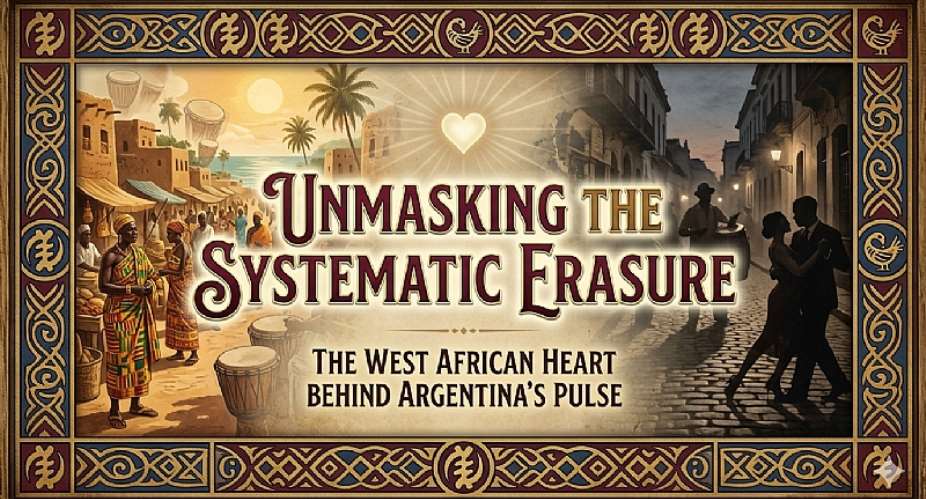
Whenever the global football season kicks into gear, a recurring question dominates conversations across the African continent: Why are there no Black players on Argentina’s national football team?. For years, mainstream media has offered a convenient, clean-cut narrative—that Argentina is simply a uniquely "white" nation shaped exclusively by European immigration.
But history tells a far more dramatic and deeply unsettling story. Beneath the cobblestone streets of Buenos Aires lies a deliberate, state-sponsored campaign of racial erasure that systematically targeted hundreds of thousands of African souls—many of whom trace their lineage directly back to the Akan, Ga, and Ewe coastal kingdoms of the historic Gold Coast (modern-day Ghana). This article exposes how an entire population was written out of existence, reveals the hidden Ghanaian rhythmic architecture behind Argentina's most famous dance, and unmasks a hidden map of ancestral resistance.
The Shocking Metric: When Buenos Aires Was Over One-Third Black
During the colonial era of the late 18th century, the Viceroyalty of Río de la Plata was a primary destination for the transatlantic slave trade. The historic 1757 Plan de la Ville de Buenos-Ayres by French cartographer Jacques-Nicolas Bellin captures a city completely built on slave labor.
- Demographic Reality: By 1810, national archival records confirm that 30% to 45% of Buenos Aires’ population was of African descent.
- Economic Backbone: Enslaved and freed Africans operated the tanneries, built the colonial mansions, and served as the absolute economic foundation of early Argentina.
The Tripartite Blueprint of Racial Erasure
The near-total demographic disappearance of Afro-Argentines from modern view was engineered through three brutal historical mechanisms:
- Military Conscription as Cannon Fodder: During the Wars of Independence and the War of the Triple Alliance (1865–1870), Argentine commanders forced enslaved Black men to fight on the absolute front lines with a cruel promise: survive the front line, and you win your freedom. Entire generations of Afro-Argentine men were systematically wiped out in combat.
- Epidemic Exclusion: When a devastating yellow fever outbreak crippled Buenos Aires in 1871, the white ruling elites abandoned the lower districts. Impoverished Black communities were left stranded without medical resources in the overcrowded tenements of San Telmo, causing a catastrophic mortality rate.
- The State-Sponsored "Whitening" Campaign (Blanqueamiento): Post-independence leaders like President Domingo Faustino Sarmiento openly sought to turn Argentina into a European replica. The state amended its constitution to subsidize the immigration of millions of white Europeans, effectively diluting the remaining, highly imbalanced Afro-descendant community into a tiny demographic minority. By 1887, the government completed the erasure by entirely removing the African racial category from the national census.
Soundtracks of the Diaspora: The Shared Pulse of Highlife and Candombe
While the Argentine state successfully managed to wipe Black faces off its official paperwork, it could not extinguish the African rhythm embedded in its culture.
[Ghanaian Highlife / Traditional Rhythms] ───> [The Syncopated 3-3-2 Clave] ───> [Afro-Argentine Candombe & Tango]
- The Rhythmic Ancestry: The rhythmic architecture of Argentine Candombe—the precursor to modern Tango—is structurally identical to traditional Ghanaian percussion arrangements. Both traditions run on a distinct, highly syncopated 3-3-2 rhythmic clave beat.
- The Highlife Connection: Just as Ghanaian Highlife blends foreign brass instruments over core indigenous percussive polyrhythms, early Argentine Tango was born when Black composers like Rosendo Mendizábal layered classical European arrangements over the complex, raw drum cadences of African tenements.
- Linguistic Remnants: The word Tango itself is not Spanish; it is rooted completely in the Niger-Congo language families, originally describing an African drum circle, closed dance corral, or sacred ancestral meeting ground.
Gold Coast Rebellions: The Ghanaian Freedom Fighters of South America
The ancestral connection to Ghana extends far beyond music into fierce, armed revolutionary warfare. Enslaved people taken from coastal hubs like Elmina Castle and Cape Coast Castle brought sophisticated military strategies across the Atlantic.
- The Akan Maroons: In neighboring regions of South America, captured Gold Coast warriors led the most successful Maroon resistance societies. Utilizing the dense, defensive rainforest terrains, they constructed palenques (fortified free communities) that withstood European military assaults for decades.
- The Rebellions of Bahia and Beyond: Highly organized West African leadership networks engineered massive, coordinated urban slave uprisings across the Atlantic coast. Using secret communication networks written in native scripts, they staged revolts that struck terror directly into colonial governments and accelerated the collapse of local slave economies.
- The Captain of Independence: Inside Argentina, María Remedios del Valle—a fierce Black woman known as the "Madre de la Patria" (Mother of the Nation)—rose to the rank of Army Captain under General Manuel Belgrano, braving battlefield bullet wounds and escaping public floggings to secure Argentine independence.
An Afro-Centric Travel Guide: Tracking Black History in Buenos Aires
If traveling to Argentina today, skip the standard tourist traps and prioritize these essential historical sites to honor our shared ancestral legacy:
A tiny, 2.5-meter-wide house that stands as a stark visual testament to the minimal space allotted to freed Afro-Argentine laborers by their former masters following the gradual ending of slavery.
A historical park hosting the official modern monument honoring Army Captain María Remedios del Valle, serving as a critical assembly ground for modern Black civil rights groups.
Buenos Aires' very first cultural and retail venue completely dedicated to showcasing, funding, and supporting independent Black artists and Afro-descendant entrepreneurs.
The Chapel of the Negroes (Chascomús)
Located just outside the primary city limits, this enduring, rustic Chapel of the Negroes remains an untouchable, preserved sacred space where Afro-Argentines safely met to practice traditional African spirituality and mutual-aid planning.
Strategic Recommendations for Ghana and the African Diaspora
To ensure this history is permanently preserved and leveraged for continental development, the following institutional steps are recommended:
- Curriculum Integration: The Ministry of Education and the Ghana Education Service (GES) should explicitly integrate the history of South American slave routes—particularly the Afro-Argentine and Afro-Uruguayan narratives—into national history textbooks to broaden students' understanding of the global diaspora.
- Cultural and Diplomatic Exchange Programs: The Ministry of Tourism, Arts, and Culture should establish formal cultural partnerships with Afro-Argentine civil rights organizations like DIAFAR to bring traditional Candombe ensembles to festivals like Panafest and AfroFuture in Accra.
- Diaspora Tourism Expansions: State-backed heritage tourism bodies should expand the scope of "Year of Return" initiatives by actively targeting hidden Afro-descendant communities across South America who are searching for their lost genealogical links to West Africa.
Reclaiming Our Global African Heritage
The absence of Black players on Argentina’s national football team is not a mere demographic coincidence; it is the lingering echo of a century-long whitewashing campaign that tried to write our people out of history books. Yet, despite decades of institutional erasure, the truth cannot be hidden forever. The pulse of our West African ancestors survives in the syncopation of the Tango, the legacy of their freedom fighters, and the resilience of modern Afro-Argentines who successfully fought to be recognized in the national census.
As Ghanaians, we must realize that our history does not stop at our coastlines. Reclaiming our global heritage means looking across the Atlantic, remembering those who were forced to forget us, and making sure their names, rhythms, and sacrifices are sung proudly in our homeland.
✍️ Retired Senior Citizen
For and on behalf of all Senior Citizens of the Republic of Ghana 🇬🇭
Teshie-Nungua
[email protected]

 President Mahama urges African countries to fund own peace operations, warns aga...
 Govt to borrow GHS15.38 billion from domestic market, plans DDEP bond buyback
 Finance Ministry says all 2026 ABFA allocations reserved for Accra-Kumasi expres...
 'Surprised and disappointed' — GTA CEO Efua Houadjeto responds to Abeiku Santana...
 Police arrest NDC delegates for allegedly photographing ballots at Bimbilla cons...
 Gambia’s Chief Justice pays courtesy call on Asantehene at Manhyia Palace
 NDC Constituency polls: Delegates invoke 'Antoa' deity over alleged album manipu...
 NDC Oforikrom constituency election stalls over ballot paper delays
 Former NDA CEO Sumaila Abdul-Rahman, three others fined GH¢84,000 each over proc...
 Wa: Abandoned newborn baby boy rescued at Sombo


