




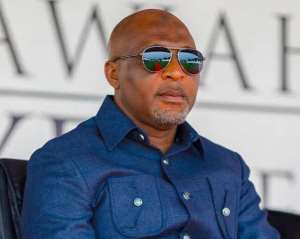
Ghana's Interior Minister, Alhaji Muntaka Mohammed Mubarak, has disclosed that preliminary investigations into a 320 kilograms methamphetamine shipment intercepted in Australia have uncovered possible involvement of some government officials suspected of facilitating the concealment and movement of the illicit drugs. The disclosure, made before Parliament's Committee on Assurances, represents one of the more serious admissions yet of internal complicity within Ghana's security architecture in an international narcotics trafficking case.
The scandal centers on a shipment of charcoal that left Ghana and arrived in Australia in April 2026. Australian Border Force officers subjected the containers to X-ray examination after detecting irregularities, and forensic testing subsequently confirmed that the suspicious substance concealed within the cargo was methamphetamine. Australian authorities estimated the seized drugs to have a street value of approximately 296 million Australian dollars, or roughly 208 million United States dollars, a quantity capable of supplying millions of street level drug transactions.
Addressing the Committee, Alhaji Muntaka said investigators suspect that certain officials may have exploited weaknesses within Ghana's security systems to enable the shipment to leave the country undetected, with several individuals currently being questioned as authorities work to determine the extent of the alleged internal collaboration. He was candid about the limits of what could be disclosed publicly at this stage.
Even as at yesterday, he told the Committee, we were still interrogating a lot of government officials, adding that a great deal remains under investigation and that there are inconsistencies that are not adding up. He said the evidence gathered so far points to the involvement of some people within the system.
Following the seizure, Australian investigators launched a wider operation targeting individuals connected to the trafficking network. Three suspects have since been arrested and are facing charges before Australian courts, among them a United Kingdom based actress, Emaa Hussen, who investigators allege supervised the unloading of bags from one of the containers at a storage facility in Girraween, in western Sydney.
The case fits an established and troubling pattern documented in independent assessments of organised crime in Ghana. According to the Organized Crime Index compiled by the Global Initiative Against Transnational Organized Crime, members of Ghana's security and intelligence services, including immigration, customs, excise, preventive services and the police, have repeatedly been implicated in facilitating drug and arms trafficking.
The same assessment notes that Ghana functions as a transit point for methamphetamine moving from Nigeria toward South Africa, a major consumption hub, and that the country also serves as a transit route for ephedrine, a precursor chemical used in methamphetamine production, much of it destined for clandestine laboratories in Nigeria.
The United States Department of State's own assessment of Ghana's narcotics landscape similarly notes that crystal methamphetamine produced in Nigerian laboratories transits Ghanaian territory and that precursor chemicals required for its production are believed to be diverted from sources within Ghana itself.
This regional dimension is worth underscoring.
Nigeria's National Drug Law Enforcement Agency recently disrupted what it described as the country's largest methamphetamine seizure to date, uncovering an industrial scale clandestine laboratory in Ogun State in May 2026 and confiscating 2.4 tons of methamphetamine along with precursor chemicals, in an operation valued at approximately 363 million United States dollars.
Analysts tracking West Africa's synthetic drug trade have also raised concerns about the emergence of flexible or combi labs capable of producing methamphetamine, MDMA and synthetic cathinones interchangeably, and about the exploitation of long established Sahelian smuggling routes by both drug trafficking networks and armed groups operating in the region.
The unfolding Ghana investigation therefore raises questions that extend well beyond a single shipment of charcoal. It touches on the integrity of border control and port security systems that Ghana's Narcotics Control Commission Act, 2020, was designed in part to strengthen, and it will test the credibility of an investigative process that the Interior Minister himself has acknowledged is still working through significant inconsistencies.
Given the scale of the seizure and the international attention it has drawn, particularly with an ongoing criminal case in Australian courts, how thoroughly and transparently Ghana's authorities identify and prosecute any officials found to have facilitated the shipment is likely to be watched closely, both domestically and by international partners who monitor West Africa's role in global drug trafficking corridors.
Mustapha Bature Sallama.
Medical/ Science Communicator,
Private Investigator, Criminal investigation and Intelligence Analysis.
International Conflict Management and Peace Building.USIP
[email protected]
+233-555-275-880
References
ModernGhana.com, Interior Minister reveals how some people within the system were involved in meth shipment scandal, https://www.modernghana.com/news/1508580/interior-minister-reveals-how-some-people-within.html
Ourhomeland Ghana, $208m meth scandal: Ghana probes alleged insider role in drug shipment, https://ourhomelandghana.com/208m-meth-scandal-ghana-probes-alleged-insider-role-in-drug-shipment/
Adomonline.com,
Muntaka reveals suspected insider involvement in Ghana-Australia meth trafficking case, https://www.adomonline.com/muntaka-reveals-suspected-insider-involvement-in-ghana-australia-meth-trafficking-case/
ENACT, Criminality in Ghana, The Organized Crime Index, https://africa.ocindex.net/country/ghana
United States Department of State, Bureau of International Narcotics and Law Enforcement Affairs, Ghana Summary, https://2021-2025.state.gov/bureau-of-international-narcotics-and-law-enforcement-affairs-work-by-country/ghana-summary/
The Guardian Nigeria, Expansion of illicit drug network in Nigeria: An objective analysis, https://guardian.ng/opinion/expansion-of-illicit-drug-network-in-nigeria-an-objective-analysis/

 Frema Osei‑Opare Blames NPP’s 2024 Defeat on Weak Grassroots Engagement
 Asiedu Nketia Urges Africa: Stop Exporting Raw Materials, Build Industries That ...
 Kyei‑Mensah‑Bonsu Warns NPP: Undefined Leadership Structure Risks Factional Conf...
 Fraud Explodes in Ghana’s Financial Sector as PSP‑Linked Cases Skyrocket — BoG R...
 Many parents are not happy with No Fees Stress reimbursement model — Dr. Adutwum
 Let's take responsibility for our environment to end perennial flooding — Joyce ...
 Mahama administration focused on ending perennial floods — Joyce Bawah
 IMANI Warns: Ghana’s Digital Politics Now Driven More by Personalities Than Poli...
 Fire displaces many at Ankaase, damages Adonten facilities at Adonten SHS

