




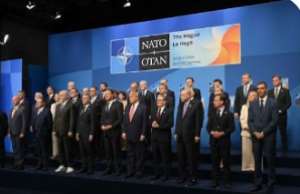
Türkiye has thrown open the doors of its capital to the transatlantic alliance, hosting the 36th NATO Heads of State and Government Summit at the Beştepe Presidential Complex in Ankara on July 7 and 8, 2026. It is only the second time Türkiye has hosted a NATO summit, following the 2004 gathering in Istanbul, and the occasion is being treated by Ankara as a moment to underscore its strategic position at the crossroads of Europe, the Middle East, and the wider Eurasian security architecture.
Leaders of all 32 NATO member states converged on the city, joined by Ukrainian President Volodymyr Zelenskyy and South Korean President Lee Jae Myung as non alliance heads of state, alongside defence and foreign ministers from Australia, Japan, New Zealand, and Gulf states affected by the recent US Israel confrontation with Iran, including Bahrain, Kuwait, and Qatar.
President Recep Tayyip Erdoğan personally welcomed arriving leaders at Esenboğa International Airport and the Presidential Complex, extending bilateral meetings to figures including Bulgarian Prime Minister Rumen Radev and Finnish President Alexander Stubb ahead of the formal proceedings.
The summit opened on its first day with the NATO Defence Industry Forum, described by organizers as the most comprehensive gathering of its kind in the alliance's history, bringing together government officials and defence manufacturers to advance joint procurement and industrial cooperation.
NATO Secretary General Mark Rutte used the opening to announce three new multinational defence initiatives, framing the Ankara gathering around a central theme, that of translating last year's spending commitments into measurable industrial capability. At the 2025 summit in The Hague, allies had agreed to raise their collective target to five percent of GDP, split between 3.5 percent on core military spending by 2035 and 1.5 percent on broader security related needs.
Turkish National Defence Minister Yaşar Güler publicly reaffirmed Ankara's backing for that five percent target during the forum.
The most striking development to emerge from the summit's opening day was a significant shift in the bilateral relationship between Washington and Ankara.
United States President Donald Trump, meeting Erdoğan on the summit's sidelines, announced his intention to remove the Countering America's Adversaries Through Sanctions Act measures that have weighed on Türkiye since its acquisition of the Russian S 400 missile defence system. He told reporters that sanctions on friends were not something Washington wanted to pursue, a notable reversal given the year’s long strain CAATSA has placed on US Turkish defence cooperation, including Türkiye's removal from the F 35 fighter jet programme.
Trump's presence at the summit was otherwise characterized by the blunt, unscripted style that has come to define his approach to the alliance. On the summit's second day, he singled out Spain for sharp criticism, calling Madrid a terrible partner within NATO, a remark that added to visible tension over defence spending among certain member states.
The White House had, in the days before the summit, publicly questioned NATO's value following the recent Iran conflict, with Secretary of State Marco Rubio calling for the alliance to reexamine its relevance, and Trump himself suggesting he was considering withdrawal, absolutely without question, in his words. That the summit proceeded regardless, with Trump in attendance and engaging directly with Erdoğan, was read by analysts as evidence that the alliance's cohesion, however strained, remains intact for now.
Analysts tracking the summit have been careful to temper expectations about its practical impact. Özgür Ünlühisarcıklı, the German Marshall Fund's regional director for Türkiye, framed this year's discussions as an effort to move from spending pledges toward actual capability, noting that European allies had already begun upgrading their defence industries following last year's commitments. Paolo von Schirach of the Global Policy Institute offered a more cautious assessment, observing that increased defence orders take years to translate into deployable hardware, and describing the summit's primary value as political rather than operational, a signal that allies remain willing to meet and project unity even as underlying disagreements persist. Zelenskyy's presence, and his scheduled bilateral meeting with Trump on the summit's second day, kept support for Ukraine and the war's trajectory firmly on the agenda, even though Ukraine itself holds no NATO membership.
The summit's second day was set to address what officials have described as the meeting's most consequential themes, including a recalibration of Europe's role in assuming primary responsibility for conventional defence and a broader vision, referred to informally as NATO 3.0, for adjusting the American military footprint in Europe.
Türkiye's hosting of the summit was accompanied by extensive security and infrastructure preparation, including road expansion and modernization along the route connecting Esenboğa Airport to the summit venue, and a blanket ban on rallies, demonstrations, and leaflet distribution across Ankara province from June 28 through July 10, imposed by the Ankara Governorship. In the two weeks proceeding the summit, anti NATO protests took place in Istanbul, Ankara, and İzmir, led by labour unions and nongovernmental organizations opposed to rising military budgets and the alliance's expansion policies.
Human Rights Watch and local rights advocates reported that anti terror operations and crackdowns targeting demonstrators resulted in the detention of more than 200 individuals, including activists, lawyers, and journalists, a development that has drawn separate scrutiny even as the summit itself proceeded under tight security, with thousands of surveillance cameras, helicopter patrols, and mounted police deployed across the capital.
For Türkiye, the summit represents both a diplomatic showcase and a test of its balancing act between NATO membership, its own defence industrial ambitions centered on firms like ASELSAN, and its complicated bilateral relationship with Washington, one now apparently entering a less adversarial phase with Trump's pledge to lift CAATSA sanctions. Whether that pledge translates into concrete policy, and whether the broader summit's declarations on Ukraine, defence spending, and burden sharing hold up against the alliance's visible internal frictions, will likely shape how Ankara's moment in the NATO spotlight is remembered.
Mustapha Bature Sallama.
Medical/ Science Communicator,
Private Investigator, Criminal investigation and Intelligence Analysis.
International Conflict Management and Peace Building.USIP
[email protected]
+233-555-275-880
References
Al Jazeera, Updates: Trump, NATO leaders in Turkiye's Ankara as defence tops agenda, https://www.aljazeera.com/news/liveblog/2026/7/7/natos-turkiye-summit-live-trump-leaders-to-meet-in-ankara
Al Jazeera, NATO summit live: Trump rips NATO allies; calls Spain 'a terrible partner', https://www.aljazeera.com/news/liveblog/2026/7/8/nato-summit-live-trump-world-leaders-meet-in-turkiyes-ankara
Al Jazeera, NATO summit begins in Turkiye's Ankara: Who is attending, what is at stake?, https://www.aljazeera.com/news/2026/7/7/nato-summit-begins-who-is-attending-and-what-is-at-stake
Türkiye Today, 2026 Ankara NATO Summit: Trump touts Türkiye as 'more loyal than others', https://www.turkiyetoday.com/nation/2026-ankara-nato-summit-trump-touts-turkiye-as-more-loyal-than-others-3223384
Türkiye Today, 2026 NATO Summit: Mark Rutte arrives in Ankara, https://www.turkiyetoday.com/world/2026-nato-summit-mark-rutte-arrives-in-ankara-3223343
Overview - 2026 NATO Summit in Ankara, https://www.nato.int/en/news-and-events/events/2026/07/overview---2026-nato-summit-in-ankara-
Wikipedia, 2026 Ankara NATO summit, https://en.wikipedia.org/wiki/2026_Ankara_NATO_summit

 Frema Osei‑Opare Blames NPP’s 2024 Defeat on Weak Grassroots Engagement
 Asiedu Nketia Urges Africa: Stop Exporting Raw Materials, Build Industries That ...
 Kyei‑Mensah‑Bonsu Warns NPP: Undefined Leadership Structure Risks Factional Conf...
 Fraud Explodes in Ghana’s Financial Sector as PSP‑Linked Cases Skyrocket — BoG R...
 Many parents are not happy with No Fees Stress reimbursement model — Dr. Adutwum
 Let's take responsibility for our environment to end perennial flooding — Joyce ...
 Mahama administration focused on ending perennial floods — Joyce Bawah
 IMANI Warns: Ghana’s Digital Politics Now Driven More by Personalities Than Poli...
 Fire displaces many at Ankaase, damages Adonten facilities at Adonten SHS

