




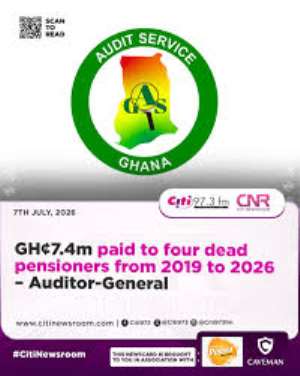
The publication of the Auditor-General's latest report has once again reignited debate over the integrity of Ghana's pension administration. According to the report, pension payments amounting to approximately GH¢7.49 million continued to be made in respect of four deceased pensioners over several years. Naturally, many Ghanaians have reacted with disbelief. Some have concluded that "dead people are receiving pensions."
Strictly speaking, dead people do not collect pensions. Living people do. This distinction is important because it shifts attention from the deceased to the weaknesses within the systems responsible for managing pension payments.
Beyond the Headlines
The Auditor-General's findings should not merely provoke public outrage. They should provoke institutional reflection. Several questions immediately arise:
- How were these deaths not detected?
- Why did payments continue for years?
- Who accessed the funds?
- Were banks informed of the deaths?
- Were the deaths ever reported to the pension authorities?
- Did weaknesses exist in the exchange of information among public institutions?
Until these questions are answered, assigning blame would be premature.
A Systemic Problem Rather Than an Isolated Incident
This is not the first time Auditor-General reports have identified payments to deceased pensioners. Over the years, similar findings have appeared in audit reports involving government payrolls and pension systems. The recurrence suggests that Ghana's challenge is not simply dishonest individuals. It is also outdated administrative systems that rely heavily on manual reporting and fragmented databases. Where one institution records a death but another institution remains unaware, opportunities for abuse emerge.
The Cost of Weak Controls
Every cedi wrongly paid represents resources that could have supported genuine pensioners struggling with rising living costs. Many pensioners survive on modest monthly incomes. They worry about medicine, food, transportation and accommodation. When public funds are lost through weak controls, confidence in the pension system is undermined. Equally worrying is the reputational damage caused to pension institutions whose overwhelming majority of beneficiaries are honest citizens.
Technology Must Become Part of the Solution
Fortunately, modern technology offers practical solutions. Government databases should communicate seamlessly with one another. Once a death is officially registered, the information should automatically trigger notifications to relevant institutions, including pension administrators, banks and other agencies responsible for public payments.
Biometric verification can also reduce opportunities for fraudulent withdrawals while ensuring that genuine pensioners continue receiving their benefits without unnecessary inconvenience. Periodic digital life-certification systems, supported by in-person alternatives for elderly pensioners, can further strengthen accountability.
Banks Also Have a Responsibility
Financial institutions cannot be excluded from the conversation. Banks maintain records of account activity. Where an account belonging to a deceased pensioner continues to receive and disburse pension payments over a prolonged period, questions naturally arise regarding the effectiveness of monitoring procedures. This is precisely why the Auditor-General has recommended recovery of the funds and, where necessary, legal action. Accountability should extend to every institution that has a role in safeguarding public resources.
Reform Must Not Punish Genuine Pensioners
While strengthening controls is necessary, reforms should not create unnecessary hardship for law-abiding pensioners. Many elderly pensioners live in rural communities. Some have mobility challenges. Others are unfamiliar with digital technology. Any verification exercise must therefore be simple, accessible and respectful of their dignity. Technology should reduce fraud, not increase suffering.
A National Opportunity
Rather than viewing this latest audit finding solely as another scandal, Ghana should treat it as an opportunity to modernize pension administration. An integrated national database linking the Births and Deaths Registry, pension administrators, the Controller and Accountant-General's Department, banks, the National Identification Authority and other relevant institutions would significantly reduce opportunities for fraudulent payments. Such reforms would not only protect public funds but also strengthen confidence in Ghana's social protection systems.
My Thoughts
The issue before us is bigger than four deceased pensioners. It is about whether public institutions possess the systems needed to protect taxpayers' money while serving pensioners with efficiency and dignity. Audit reports should not merely expose weaknesses; they should inspire reforms. If Ghana acts decisively on these recommendations, future Auditor-General's reports may finally tell a different story, not of payments to deceased pensioners, but of institutions that have learned from past mistakes and built systems worthy of public trust.
FUSEINI ABDULAI BRAIMAH
+233208282575 / +233550558008
[email protected]


 Frema Osei‑Opare Blames NPP’s 2024 Defeat on Weak Grassroots Engagement
 Asiedu Nketia Urges Africa: Stop Exporting Raw Materials, Build Industries That ...
 Kyei‑Mensah‑Bonsu Warns NPP: Undefined Leadership Structure Risks Factional Conf...
 Fraud Explodes in Ghana’s Financial Sector as PSP‑Linked Cases Skyrocket — BoG R...
 Many parents are not happy with No Fees Stress reimbursement model — Dr. Adutwum
 Let's take responsibility for our environment to end perennial flooding — Joyce ...
 Mahama administration focused on ending perennial floods — Joyce Bawah
 IMANI Warns: Ghana’s Digital Politics Now Driven More by Personalities Than Poli...
 Fire displaces many at Ankaase, damages Adonten facilities at Adonten SHS

