




Abstract
Flooding in Accra is frequently framed as a natural disaster driven by extreme rainfall and climate variability. However, this framing obscures the structural and institutional drivers that shape urban vulnerability. This article argues that recurrent flooding in Accra is better understood as a governance and urban planning failure produced through cumulative land-use decisions, weak enforcement of planning regulations, inadequate infrastructure development, and fragmented institutional coordination. While climate change is a stressor, it is not the primary driver of flooding patterns. Instead, flooding echoes systemic contradictions between rapid urban expansion and insufficient spatial regulation. The article concludes with policy-oriented recommendations emphasizing enforcement, infrastructure redesign, ecological restoration, and risk-based urban planning.
Introduction: When Rain Becomes a Mirror of Governance
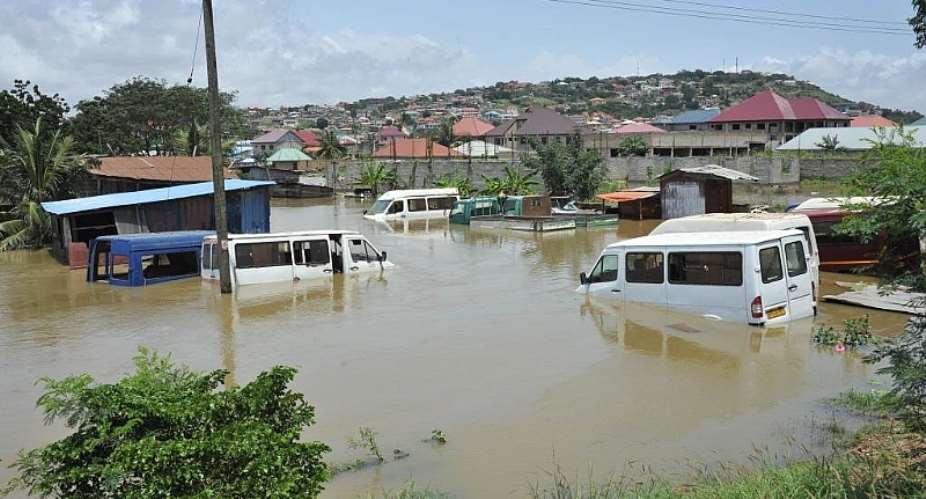
Every year in Accra, the first heavy rainfall is treated as an unpredictable disruption. Streets turn into waterways, homes are inundated, transport systems collapse, and economic activity slows significantly. These events are routinely portrayed in public discourse and media reporting as "flood disasters," implying suddenness, inevitability, and natural causation. Nevertheless, this framing is increasingly difficult to sustain.
Flooding in Accra is not an isolated act of nature. It is the visible expression of accumulated governance decisions, including land-use choices, infrastructure investments, regulatory enforcement, and urban expansion. Rainfall primarily functions as a trigger event; the conditions that turn it into a disaster are produced gradually by human systems. The city's vulnerability is therefore cumulative rather than episodic. It is embedded in thousands of incremental decisions: settlement in restricted or marginal zones, approval of developments in floodplains, insufficient drainage maintenance, and delayed infrastructure expansion. What appears during rainfall as a crisis is, in fact, the predictable outcome of long-term urban governance processes. This distinction is crucial. When floods are framed as natural disasters, responses tend to prioritize emergency relief. When they are understood as governance failures, attention shifts toward prevention, institutional accountability, and structural reform. In this sense, Accra is not merely experiencing flooding; it is revealing the consequences of how it has been planned, governed, and allowed to grow.
A City Built Against Its Own Geography: Integrated Urban Vulnerability in Accra
Accra’s physical geography is central to understanding its flood risk. The city sits on low-lying coastal plains historically shaped by wetlands, streams, and interconnected drainage corridors that naturally regulated seasonal runoff. These ecological systems once functioned as a distributed hydrological network, absorbing, slowing, and channeling excess water during periods of heavy rainfall. Over time, this natural infrastructure has been progressively disrupted. Wetlands have been reclaimed for residential and commercial development, waterways have been constricted or converted into culverts, and floodplains have been absorbed into dense urban expansion. As a result, the landscape’s original capacity to regulate water has been fundamentally altered. Water continues to follow historical drainage pathways, but the built environment increasingly obstructs those routes. This mismatch between natural hydrology and urban form produces predictable surface water accumulation during rainfall events. The problem is further intensified by the rapid expansion of impermeable surfaces, roads, rooftops, and pavements, which prevent infiltration and accelerate runoff. Rainfall that once diffused gradually into soil and wetlands is now rapidly concentrated into overburdened drainage channels. This is not merely environmental degradation; it is a structural reconfiguration of urban hydrology. The geography has not disappeared, but its regulatory function has been systematically weakened by urban expansion.
The Enforcement Gap: Law in Principle, Flexibility in Practice
Ghana has formal urban planning frameworks that regulate land use, protect drainage corridors, and guide urban development. On paper, these systems are comprehensive. The persistent challenge lies not in the absence of regulation but in its enforcement. Unauthorized construction in flood-prone zones remains widespread. Buildings encroach on waterways, drainage buffers are occupied, and informal settlements continue to expand into environmentally sensitive areas. Over time, these incremental violations accumulate into entrenched urban forms that are difficult to reverse. Several structural factors underpin this enforcement gap. Political sensitivity around demolition or relocation, particularly in informal settlements, creates significant social and electoral risks. Authority over land use is also fragmented across multiple institutions, including planning departments, local assemblies, and customary land actors, resulting in coordination failures. These institutional constraints are compounded by limited technical and financial capacity to monitor rapid urban expansion. Enforcement agencies often lack the resources to conduct consistent inspections or to intervene promptly.
Meanwhile, informal land markets create strong incentives for rapid, non-compliant development, especially where formal housing is inaccessible. In practice, enforcement becomes uneven and selective. This inconsistency reshapes behavior: non-compliance becomes a rational strategy for accessing land and opportunity. Over time, this weakens institutional credibility and embeds informality into the structural logic of urban growth.
Infrastructure Deficits and Hydraulic Overload
Even in the absence of encroachment, Accra faces significant infrastructural constraints. Much of its drainage system was designed for a smaller population and a less intensively built environment. However, urban expansion has far outpaced infrastructure development. Three interrelated processes have increased surface runoff: the expansion of impermeable surfaces, the densification of housing structures, and the reduction of permeable soil coverage. Together, these changes increase both the volume and velocity of water entering drainage systems during rainfall events. The result is hydraulic overload. Drainage channels that once functioned adequately under lower demand are now required to manage significantly higher peak flows. When capacity is exceeded, water is displaced into surrounding residential and commercial areas, producing widespread flooding. This structural pressure is compounded by inadequate maintenance. Sedimentation, structural degradation, and inconsistent clearing reduce drainage efficiency over time. System failure is therefore not only a function of undersized infrastructure but also of declining performance due to neglect.
Solid waste contributes significantly to drainage obstructions in Accra, but attributing flooding solely to individual behavior misrepresents the structural conditions that shape waste-disposal practices. Waste collection services remain unevenly distributed across the city, particularly in informal settlements and rapidly expanding peri-urban areas. In such contexts, residents often lack reliable alternatives to improper disposal. Combined with weak enforcement of sanitation regulations, this results in the accumulation of waste in open spaces and drainage channels. The outcome is systemic rather than purely behavioral. Waste in drainage systems reflects broader failures in service provision, institutional coordination, and urban governance capacity. It is therefore more accurately understood as an infrastructural outcome embedded within uneven urban development.
Climate Change as an Amplifier, Not a Primary Cause
Climate change is increasing rainfall intensity and variability across West Africa, including Accra. This intensification raises flood risk by increasing runoff volumes and reducing rainfall predictability. However, climate change alone does not explain the spatial distribution of flooding or why certain neighborhoods are repeatedly affected while others remain relatively resilient under similar rainfall conditions. These differences are shaped primarily by local structural variables: topography, land-use compliance, drainage infrastructure condition, and environmental encroachment. Climate change, therefore, functions as an amplifier of existing vulnerabilities rather than their root cause. Where systems are weak, climate variability can cause disasters. Where systems are resilient, the same rainfall results in manageable runoff. The determining factor is not rainfall intensity alone but the structural capacity of the urban system.
The Political Economy of Flood Risk
Flood management in Accra is deeply political. Enforcement of planning regulations often involves trade-offs between technical necessity and political feasibility. Actions such as demolishing illegal structures or restricting development in informal settlements can generate social conflict and electoral costs. As a result, enforcement is frequently delayed, softened, or selectively applied. Over time, this produces a cyclical pattern:
- Encroachment into drainage zones
- Weak or selective enforcement
- Increased densification in high-risk areas
- Flood events during rainfall
- Emergency response and relief interventions
- Reversion to weak enforcement
This cycle reinforces vulnerability rather than resolving it. Each iteration deepens exposure while normalizing flooding as a routine feature of urban life.
Conclusion: Rain Will Not Stop, But Collapse Is Not Inevitable
Flooding in Accra is often framed as an unavoidable consequence of geography and climate. While rainfall is inevitable, disaster is not. Recurrent flooding should be understood instead as a signal of misalignment among urban form, institutional capacity, and environmental systems. Each event reflects predictable failures in planning, enforcement, and infrastructure design. This pattern is structured and geographically concentrated, indicating that flooding is not merely a hydrological phenomenon but a governance outcome. Reframing floods as policy failures expands the scope of response beyond emergency relief toward prevention, accountability, and systemic reform. Ultimately, the challenge is not to eliminate rainfall but to redesign the relationship between the city and its environment. A resilient city is not one that reacts better to floods, but one that prevents them from becoming disasters. Cities are shaped not only by what is built, but also by what is permitted, neglected, or left unregulated. When natural systems are constrained, they do not disappear - they respond. Moreover, in doing so, they reveal the limits of governance itself.


 Trump to meet Macron in New York before UN General Assembly
 Five takeaways from Germany's regional elections after far-right gains
 Putin party retains majority in first vote since 2022 invasion of Ukraine
 Third-country removals: Trump’s deportation policy by the numbers
 US, China discuss AI safety ahead of Trump-Xi summit
 Mysterious illness leaves children struggling to walk, hear in Mafi Kope
 ‘We’ve come back to make sure our father's ideas never die’ – Nkrumah family
 Ghana Jollof: Akosua Manu appeals to Naana Jane to use her influence to free Sal...
 Yellow fever confirmed in Sissala East after 21 mysterious deaths
 Kenyasi man allegedly attacked by prison officers and inmates over yam theft cla...


