




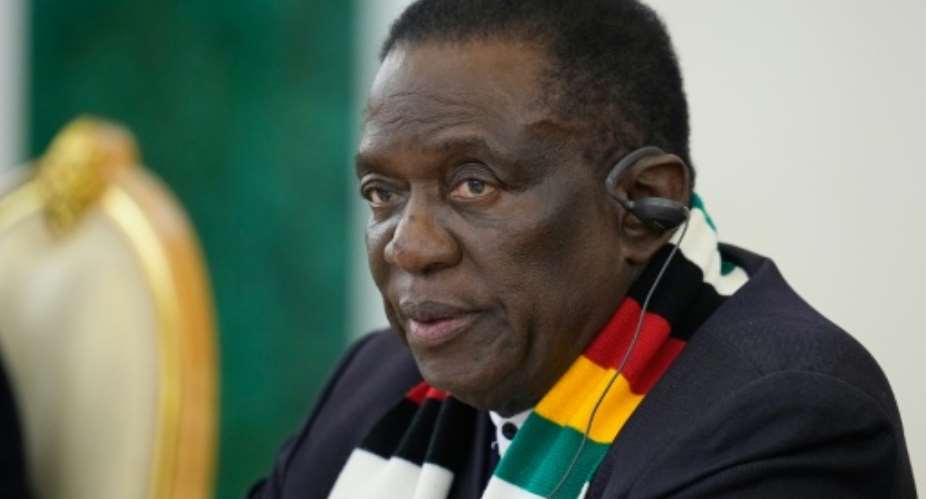
Zimbabwean President Emmerson Mnangagwa on Tuesday signed into law constitutional changes that will extend his term by two years until 2030 and scrap direct presidential elections.
The raft of amendments have been sharply criticised by opposition figures in the country where 83-year-old Mnangagwa's Zanu-PF party holds a parliamentary majority.
"SIGNED, SEALED AND DELIVERED -- IT'S NOW LAW," information ministry senior official Nick Mangwana announced in a post on X that showed a copy of the new act.
The raft of changes -- labelled a "constitutional coup" by critics -- includes a provision that would extend the presidential and parliamentary terms from five to seven years.
Another amendment gives parliament the power to appoint the president, doing away with direct presidential elections that were introduced in 1987, seven years after independence.
The sweeping changes sailed through both houses of parliament and were finalised by the National Assembly a week ago.
When the cabinet approved in February the plan to extend Mnangagwa's term, it said this would "enhance political stability and policy continuity to allow development programmes to be implemented to completion".
Mnangagwa -- nicknamed "The Crocodile" because of his ruthlessness -- came to power in 2017 in a military-backed coup that ousted Robert Mugabe at the age of 93 and after 37 years in power.
He was elected for two five-year terms, in 2018 and 2023, which is the constitutional limit for a president.
Privatisation of power
Zimbabwe's opposition, weakened by years of repression and tainted elections, charges that the amendments will entrench Zanu-PF's grip on power in the resource-rich nation, which it has governed since independence in 1980.
Prominent opposition lawyer Tendai Biti said on X that the new law allowed "the complete privatization of power".
"It pushes away power and legitimacy from millions of Zimbabweans to those that will be able to control the process and outcomes of any party primary election process," Biti said, adding elections were effectively suspended to an unknown date.
Lawyer and leading opposition figure Doug Coltart said Mnangangwa had "failed to defend and uphold the constitution".
"There will be challenges made," he told AFP. This included via the courts over the failure to submit the Bill to a referendum as required by the constitution, he said.
"It is also important for the people of Zimbabwe to stand up and use their lawful right to defend their constitution," he said.
Democracy activist Lovemore Madhuku told AFP that Mnangagwa "is in office by virtue of an election by the people yet uses that office to take away the very power that brought him into office".
Critics of the changes have told AFP they have been tortured, intimidated and abducted by suspected state agents.
They accuse Zanu-PF of failing to tackle deep economic problems or shake off accusations of corruption and repression.
Human Rights Watch said in March that Zimbabwean authorities had used violence and intimidation against opponents of the constitutional amendments.
strs-jc/br/phz


 It’s unlawful for landlords to increase rent charges without approval from us — ...
 Rent Control Boss directs landlords, hostel operators to issue rent cards
 “What type of scholarship pays only 25%; If you can’t spell it, don’t write it” ...
 Government gives Adamus Resources 12-month reprieve to revive mining operations
 'I was not the Chief of the Defence Staff in 2023 to procure armoured vehicles' ...
 ’We must unite to win 2028 elections’ - Bawumia tells new NPP executives
 Police arrest 27-year-old over provocative TikTok video on death of Mion Lana
 CLOGSAG Executive Secretary Dr Isaac Bampoe Addo dies
 Muntaka orders police to crack down on vigilante groups, unauthorised guards
 Wontumi campaign team picks NPP National Chairman nomination forms despite 20-ye...

