




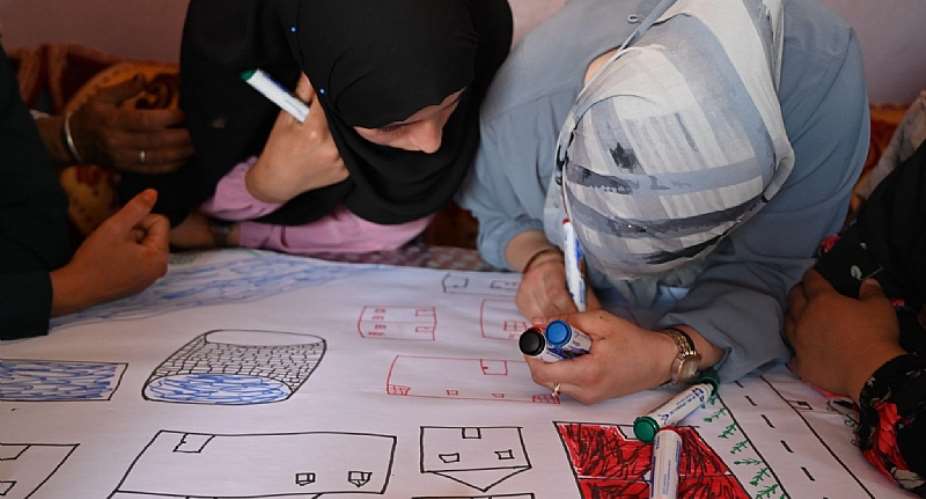
At the High Atlas Foundation in Morocco, I have been focusing on the role emerging technologies might be able to play in supporting development efforts. Yet alongside conversations about the promise of artificial intelligence, I have found myself returning to a different question: if rural communities help create value for AI systems, what do they receive in return?
This question remained in the back of my mind as we visited various rural communities in the High Atlas Mountains. In some places I noticed that technology was everywhere. People were scrolling on smartphones, using messaging applications, and connecting with family members. Yet it was difficult to understand exactly how these technologies were being used in everyday life, and more importantly, what additional technological needs remained unmet.
During our visits, I saw that before we can even begin debating the role of artificial intelligence in development, we must first think about foundational digital needs: reliable internet connectivity, cellular service, access to devices, and digital literacy. Without these prerequisites, conversations about AI remain largely hypothetical. But where these foundations do exist, the possibilities are significant.
Artificial intelligence could help women develop business plans and marketing materials for their cooperatives, provide personalized educational support to students unable to attend school in person, assist communities with grant proposals, and expand access to health information. In many ways, AI has the potential to expand access to knowledge and specialized expertise that may otherwise be unavailable in rural communities.
If rural communities are to engage with AI systems, what obligations, if any, do technology companies have to give back to the communities whose interactions, knowledge, and data contribute to these technologies?
This question is particularly relevant when considering the widespread use of large language models such as ChatGPT and Claude. Millions of people around the world interact with these systems every day, contributing prompts, feedback, and information that can ultimately help improve future versions of these technologies. While companies such as OpenAI allow users to opt out of having their conversations used for training, a recent academic study found that most users of conversational AI systems did not know that their conversations could be used to train models or that they could opt out of this process.
Regardless of whether users fully understand these practices, their interactions continue to generate valuable data that can improve future versions of these technologies. As a result, users often help create value for AI systems without fully understanding the extent of their contribution or receiving any direct compensation in return. The economic benefits generated by these systems are largely captured by the companies developing them. It remains unclear whether access to increasingly capable AI models is, by itself, sufficient compensation for the value user data creates.
Concerns about this imbalance have prompted some policymakers and technologists to propose new models of compensation. Former U.S. presidential candidate Andrew Yang launched the Data Dividends Project, while California Governor Gavin Newsom has similarly argued that individuals should share in the economic value generated from their data. Although these proposals have yet to be implemented, they raised important questions about how concepts like data dividends might be relevant for rural communities.
One important piece to note is that knowledge and data within these communities is not merely individual data. Rural communities often hold forms of collective cultural knowledge that have been cultivated and refined across generations: agricultural practices adapted to local environments, traditional ecological knowledge, indigenous languages, artisan techniques, and community-based problem-solving strategies. This knowledge is often collective rather than individual, and deeply embedded within local histories and cultures.
What happens when the knowledge being shared belongs not to a single individual, but to an entire community? In many cases, a single individual may not have the authority to share knowledge that belongs to an entire community. Yet once this information is incorporated into AI systems, technology companies may be able to commercialize and profit from it without returning any benefits to the
communities that developed it over generations. In doing so, communities risk losing control over how their knowledge is represented, used, and monetized.
Some scholars describe the extraction and monetization of this knowledge as a form of digital colonialism. While historical colonial systems extracted natural resources, labor, and wealth from colonized societies, digital colonialism refers to situations in which data, knowledge, and digital labor flow from local communities to institutions located elsewhere, often with limited local influence over how that information is used.
For example, Indigenous scholars have raised concerns that AI companies may scrape Indigenous languages, ecological knowledge, and cultural materials from publicly available sources without community consent, incorporating them into commercial AI systems while providing little control or compensation to the communities from which this knowledge originated.
Development practitioners, and organizations such as the High Atlas Foundation, have long emphasized participation, local ownership, and community empowerment as prerequisites for sustainable change. If these principles are central to development practice, should they not also shape how artificial intelligence is introduced into development contexts?
There are many possible models for using AI more equitably in development, but any successful approach must begin with active participation. We should first ask what digital foundations those communities still need, such as reliable connectivity, access to devices, and digital literacy, and then work alongside them to identify the technologies that would be most valuable in addressing their own priorities. Organizations like the High Atlas Foundation are uniquely positioned to facilitate these conversations by connecting communities with technology companies in ways that prioritize local ownership and collaboration.
There are already promising examples of this approach. Digital Green, for instance, has partnered with Microsoft and OpenAI to develop Farmer.Chat, an AI assistant designed for smallholder farmers. Most importantly, Digital Green developed relationships with rural communities, so the technology is built together. While every community has different needs, partnerships like these suggest one possible path forward. Instead of viewing rural communities solely as end users of AI, we should begin thinking about them as valuable partners in shaping the technologies that will increasingly shape their futures.
Lidia Zur Muhlen is a rising third-year Jefferson and Echols Scholar at the University of Virginia pursuing an interdisciplinary major focused on the politics, economics and ethics of emerging technologies. She spent the summer interning with the High Atlas Foundation in Morocco.
 'There was no request for a state visit to Ghana' — South Africa clarifies over ...
 Assemblies accused of taking penalties instead of demolishing illegal buildings ...
 NACOC directs businesses dealing in precursor chemicals to obtain licences by Ju...
 Decision to defer Ramaphosa's visit a right one — Former Ghana High Commissioner...
 GNFS recovers body from flooded drain channel at Kpando
 BoG injects $2.01bn into forex market in June
 Police warn against unauthorised use of sirens, strobe lights on vehicles
 'Fake' — GES debunks statement announcing 2026 BECE results, school placement ex...
 Ex-Black Stars player Charles Taylor accuses GFA of abandoning him in US after f...
 Arthur Kennedy urges Supreme Court use case on delegates system of political par...

