




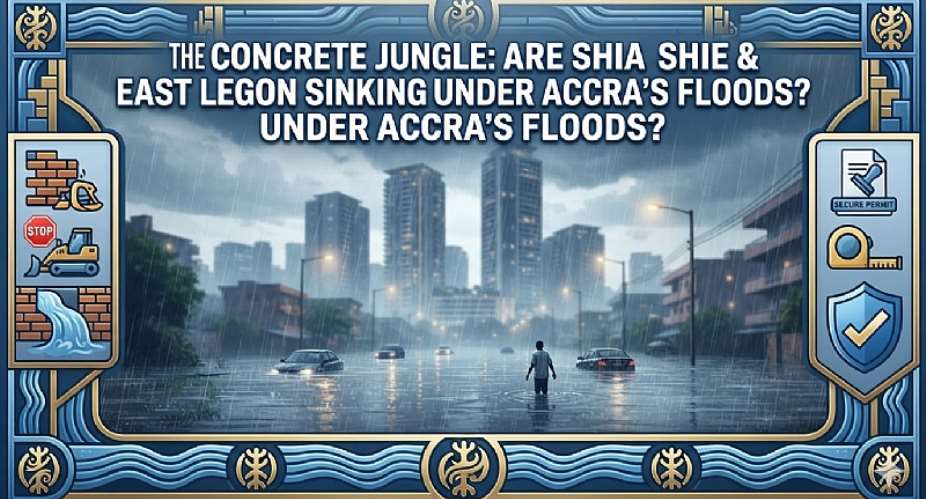
Every rainy season, a familiar panic grips the capital. As the skies darken, social media lights up with videos of submerged cars near the Tetteh Quarshie Interchange and flooded streets across Shiashie and East Legon. For years, the public finger has been pointed at elite, towering developments like Villagio Vista, with many claiming they sit directly in waterways.
But is the crisis truly caused by luxury high-rise buildings, or are we ignoring a deeper, systemic failure of urban planning, civil service complicity, and real estate greed? It is time to look past the myths and confront the hard geographic realities, political warnings, and severe statutory penalties that are turning Accra’s most expensive suburbs into waterlogged hazards. As the renowned international author Matshona Dhliwayo once observed, “A house built on sand cannot withstand the storm, but a nation built on compromise cannot withstand time.”
The Geographic Truth: East Legon is Not a Monolith
To solve Accra's flooding crisis, Ghanaians must first understand the stark difference between perception and topography. Wealthy suburbs do not automatically equal safe terrain. The Ga proverb teaches us, “Nshɔ ji anyɛmi, ni nshɔ gbeɔ mɔ” (The sea is a brother, yet the sea kills)—a reminder that nature is unyielding, no matter how affluent a neighborhood appears. The Shiashie and East Legon enclaves are actually split into three distinct risk zones:
- The Shiashie Bowl (High Risk): Shiashie sits down-gradient from higher zones like Airport Residential Area. It acts as a natural basin for surface runoff, meaning water from surrounding high ground naturally drains into it.
- The Motorway and Bawaleshie Low-Lying Pockets (High to Medium Risk): Sections of East Legon facing the Tema Motorway, along with parts of Bawaleshie and Adjiringanor, sit in deep drainage depressions. When it rains, water pools here rapidly because the natural exit routes are choked.
- The Prime East Legon Ridge (Low Risk): The elevated, older, central parts of East Legon drain exceptionally well. This proves that flood vulnerability is determined by elevation and engineering, not by the wealth of a neighborhood.
High-Rises vs. Night-Time Builders: The Enforcement War
The common belief that structures like Villagio Vista are built inside active waterways is technically inaccurate. City authorities and engineers confirm these massive projects hold valid permits because they do not block natural river channels. Instead, the crisis is fueled by an infrastructure deficit and a complete disregard for spatial planning by private citizens:
- The "Concrete Jungle" Effect: Massive concrete footprints and paved compounds have completely sealed the earth. Because the soil can no longer absorb rainwater, ordinary surface runoff transforms into violent flash floods on our tarred roads.
- The Night-Time Builders: Hundreds of individual developers build illegal structures, walls, and shops over gutters overnight without permits, completely choking the local drainage network.
The state’s patience with these illegal developments has run completely thin. Following a series of devastating flash floods, Greater Accra Regional Minister, Honorable Linda Obenewaa Akweley Ocloo, has launched an aggressive, zero-tolerance campaign targeting unauthorized buildings on watercourses. Addressing the fierce public and traditional pushback, Minister Ocloo stated bluntly on Daily Graphic:
"I tackled flooding within the Greater Accra Region… knowing very well that some of the buildings at Ramsar sites will have effect when it rains, I went on and I did a lot of demolition. Hence, I have a lot of people that hate me because of this demolition exercise."
The Regional Coordinating Council (GARCC) and REGSEC have backed these words with action, deploying bulldozers to clear structures obstructing the free flow of water in flood-hit municipalities. Minister Ocloo has also turned her sights internally toward corrupt town planning officials, stating clearly on CitiNewsroom that Accra will no longer be a sanctuary for indiscipline.
See Something, Say Something: How Citizens Can Report Illegal Waterway Construction
For generations, Ghanaians have stayed silent while neighbors blocked gutters, ignoring the wisdom of Proverbs 22:3: “A prudent person foresees danger and takes precautions; the simpleton goes blindly on and suffers the consequences.” Citizens can no longer afford to look away while lawless developers endanger entire communities.
The Greater Accra Regional Coordinating Council (GARCC) and various Municipal Assemblies have enhanced mechanisms enabling residents to report illegal developments and environmental violations safely. If you see an illegal structure being built overnight on a waterway or drain buffer, take action immediately through these official channels:
- The NADMO Disaster & Monitoring Hotline: Report active construction on watercourses directly to the National Disaster Management Organisation (NADMO) via their emergency response lines or their active WhatsApp reporting platform.
- The GARCC Citizens’ Portal: Visit the Greater Accra Regional Coordinating Council Portal to log a spatial planning violation anonymously.
- The MMDA Client Service Unit: File a formal, written complaint or physical tip-off directly with the Works Department or the Physical Planning Department at your local Municipal Assembly (e.g., Ayawaso West Municipal Assembly for Shiashie). They are legally mandated to issue immediate "Stop Work" notices and demolish unapproved foundations.
The Legal Teeth: Harsh Penalties Under the Land Act, 2020 (Act 1036)
Many Ghanaian land buyers mistakenly believe that the worst consequence of building illegally is simply losing the structure to a bulldozer. This is a dangerous misconception. Under the Land Act, 2020 (Act 1036), constructing structures on unapproved land or waterways carries heavy criminal liabilities:
- Criminalization of Encroachment: Section 236 of the Land Act explicitly makes it a criminal offense to unlawfully occupy, develop, or encroach upon state lands, public reservations, wetlands, or designated watercourses.
- Hefty Fine Penalties: Individuals found guilty of illegal development can face severe summary convictions, resulting in fines ranging between 5,000 to 10,000 penalty units (translating to tens of thousands of Ghana Cedis).
- Mandatory Prison Sentences: The law has teeth. Courts can sentence unlawful developers to a prison term of not less than five years and up to fifteen years without the option of a fine, or both.
- No Right to Compensation: Under the Act, when the state demolishes an unauthorized structure built on an active watercourse or state buffer, the developer is legally entitled to zero compensation, and the state can sue the developer to recover the financial cost of the demolition exercise.
Recommendations and Suggestions for Ghanaians
To fix this perennial national crisis, action must be taken by both citizens and state institutions.
For Property Buyers, Renters, and Citizens:
- Test Properties After Heavy Rain: Never buy or rent a property in Shiashie or East Legon during the dry season without visiting the exact street during or immediately after a heavy downpour.
- Inspect Ground Walls for Stains: Look closely at the base of ground-floor walls for watermark lines, peeling paint, or white powdery salt deposits (efflorescence), which indicate frequent flooding.
- Demand Stamped Legal Permits: Before handing over money to any landlord or developer, demand to see their stamped MMDA Building Permit and EPA clearance certificate.
- Interview At Least Two Neighbors: Talk to local roadside vendors or long-term neighbors; they will give you an honest history of the street's water levels.
For State Authorities and Policy Makers:
- Sustain the REGSEC Red Line: The Greater Accra Regional Security Council must ignore political or traditional interference and continue dismantling structures built over primary storm drains.
- Audit Municipal Infrastructure: MMDAs must force large private estates to link their internal drains to expanded, high-capacity municipal storm channels instead of letting water spill onto public roads.
- Mandate Green Spaces: Introduce bylaws requiring all new developments in Accra to leave at least 20% of their land unpaved to allow rainwater to naturally sink into the ground.
Accra's perennial flooding is not a natural disaster; it is a man-made engineering, greed, and enforcement crisis. As the Akan proverb warns, “Ɔbra nye wo ara wo bɔ” (Life is what you make of it)—our cities will only be as safe as our collective discipline allows them to be. As long as citizens continue to build overnight without permits and assume their wealth protects them from the law, water will always find its natural path—regardless of how expensive the neighborhood is. True patriotism means protecting our drainage systems. Guard your investment, demand accountability from your local assembly, and remember that nature does not respect a luxury zip code.
✍️ Retired Senior Citizen
For and on behalf of all Senior Citizens of the Republic of Ghana 🇬🇭
Teshie‑Nungua
[email protected]


 'Suing me won’t gag me, what did you do for NDC to continue to keep you in offic...
 'Ghana is now training lawyers illegally' — Former Bar president
 Akyem Hemang residents demand justice for alleged military shooting of 29-year-o...
 Adenta-Accra morning travel time improves significantly in just 23 minutes under...
 US 'steals' Bawumia’s idea, launches America.gov for public services five years ...
 “Disband Black Stars, sack FA and let FIFA ban us for two years” – Sam George af...
 South Africa summons US ambassador for 'record' third time
 Dangote to launch $16bn refinery in Kenya
 Ghana, Luxembourg to explore visa waiver agreement
 Tullow loses $393m tax arbitration case against Ghana – Finance Minister


