




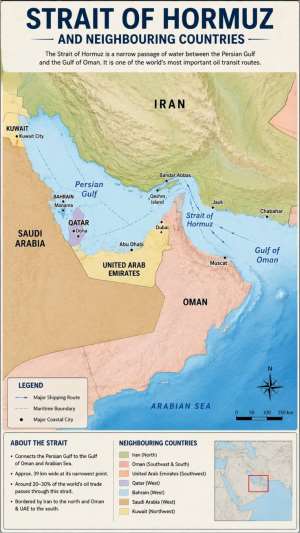
Somewhere south of Iran, a narrow stretch of water no wider than the distance between Accra and Tema carries roughly a fifth of the entire world's oil supply through it every single day. Most Ghanaians have never heard its name. Every single one of us already depends on it.
That waterway is the Strait of Hormuz, and it is currently sitting at the centre of one of the most dangerous stand-offs in the world — a tightening confrontation between Israel, Iran, and the United States that geopolitical analysts across the world are now watching with genuine alarm. You do not need to believe every viral prediction circulating online to understand that this single fact, on its own, should worry every Ghanaian household.
Why a strait you cannot find on a map controls your fuel price
Here is the plain, verifiable reality. The Strait of Hormuz is the only sea passage connecting the oil-rich Persian Gulf to the open ocean, and a substantial share of the world's daily crude oil exports — along with a significant portion of global liquefied natural gas — physically has no other route out. There is no meaningful detour. Tankers that cannot pass through Hormuz do not simply take a longer road; in most cases, they simply do not deliver at all, or do so at extraordinary added cost and delay.
This is not analyst speculation. This is basic maritime geography that has made the strait a flashpoint for global anxiety for decades, long before this current crisis.
The nut of the matter
State the thesis plainly: any serious disruption to shipping through the Strait of Hormuz — whether from military conflict, mining of the waters, or even the mere credible threat of either — would send global oil prices sharply upward within days, and Ghana, a country that imports the overwhelming majority of its refined petroleum products, would feel that shock at the pump, in transport fares, in food prices, and in the value of the cedi almost immediately. This is not a distant Middle Eastern problem. It is a Ghanaian household budget problem waiting to happen.
What this actually means for the average Ghanaian
Walk through the chain plainly, because most commentary on this crisis stops at "oil prices will rise" without ever explaining what that sentence means for a trotro driver in Kaneshie or a mother buying rice in Kumasi.
A spike in global crude prices raises the cost of importing refined fuel. Higher fuel import costs raise pump prices at every filling station in the country. Higher pump prices raise transport fares, because every trotro, taxi, and cargo truck runs on that same fuel. Higher transport costs raise the price of every single good that has to move from farm to market — meaning food prices climb even in regions that grow their own crops, because fertiliser, transport, and processing all depend on the same energy inputs. And because Ghana still imports a meaningful share of its wheat, rice, and other staples, a global shock that also disrupts international shipping — as a Hormuz crisis certainly could — compounds the food price pressure on top of the fuel price pressure.
This is not abstract economics. This is the difference between affording school fees this term and falling behind on them.
The cedi's exposure nobody is discussing enough
There is a second, quieter danger here that deserves far more attention in Ghanaian financial commentary than it currently receives. Oil price shocks do not only raise costs directly — they also strain the foreign exchange reserves of countries like Ghana that must pay for imported fuel in U.S. dollars. A sustained spike in the global oil price means Ghana needs more dollars to buy the same amount of fuel, placing additional pressure on the cedi at a time when the currency can least afford it. Ghanaians who lived through the fuel and currency pressures of recent years know exactly how quickly that particular chain reaction can move from a headline abroad to a queue at the filling station at home.
What we should take seriously from the analysts — and what we should not
Geopolitical commentators who study this region closely, including analysts who correctly anticipated earlier stages of this crisis, are now debating how far it could escalate — whether other major powers might become more directly involved, and whether the current confrontation could widen into something considerably larger and more dangerous than what we have seen so far. Some of these same analysts have gone further still, offering specific percentage odds of a broader global conflict, and predictions about territorial outcomes in multiple theatres at once, from Eastern Europe to the Korean peninsula to domestic American politics.
I want to be honest with you about those specific predictions rather than repeat them as settled fact: they are exactly that, predictions — informed, closely argued, and worth watching, but unverified forecasts from individual analysts, not confirmed outcomes. Some of what circulates in this space, including claims about American constitutional politics, runs directly against how that system currently operates. A columnist's job is to help you see clearly, not to hand you someone else's certainty dressed up as news. What is not speculation is the Strait of Hormuz itself, its role in the global oil supply, and the direct financial exposure that role creates for a country like ours.
Ghana's specific vulnerabilities in a crisis like this
Beyond fuel and food, there are exposures worth naming plainly. Ghana has a real and growing population of citizens working and living across the Gulf region, and any serious escalation in that part of the world carries direct safety and remittance implications for those workers and the families back home who depend on what they send. Ghana's own oil sector, still finding its footing on the world stage, would face a market thrown into volatility exactly when stability would serve our own producers best. And a country already managing its own fiscal pressures does not have unlimited room to absorb an external energy shock without real consequences for ordinary households.
What Ghana must actually do, starting now
This is not a column meant to spread panic, and nothing here should be read as certainty about a conflict none of us can fully predict. It is a call for basic preparedness that a country as exposed as ours cannot afford to skip. Our energy planners should be stress-testing fuel reserve strategies against a genuine Hormuz disruption scenario, not waiting for prices to spike before reacting. Our fiscal authorities should be modelling what a sustained oil shock does to our dollar reserves and the cedi, publicly, so households are not blindsided. And ordinary Ghanaians deserve straight talk from their leaders about this risk now, in calm times, rather than a scramble of contradictory statements once queues start forming at filling stations.
A country that only plans for the crisis it can already see coming is not actually planning. It is simply hoping.
The circle closes
Return to that narrow stretch of water most Ghanaians could not point to on a map. It does not care that we are thousands of kilometres away. It does not care that our attention is, understandably, fixed on ECG's load-shedding schedule or the price of tomatoes at Makola. Global energy markets have never respected distance, and they are not about to start now.
We do not need to believe every viral prediction about how this crisis ends to understand what is already true.
The waterway is real. The exposure is real. The only question left is whether Ghana prepares for it before the shock arrives, or after.
About the author
Chief Tutu Baffour Asare Brownsy Williams is a Ghanaian columnist, novelist, and filmmaker, and the founder of Brownsy Silva Company, a multi-disciplinary creative enterprise spanning literature, film, and digital content. He writes on Ghanaian civic life, economics, and global affairs for Modern Ghana, with a readership spanning Accra, Kumasi, and the Ghanaian diaspora across the UK, USA, Canada, and Germany. He is the author of the multi-generational family saga The River Remembers, the Kumasi-and-Accra family drama The Sons of Brownsy, and the mythic epic Reborn: The River of Girls, among other works exploring family, tradition, and the quiet costs of silence in African life.
Author's note: This piece was written using publicly available geopolitical analysis current as of early 2026. Readers should verify the latest developments in the Israel-Iran-U.S. situation through current news sources, as this is a fast-moving and evolving crisis.

 Judge halts Ex-NAFCO CEO's trial until ruling on seized phones
 Manhyia South MP who resisted arrest reports to EOCO a day after arrest warrant ...
 "Show us evidence" —Upper West teacher unions demand proof of payment before end...
 Adenta: Bolt driver jailed 25 years for cutlass attack and robbery of beautician...
 EOCO drags Manhyia South MP to former law firm, residence for search
 BNI investigates Yaw Ampofo Ankrah over alleged World Cup visa facilitation sche...
 EOCO arrests three over drone flights at headquarters during arrest, probe of Ma...
 Police arrest three suspected kidnappers over Yendi abduction
 Prof Emmanuel Osei Sarpong appointed Acting NSA Director-General
 NSA Boss Yaw Ampofo Ankrah suspended over US$623,000 World Cup visa allegations


