




Online visibility used to rely heavily on Search Engine Optimisation (SEO), with the primary goal being to appear on the first page of Google.
While this remains a key objective for businesses, artificial intelligence (AI) has changed the game when it comes to online brand visibility. AI now plays a direct role in deciding which answers people see, often providing those answers without users needing to click a link.
The Emergence of Google AI Overviews
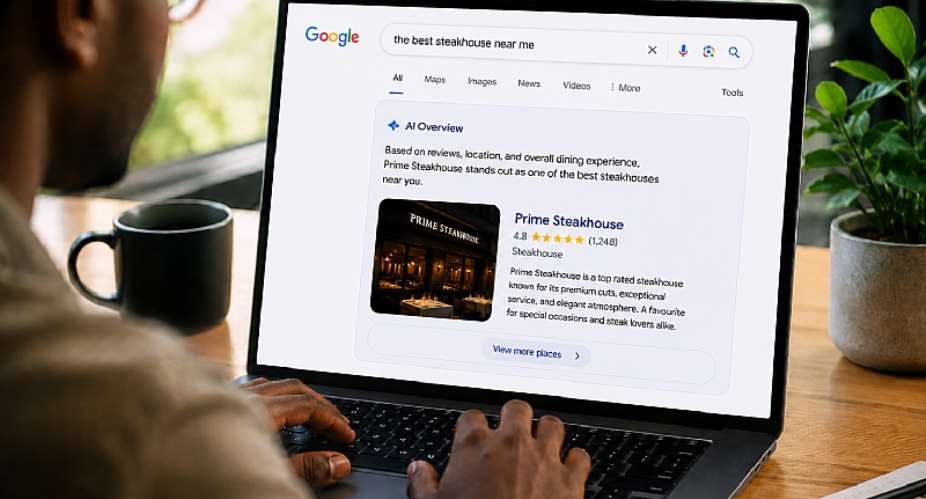
Google Search is no longer just a list of links. Increasingly, results are led by an AI overview - a short, useful summary that answers the user’s question upfront. It pulls from multiple websites and online sources, then packages the information into what it determines to be the most relevant response.
For users, this is convenient. They get an answer quickly, without having to visit each website individually (also known as zero-click outcomes). The question then becomes: if AI is doing the research on the user’s behalf, is your brand one that AI chooses to display?
Consider a search for “the best steakhouse near me”. The restaurants that appear in an AI-generated response are unlikely to be there by chance. AI looks for signals that indicate credibility and relevance, from customer reviews and location data to the consistency and quality of a brand’s online presence.
The implications are significant. You may genuinely serve the best steak in town, but if AI doesn't recognise your business as a credible answer, you may not get the visibility, website traffic or the customer visit.
Impact of Zero-Click Search
Recent search behaviour data suggests that the zero-click trend is accelerating. 2026 research indicates that roughly two-thirds of United States Google searches now end without a click, with only 232 clicks to the open web for every 1 000 searches.
As AI-generated results become more prevalent across markets, the zero-click trend is expected to continue growing. This doesn't mean SEO is becoming less important. It means visibility is no longer measured solely by clicks and rankings, but by whether your brand is considered authoritative enough to be included in the answer itself. In other words, the collective success metric is changing.
It’s no longer about who does services and products best – competitive advantage is now about who plays the AI visibility game best.
How AI Platforms Serve as Search Engines
Google’s Search Generative Experience (SGE), OpenAI’s ChatGPT Search, and tools like Perplexity and Gemini all use large language models (LLMs) that generate intuitive answers rather than list results.
People are now bypassing Google altogether by asking these AI-driven platforms questions such as “What's the best compact SUV available in South Africa for my budget?”
What Are Some of the Credibility Signals AI Looks For?
Search engines now behave more like researchers than librarians. They don’t just index pages – they read, interpret, and decide which ones are reliable enough to quote. Your online visibility may start to decrease if your site lacks:
- Clear topical expertise
- Consistent, original content
- Structured data such as metadata, schema markup and Frequently Asked Questions (FAQs)
- Mentions and citations from credible sources including online review sites
This means lost traffic, relevance and revenue.
How Can Brands Remain Visible in an AI-Powered Search Landscape?
Transitioning to AI-optimised digital strategies requires a mindset shift from only focusing on keywords and algorithms to prioritising customised content and credibility.
These are some ways brands can improve AI-driven SEO visibility:
- Creating content that AI can interpret using clear structure, schema markup and concise language. AI models often value freshness. Update statistics, references and insights frequently.
- Building authority through expert perspectives, citations and digital PR. Google’s systems recognise and rank people as well as pages. Add clear authorship, credentials and bios to boost authority signals.
- Understanding intent using AI tools to identify what people are really searching for, not just the words they type.
- Optimising for conversations since users now “ask” rather than “search”. Search engines are now trusted advisors at users’ fingertips.
The Future of Search Belongs to the Agile
Brands that invest in intelligent, human-led content and robust data foundations will be the ones AI trusts to represent them.
If you’re not optimised for AI search, you don’t just fall off page one – you fall out of the conversation entirely. AI-driven search engines no longer just find information - they increasingly influence which information people discover and trust. Make sure your brand is part of that story.
About the Author
Duduza Moyo has 11 years of experience in digital marketing, with a specialisation in Search Engine Marketing. Currently Head of Search Engine Marketing at CBR Marketing, he helps brands improve online visibility and stay competitive in an evolving search landscape shaped by market behaviour, AI and other emerging technologies.
 Network fault causes power outage in parts of Tema — ECG
 Man arrested for allegedly impersonating President's Executive Secretary Dr. Cal...
 June 29 floods: Gov't activates comprehensive recovery and mitigation programme
 'Progressive intervention' — Kwasi Kwarteng lauds move to replace passports lost...
 Foreign Affairs Ministry to replace passports lost in June 29 floods
 'Resign if you still don't understand double track' — Kwasi Kwarteng tells Educa...
 'We're building an electronic warfare centre to strengthen security surveillance...
 'June 29 floods were not caused by YEA-Zoomlion contract cancellation' — Manasse...
 Don't consume any food or product retrieved from June 29 flood waters — FDA caut...
 AMA begins week-long clean-up to clear debris of June 29 floods
