




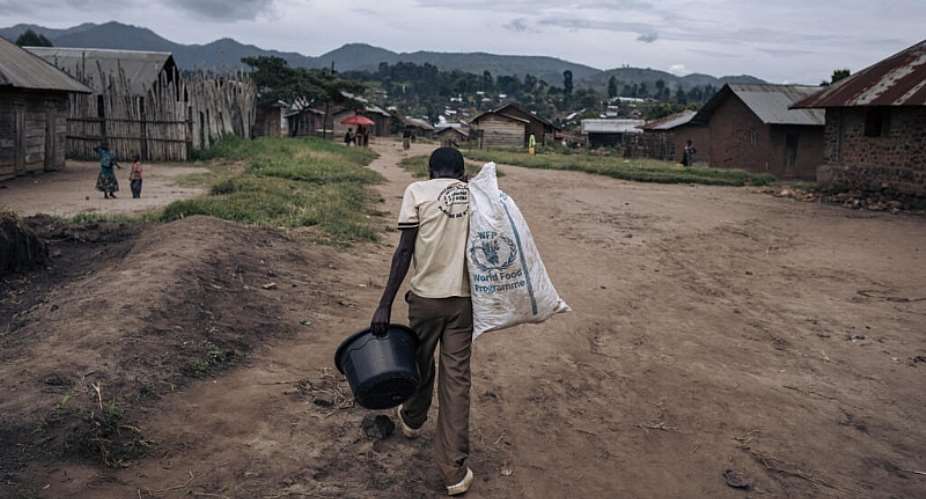
The eastern DRC has been torn apart by decades of conflict involving the country's army and more than 100 armed groups competing for land, power and valuable minerals such as gold and coltan, a mineral used in mobile phones and laptops.
The M23 rebel group controls large swathes of eastern Congo – a group the DRC, the United Nations and several Western governments say Rwanda supports, which Kigali denies.
For its part, Rwanda says its main security threat is the Democratic Forces for the Liberation of Rwanda (FDLR), an armed group linked to the 1994 genocide against the Tutsi people in Rwanda – and accuses the Congolese government of failing to dismantle it.
A peace agreement signed in Washington on 27 June, 2025, was meant to address both sides' concerns. The DRC agreed to dismantle the FDLR, while Rwanda agreed to withdraw its forces and end its alleged support for M23. Rwandan Foreign Minister Olivier Nduhungirehe attends the signing of the Washington peace agreement between Rwanda and the Democratic Republic of Congo on 27 June 2025.
Washington sanctions former DRC president Kabila over 'support' for rebels
The accord has come under renewed scrutiny in recent weeks.
On 25 June, the United States sanctioned Gasabo Gold, a Rwandan gold-refining company, two of its executives and three related mining firms, freezing their assets and barring US citizens from doing business with them. Washington accuses them of helping smuggle gold out of areas controlled by M23.
At a recent UN Security Council meeting, White House senior adviser for Africa Massad Boulos said neither side had fully met its commitments.
To help ensure both sides keep their promises, the two countries and their international partners set up a Joint Oversight Committee. At its sixth meeting in London last week, Rwanda and the DRC agreed to reduce tensions around Minembwe and strengthen monitoring of the ceasefire.
It is against this tense backdrop that Nduhungirehe rejected the allegations against Rwanda and accused the United States of bias in its mediation efforts.
RFI: At the latest Security Council meeting, Massad Boulos questioned whether Rwanda was meeting its commitments under the Washington agreement. How do you respond?
Olivier Nduhungirehe: You have to consider those comments alongside what Secretary of State Marco Rubio said on 5 June during a hearing before the House of Representatives. He said Rwanda was implementing its commitments, even if it was not enough. But he said nothing about the DRC.
The problem is that the DRC's commitments are also an integral part of the Washington agreement. So far there has not been the slightest sign that they have begun implementing them.
Mass graves found in eastern DRC following M23 withdrawal from Uvira
RFI: But what about your own commitments?
ON: On those commitments, the problem is that the peace agreement was signed by two parties, each with security obligations and commitments. Even the Americans say the Congolese government has never begun implementing its main security obligation.
RFI: You say the DRC has failed to neutralise the FDLR, which is based on Congolese territory. But Massad Boulos has also said Rwanda should withdraw from Congolese territory. Why has Rwanda not done so?
ON: Do you think the Washington agreement is a one-sided agreement that concerns only Rwanda?
Why, in a peace agreement, do we acknowledge that one party has failed to implement its commitments, continues to support the FDLR and continues to use drones that kill civilians, while at the same time saying the other party must fulfil its obligations, as if the agreement applied only to Rwanda?
At some point we have to be consistent. Both parties, as required by the Washington agreement, must implement their obligations. It is not only Rwanda that must do so.
RFI: The US has sanctioned Gasabo Gold and several other Rwandan companies accused of taking part in trafficking gold and coltan from areas controlled by M23 in eastern DRC. What is your response?
ON: The United States acknowledges that the Congolese side has not fulfilled its obligation to neutralise the FDLR. The United States also acknowledges there has been an increase in drone attacks. Have you seen the latest statement by the International Contact Group referring to those drone attacks?
But when it comes to sanctions, only Rwanda is sanctioned. So there is a problem. That brings us to another point about the mediation. We are disappointed by what we see as its bias, a bias that is increasingly blatant and increasingly glaring.
Despite the evidence on the ground, and despite the information we have provided to the Americans almost every day since last year about Kinshasa's daily violations of the peace agreement, in the end only Rwanda is sanctioned. That is a problem.
Goma's residents reflect on life a year after DR Congo city fell to M23 rebels
RFI: What explains that?
ON: You would have to ask those who impose the sanctions. That is not us.
RFI: This is not the first time Rwanda has faced sanctions. The Rwandan army, military officers and now Gasabo Gold have all been sanctioned. Why do you think Rwanda keeps being singled out?
ON: Yes, exactly. That is the question that should be put to those who impose the sanctions.
If the Americans or the Europeans said the DRC was implementing its commitments, I would understand why they were not sanctioning the DRC. But the problem is that they themselves acknowledge the DRC has done nothing to neutralise the FDLR.
In fact, instead of moving towards that solution, the DRC has gone in the opposite direction. For example, in mid-March, during the first meeting between the DRC, Rwanda and Burundi, following the capture of Uvira, the Congolese army said in Kisangani on 29 March that the Congolese army would take action against the FDLR.
But what happened? Two days later, on 31 March, they sent helicopters to Walikale [a mineral-rich town in North Kivu province] carrying weapons, ammunition and money to those same FDLR fighters. We provided that information to the Americans.
So there is a problem with this mediation. The bias of the US mediation does not bode well for the effective implementation of the Washington agreement. Nor does it bode well for lasting peace in eastern DRC and the wider African Great Lakes region.
This interview has been adapted from an audio version in French by Patient Ligodi and edited for clarity


 Surrogacy: Supreme Court judge warns of citizenship and inheritance challenges f...
 Ghana has a surrogacy law, but… - Supreme Court Justice
 Ghana faces challenge to persuade Brics it deserves a seat at the table
 Stop the Sermon Before the Engine Starts: Why Ghana Regulates Preaching on Movin...
 Don’t let speed of information become your judgement — Chief Justice tells new l...
 ‘Big Push’: Government assures contractors of prompt payments
 GES to develop plan to recover teaching time lost during teachers’ strike – Clem...
 'All human emotions': French astronaut Sophie Adenot's first words since returni...
 French astronaut recounts 'astonishing' emotions after return to Earth
 India's 'cockroach' movement chief detained ahead of major protest


